A paid social strategy for a DTC brand is a sequence. Work out contribution margin and allowable CAC first. Launch on Meta, add TikTok, Snapchat or Pinterest only where the audience fits. Ship new creative weekly. Measure blended CAC, not platform-reported ROAS. Fix the landing page before raising budget. The 90-day plan below runs in that order.
Most “paid social media strategy” articles are a tour of platforms. This one is the plan we run. It assumes a Shopify or similar store, a real margin, and a budget between about $5,000 and $50,000 a month. Smaller than that, the same order applies, just slower.
What should a paid social strategy start with, unit economics or platforms?
Unit economics. Every platform decision downstream depends on one number: the most you can pay for a new customer and still make money. Most brands skip this and discover it later as “the ads stopped working”.
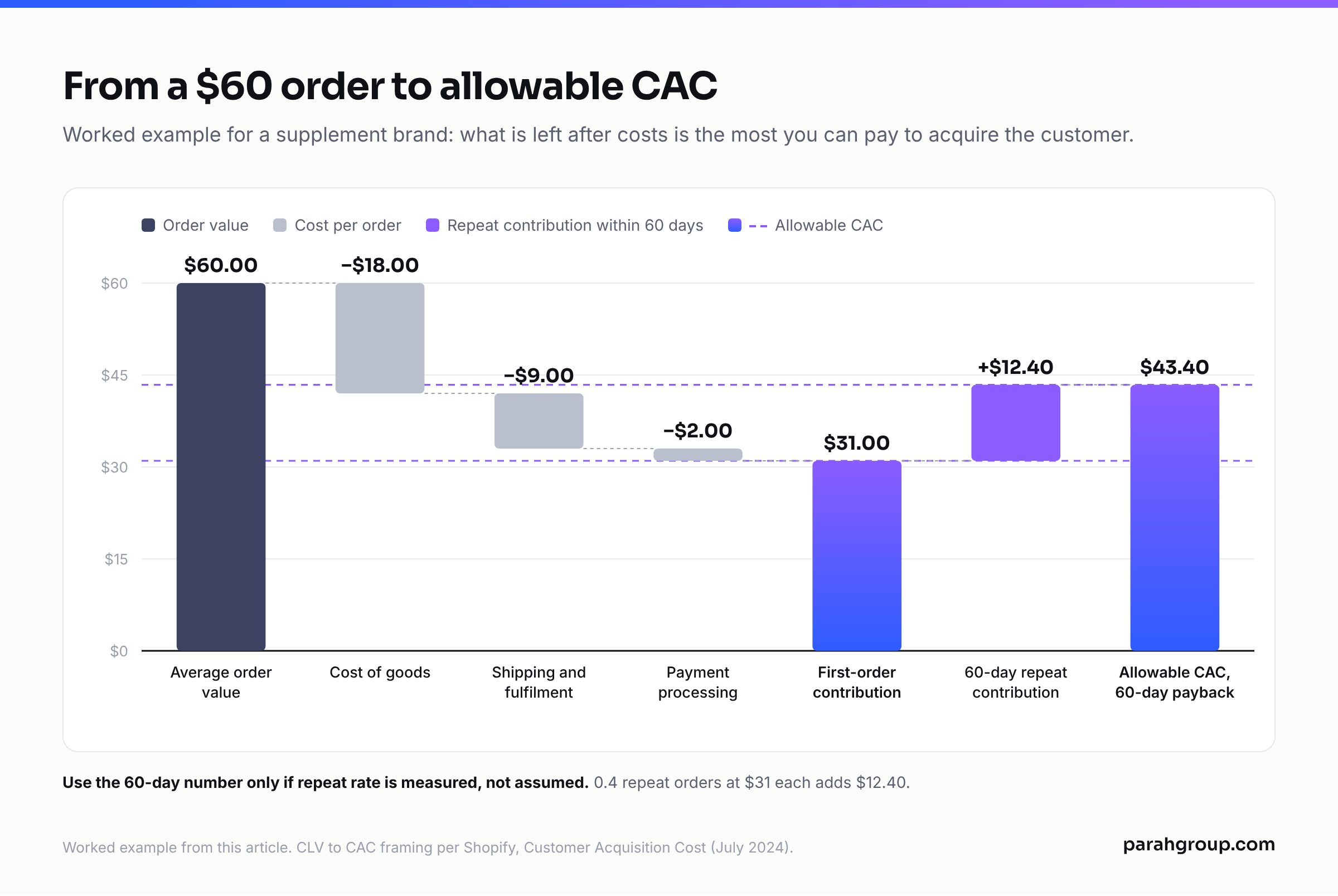
Start with contribution margin per first order. Take average order value, subtract cost of goods, shipping and fulfilment, payment fees and any discount in the offer. What is left is the money available to buy the customer. Then decide the payback window. If you need first-order breakeven, allowable CAC equals first-order contribution. If 60-day repeat purchase is reliable and you can carry the cash, add the expected contribution from repeat orders inside that window.
Here is a worked example for a supplement brand, which is the category we see most often.
| Line | Per first order | Note |
|---|---|---|
| Average order value | $60.00 | After the launch offer discount |
| Cost of goods | $18.00 | Landed cost |
| Shipping and fulfilment | $9.00 | Pick, pack, carrier |
| Payment processing | $2.00 | About 3% |
| First-order contribution | $31.00 | Allowable CAC at first-order breakeven |
| 60-day repeat contribution | $12.40 | 0.4 repeat orders at $31 each |
| Allowable CAC, 60-day payback | $43.40 | Only if repeat rate is measured, not assumed |
Shopify’s own guide on customer acquisition cost (July 2024) frames the same check at the lifetime level: a CLV to CAC ratio between 3:1 and 5:1, and profit per customer (CLV times gross margin) that clears CAC. Use the lifetime ratio to judge the business. Use the 60-day number to run the ads, because 60 days is what your bank balance feels.
The allowable CAC then decides the platform. A $31 ceiling with a landing page converting at 3% means you can afford about $0.93 per click. That is comfortable on Meta and TikTok at third-party click costs, and marginal on Pinterest at its median. The same ceiling with a 1% page means $0.31 a click, which no platform will sell you at scale. The platform did not fail. The page did.
Which platform should a DTC brand launch on first?
Meta, almost always. It has the largest buyer pool, the most mature purchase optimisation, and the fastest feedback on creative. Our founder has bought Facebook ads for close to 15 years and the launch order has not changed: prove the offer and the page on Meta, then take the winning angle to a second platform chosen by audience fit, not by novelty. If you want the Meta side run for you, that is what our Meta ads agency page covers.
The second platform depends on who buys. TikTok for under-35 impulse categories with a demonstrable product. Snapchat for a similar age band where you already have TikTok creative to reuse. Pinterest for home, wedding, food and gifting categories where people plan purchases weeks ahead. Tinuiti’s Q3 2025 benchmark report shows where money is moving: Pinterest investment up 63% year over year for the median advertiser, TikTok down 4% after a 20% drop in Q2, and Meta impressions up 16% with CPM down 2%. Supply on Meta got cheaper, which is one more reason to start there.
Costs are auction prices and move by season, but the third-party ranges below are what you should budget against. All are third-party, as of October 2026, with the source and date in the table.
| Platform | CPM, third-party range | Cost per click, third-party | Source and date | Launch position |
|---|---|---|---|---|
| Meta (Facebook and Instagram) | $8.17 avg (Gupta); $7.47 avg Facebook (WebFX) | $0.37 per link click (Gupta); $0.77 traffic CPC (WordStream) | Gupta Media tracker, Oct 2025; WebFX, May 2026; WordStream, updated Sep 2026 | First. Weeks 1 to 2 |
| TikTok | $4 to $10 (WordStream); $5 to $12 (Darkroom) | $0.30 to $1.50 | WordStream, Aug 2026; Darkroom, Jan 2026 | Second, if under-35 and video-friendly. Week 7 or later |
| Snapchat | $12.84 latest reading (Gupta); about $27 median for conversion-optimised (Stackmatix) | $0.51 to $1.02 | Gupta Media, Oct 2025; Stackmatix, Sep 2026 | Third, reusing TikTok creative |
| $5.10 median | $1.50 median | Benchmarketing, Q1 2023 to Q4 2024, updated Mar 2026 | Second for planned-purchase categories |
Read the TikTok row carefully. Impressions are cheaper than Meta, but TikTok’s own help centre recommends three to five creatives per ad group and three to five ad groups per campaign, which means creative volume, not media, is the real cost. We go through the full budget maths in how much TikTok ads cost. The short version: do not add TikTok, with us as your TikTok ads agency or on your own, until you can feed it 12 or more new videos a month and Meta has produced two winning angles to port.
How many ads do you need to test each week?
Enough to replace the ones that die. On Meta, a winning ad in a DTC account usually fatigues in two to six weeks. On TikTok, faster. If you launch with five ads and make no more, you will be rebuilding the account from zero in month two. The creative system is the part of a paid social strategy most operators under-resource, and it moves CAC most once the page is fixed.
The weekly cadence we run looks like this. Monday, read last week’s results by hook, not by ad: which first three seconds earned the click. Tuesday to Thursday, produce four to six new variations, most of them new hooks on the proven body rather than new concepts. Friday, launch them into the existing ad set so the learning history carries over. TikTok’s creative guidance says the same thing about structure: add new creatives to an existing ad group instead of creating a new one, put the hook in the first six seconds and the proposition in the first three.
Concept versus hook matters for budget. A concept is a new angle: price, ingredient, before and after, founder story, unboxing. A hook is a new opening on an existing concept. Test concepts in month one, three or four at a time, each with two or three hooks. From month two, 80% of production is hooks on the two winning concepts and 20% is a new concept, so the account always has a candidate ready when a winner fades.
Campaign structure should stay boring. One prospecting campaign using Meta’s Advantage+ sales campaign (the 2025 replacement for what Meta called Advantage+ shopping campaigns; Jon Loomer’s write-up lists the differences, including unlimited ad sets and a 50-ad cap per ad set), one retargeting campaign at a small budget, and a weekly creative drop into both. TikTok’s learning-phase guidance notes volatility settles after roughly 25 results or seven days, and pausing or editing resets the clock. Meta behaves the same way in practice. Change creative, not structure.
How do you measure paid social when platform numbers overclaim?
Three layers, and all three on day one. First, the tracking layer: pixel plus server-side events on every platform. Meta’s Conversions API documentation describes server events as processed “like events sent using the Meta Pixel” and tells you to confirm that events are deduplicated and matched. TikTok’s Events API page is blunter: it recommends an Events API integration alongside the existing Pixel “to maximize performance benefits”, because pixel-only tracking misses conversions through connectivity and browser issues. On Shopify, both are a few clicks in the platform’s sales channel app. Do it before the first dollar is spent, because the optimisation algorithm learns from whatever events it receives.
Second, the survey layer. A one-question post-purchase survey, “how did you hear about us”, on the order confirmation page. Fairing, which builds this for Shopify, claims response rates up to 80% when the survey sits at the point of conversion, and positions it to compare against UTM data and identify dark traffic. Treat the claimed rate as a vendor number; the mechanism holds. Survey-attributed share by platform is the sanity check against Ads Manager. When Meta claims 60% of new customers and the survey says 35%, the truth sits between, and the survey is usually closer.
Third, the number you actually manage to: blended new-customer CAC. Total paid social spend divided by total first-time customers for the period, from the store, not from any ad platform. Platform-reported ROAS tells you which ad set is relatively better. Blended CAC tells you whether the program pays. Weekly reporting in our paid social agency program is built on four numbers: CAC, AOV, contribution margin and new-customer revenue. Everything else is diagnostic.
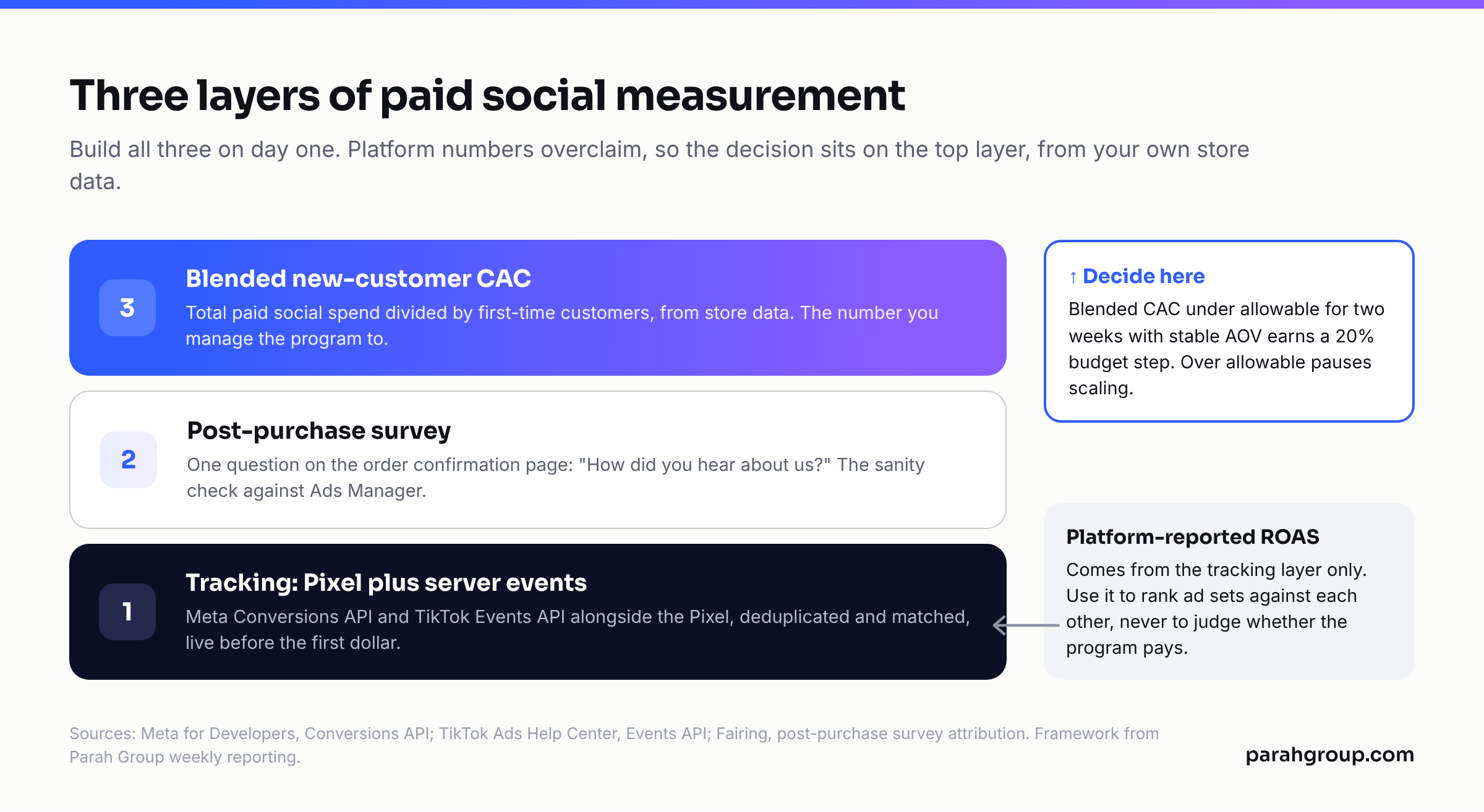
Set the decision rules before the data arrives. Ours: an ad set gets two full weeks and at least 50 purchases before a verdict. Blended CAC over allowable for two consecutive weeks pauses scaling, not spend. Blended CAC under allowable for two weeks with stable AOV earns a 20% budget increase, not 100%. Doubling budget in a week resets what the algorithm learned and usually buys a worse week.
Why does the landing page decide whether the plan pays?
Because every cost above is a cost per click, and the page converts clicks into the orders that CAC is built from. Unbounce’s 2024 benchmark across about 41,000 landing pages puts the ecommerce median at 4.2%. Most paid traffic lands on product pages that convert cold visitors at 1 to 2%. Move a page from 1.5% to 3% and CAC halves with no change in the ad account. No bidding change comes close.
This is why we run the page and the ads as one program. Our clearest example on the CAC side is Bounce Nutrition, a supplement brand where paid-social CAC fell 20% in three months. The work was on the page and the offer: social proof placed where cold traffic lands, a gamified progress bar that lifted AOV, offer tests, and post-purchase upsells. The media buying did not get smarter. The page stopped wasting clicks.
The second case is what happens when paid scales. Willie’s, a cannabis DTC store, grew subscription take rate 75%, AOV 25% and conversion 20% in three months while paid traffic was increasing. Rebuy post-purchase offers, Intelligems checkout tests and a gamified cart bar carried that. Rising spend normally degrades conversion because you reach colder audiences. The page work offset it.
Three layers to build in weeks 1 to 6, in this order. The offer: one clear first-order deal that the hook can state in five words. The landing page: a dedicated page per winning angle, message-matched to the ad, built the way our landing pages for paid traffic are built, with the proof above the fold and a single call to action. The post-purchase layer: one upsell at checkout and one on the thank-you page, which raises AOV and therefore allowable CAC without touching the ad account. If you want us to check whether your pages are the constraint before you spend more, the free audit covers the ad account and the pages it lands on.
What does the 90-day plan look like week by week?
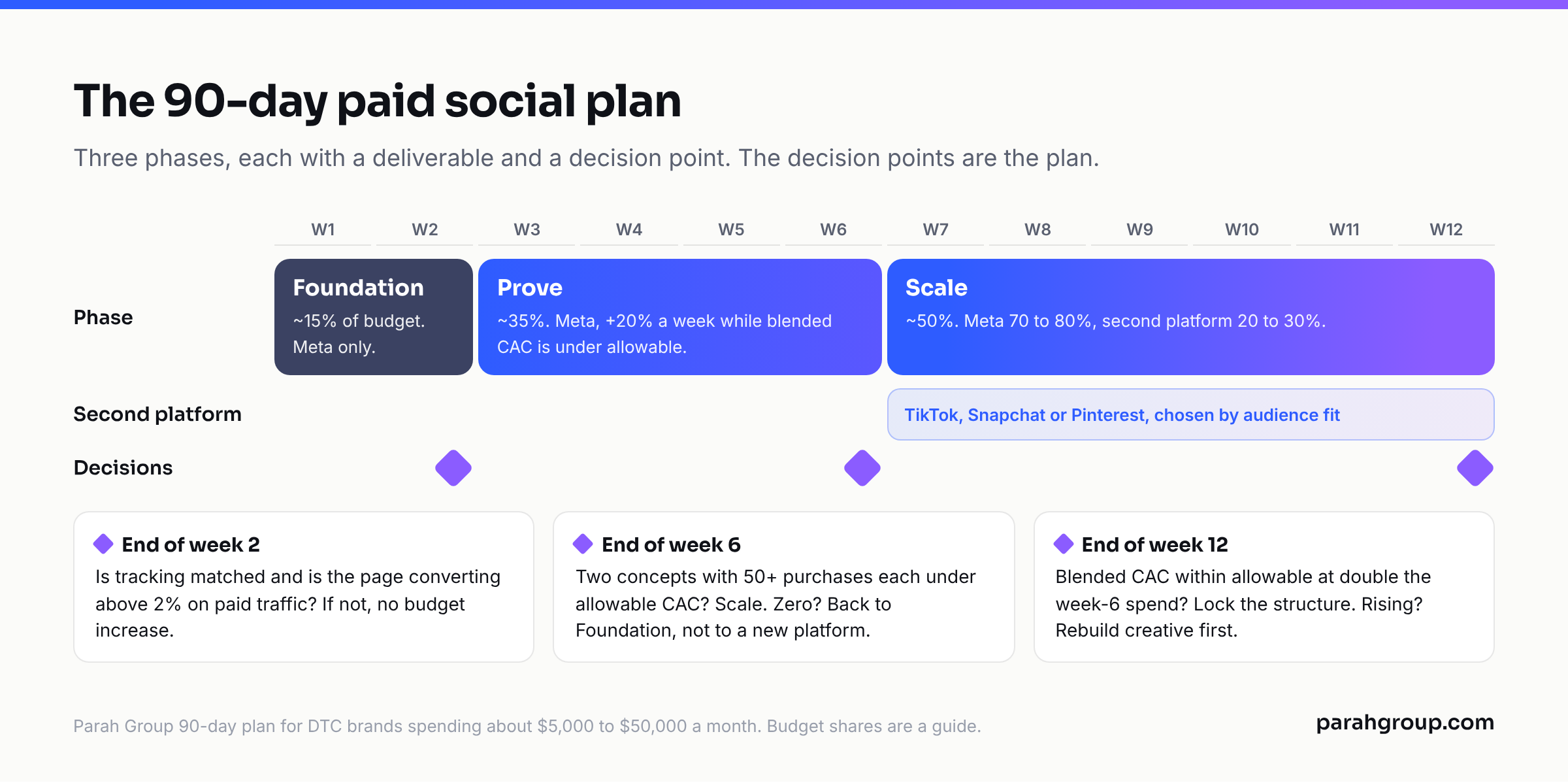
Three phases, each with a deliverable and a decision point. The decision points are the plan. Skipping one is how brands end up in month four with no idea whether the problem is creative, page or platform.
| Phase | Weeks | Deliverables | Budget | Decision point at end of phase |
|---|---|---|---|---|
| Foundation | 1 to 2 | Contribution margin and allowable CAC signed off. Pixel plus Conversions API and TikTok Events API live, deduplicated, tested with a purchase. Post-purchase survey on the confirmation page. One offer, one dedicated landing page, one checkout upsell. Three to four concepts at two to three hooks each, 8 to 12 ads. One Advantage+ sales campaign, one retargeting campaign. | About 15% of the 90-day budget. Meta only. | Is tracking matched and is the page converting above 2% on paid traffic? If not, no budget increase until it is. |
| Prove | 3 to 6 | Weekly creative drops of 4 to 6 ads. Hook-level reporting. Second landing page for the second-best concept. Offer test (threshold, bundle or gift). First survey read against platform attribution. Weekly CAC, AOV, contribution margin, new-customer revenue report. | About 35%. Meta, with budget stepping up 20% per week when blended CAC is under allowable. | Two concepts with 50 or more purchases each under allowable CAC? Scale. One? Keep testing. Zero? The offer or the page is wrong; go back to Foundation, not to a new platform. |
| Scale | 7 to 12 | Winning concepts ported to the second platform chosen by audience fit. Production stepped up to 12 or more videos a month if TikTok is on. Post-purchase upsell test on the thank-you page. Subscription or repeat offer tested. First 60-day cohort read to confirm repeat contribution assumed in allowable CAC. | About 50%. Meta 70 to 80%, second platform 20 to 30%. | Blended CAC within allowable at double the week-6 spend? Lock the structure and plan Q2. Rising? Hold spend and rebuild creative before adding anything. |
Budget shares are a guide for a brand new to this level of spend; an account with clean history moves faster through Prove. The second platform sits in week 7 deliberately. Brands that launch three platforms in week one learn the same lesson three times, at three times the cost.
Paid social strategy example: a $12,000 a month supplement brand
Take the unit economics table above: $31 first-order contribution, $43 allowable CAC on a 60-day payback. The 90-day budget is $36,000, so roughly $5,400 in Foundation, $12,600 in Prove and $18,000 in Scale.
Foundation runs Meta at about $385 a day. At Gupta’s $0.37 per link click (Oct 2025 tracker reading) that is around 1,000 clicks a day; at WordStream’s $0.77 it is 500. If the page converts at 1.5%, that is 8 to 15 orders a day at $26 to $51 CAC. The higher end breaks the $43 ceiling, so Foundation’s job is the page, and the week-2 decision is clear.
Prove gets the page to 2.5% with social proof above the fold and a stronger first-order offer. The same clicks now produce 12 to 25 orders a day at $15 to $31 CAC, inside the ceiling at both click prices. The weekly 20% step-ups start. By week 6, two concepts have cleared 50 purchases each. The post-purchase survey says Meta is 40% of new customers against the 55% Ads Manager claims, which sets the discount you apply to platform ROAS from here on.
Scale adds TikTok at $120 to $150 a day because the buyer is under 35 and the product demos well. TikTok CPCs of $0.30 to $1.50 and the TikTok landing page at 2% give a wide CAC band, $15 to $75, so the first four weeks on TikTok are judged on blended CAC for the whole program, not on TikTok’s own reporting. The thank-you page upsell lifts AOV from $60 to $66, which moves first-order contribution to about $36 and allowable CAC to $49. By week 12 the brand knows its blended CAC at $12,000 a month, has two proven concepts, a page above 2.5%, survey-corrected attribution and a second channel with 30 days of data.
The order is the point. Margin first, then Meta, then creative, then measurement, then page, then a second platform. Brands that start at step six are the ones who say paid social does not work. Get a free, no-obligation audit of your ad accounts and the pages they land on at our contact page and we will tell you which step you are actually on.
Frequently asked questions
What is a paid social strategy?
A paid social strategy is the plan for buying customers through social platform ads: how much you can pay per customer, which platforms you run in what order, how creative is produced and tested, how results are measured, and how the landing page and offer are improved alongside the ads. It is a sequence with decision points, not a list of platforms.
How much should a DTC brand spend on paid social to start?
Enough for the purchase-optimised ad set to clear roughly 50 purchases in two weeks at your expected CAC. At a $40 CAC that is about $140 a day. Below that, the platform cannot learn and your results are noise. Start on one platform, Meta, and add a second only after two concepts have proven out.
Which platform is best for a paid social strategy for ecommerce?
Meta first for almost every DTC category, because of audience size and mature purchase optimisation. TikTok second for under-35 buyers and products that demo well on video. Pinterest for planned purchases such as home, wedding and gifting. Snapchat when you already have TikTok creative to reuse. Choose by audience fit, then by cost.
How do I know if paid social is actually profitable?
Compare blended new-customer CAC, which is total paid social spend divided by first-time customers from your store data, against allowable CAC from contribution margin. Platform ROAS overstates. Add a post-purchase survey to check platform attribution against what customers say. If blended CAC is under allowable for two consecutive weeks, it is profitable.
How often should I refresh paid social creative?
Weekly. Launch four to six new ads a week, mostly new hooks on proven concepts, into the existing ad set so learning carries over. Winning ads on Meta usually fatigue in two to six weeks, faster on TikTok. TikTok’s own guidance recommends three to five creatives per ad group and refreshing when results trend down.
Why is my paid social CAC too high even though CPMs are normal?
Usually the landing page. CAC is cost per click divided by page conversion rate. A page converting cold traffic at 1% doubles CAC against one at 2% with no change in the ad account. Check page conversion on paid traffic, message match between ad and page, and the first-order offer before changing bids or platforms.
Sources
- Shopify, Customer Acquisition Cost (July 2024)
- Tinuiti, Digital Ads Benchmark Report Q3 2025
- Gupta Media, Social Media Ads Cost tracker (October 2025 readings)
- WebFX, Meta Ads Benchmarks (updated May 2026)
- WordStream, Facebook Ads Benchmarks (2023 to 2024 data, updated September 2026)
- WordStream, How Much Do TikTok Ads Cost (updated August 2026)
- Darkroom, TikTok Advertising Cost Guide (January 2026)
- Stackmatix, Snapchat Ads Cost (September 2026)
- Benchmarketing, Pinterest Ads Benchmarks (Q1 2023 to Q4 2024, updated March 2026)
- TikTok Ads Help Center, Creative Best Practices
- TikTok Ads Help Center, Learning Phase
- TikTok Ads Help Center, Events API
- Meta for Developers, Conversions API
- Jon Loomer, Advantage+ Sales Replaces Advantage+ Shopping (March 2025)
- Fairing, The Post-Purchase Survey Marketing Attribution Tool
- Unbounce, What’s a Good Conversion Rate (2024 Conversion Benchmark Report)