Advantage+ shopping campaigns are now Advantage+ sales campaigns. Run them when your pixel has steady purchase volume, your catalog is broad, and you can feed six or more fresh creatives a month. Run manual campaigns when the account is new, exclusions are non-negotiable, or you are launching a product the pixel has never seen. Test both for 30 days before you commit.
Most advice on this topic describes a product Meta rebuilt in 2025. This post covers what changed, how to decide between automated and manual, how to read the reporting honestly, and the one lever no amount of Meta automation touches.
What happened to Advantage+ shopping campaigns in 2025?
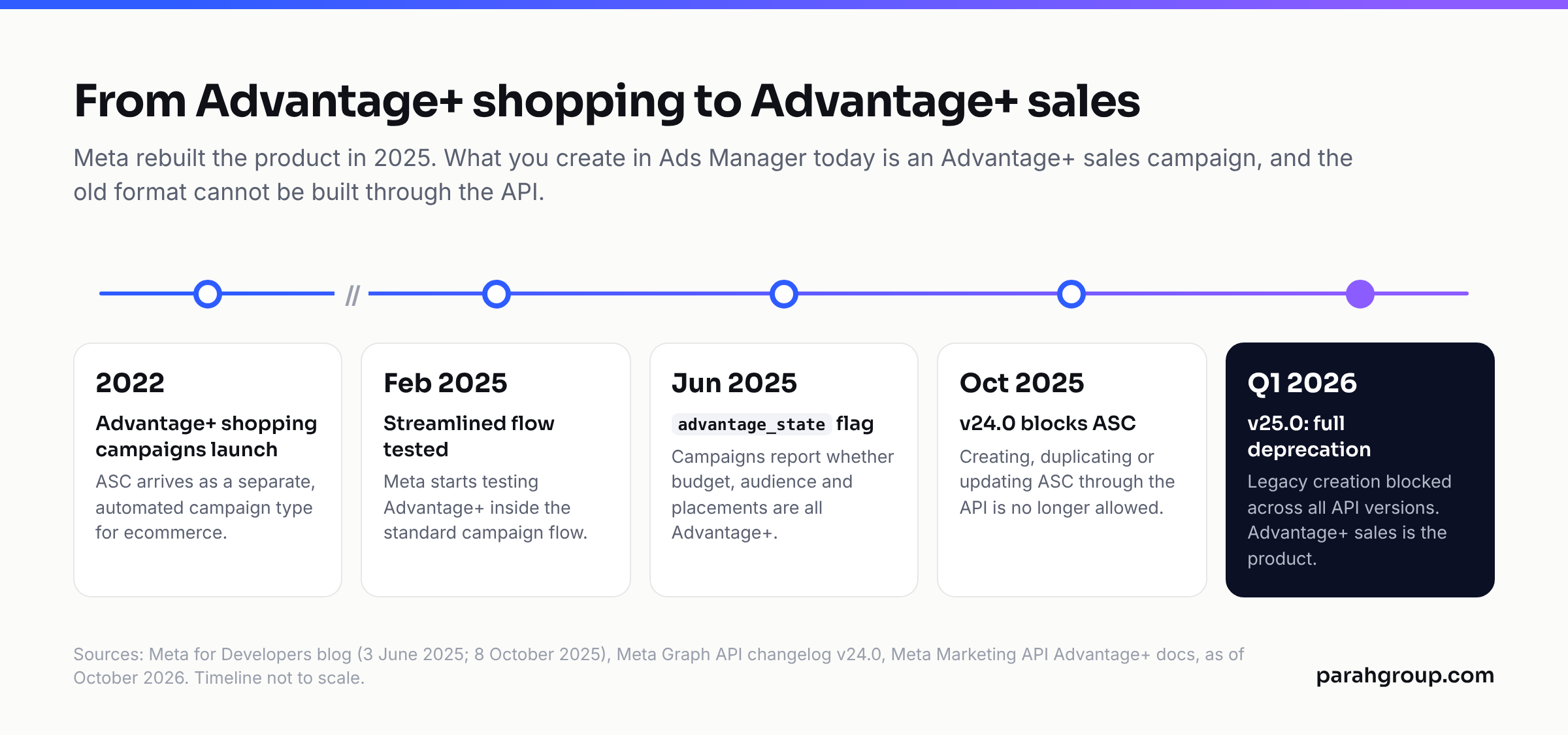
Meta renamed them. As of October 2026, the product you create in Ads Manager is an Advantage+ sales campaign, and the Marketing API no longer lets you build the old format. Meta’s own developer documentation describes Advantage+ sales campaigns as “updated, streamlined versions of Advantage+ shopping campaigns and Advantage+ app campaigns” (Meta for Developers, Advantage+ Campaign Experience, as of October 2026). The name change, per Meta, reflects “the full range of advertisers that can benefit from this product.”
The mechanics changed more than the name. The old Advantage+ shopping campaign (ASC) was a separate choice at campaign creation: automated or manual. That prompt is gone. Now every Sales campaign starts in the standard flow, and it earns Advantage+ status only if three settings stay on: Advantage+ campaign budget, Advantage+ audience, and Advantage+ placements. Turn any one off and the campaign reports advantage_state: DISABLED. There is no longer a wall between “ASC” and “manual”; there is a dial with three notches.
The deprecation timeline matters if you run campaigns through a third-party tool. Meta’s v24.0 changelog states: “Beginning with v24.0, creation, duplication, and updates to Advantage+ shopping campaigns and Advantage+ app campaigns will no longer be allowed” (Meta Graph API changelog v24.0, as of October 2026). Meta’s developer blog gave Q1 2026 for v25.0, when legacy creation is blocked across all API versions (Meta for Developers blog, 8 October 2025).
What is the difference between Advantage+ sales campaigns and manual campaigns now?
Three things, and they map directly to the three settings. Budget: Advantage+ campaign budget means Meta moves spend between ad sets. Manual means ad set budgets you control. Audience: Advantage+ audience treats your inputs as suggestions it can expand past, with only location, minimum age, excluded custom audiences and language held as hard constraints. Manual means your targeting is the targeting. Placements: Advantage+ placements means every surface Meta sells. Manual means you pick.
What you gain by staying fully automated is Meta’s modelling across all three, and Meta’s historical claim for the old ASC format was “a 17% decrease in cost per action and a 32% increase in return on ad spend” for existing users (Meta for Developers blog, 31 October 2024). Treat that as a vendor number, measured against the advertiser’s prior setup, whatever that was. It is not a benchmark for your account.
What you gain by going manual is control where the automation is blind: a product the pixel has no purchase data for, a retention audience walled off from prospecting spend, a placement burning budget on a format you cannot produce well. The new structure lets you mix. Keep budget and placements on, add a second ad set with a tight custom audience, and accept that the campaign no longer reports as Advantage+. Nothing breaks; you lose the label.
| Decision factor | Advantage+ sales campaign | Manual sales campaign |
|---|---|---|
| Pixel purchase volume | Best with steady weekly purchases; the model needs signal | Works with thin data; you supply the targeting the pixel cannot |
| Catalog size | Broad catalogs let it find winners across products | Better for a single hero SKU or a launch |
| Creative volume | Needs a steady feed; up to 50 ads per ad set, six active is the practical floor | Can run on two or three strong ads per ad set |
| Audience control | Inputs are suggestions; only exclusions, location, minimum age and language are hard limits | Targeting is literal; exclusions and inclusions hold |
| New vs existing customer split | Budget cap removed; split needs two ad sets with a spend cap | Same two ad set build, with full budget control |
| Placement control | All placements; editing most of them turns Advantage+ off | Full control, at the cost of reach |
| Reporting | Audience Type breakdown (new, existing, engaged); no view into which suggestion drove results | Standard breakdowns per ad set, so each audience is its own line |
| Budget scale | Strongest above a few thousand dollars a month where it can exit learning | Workable at any budget |
When does Advantage+ beat manual for a DTC brand?
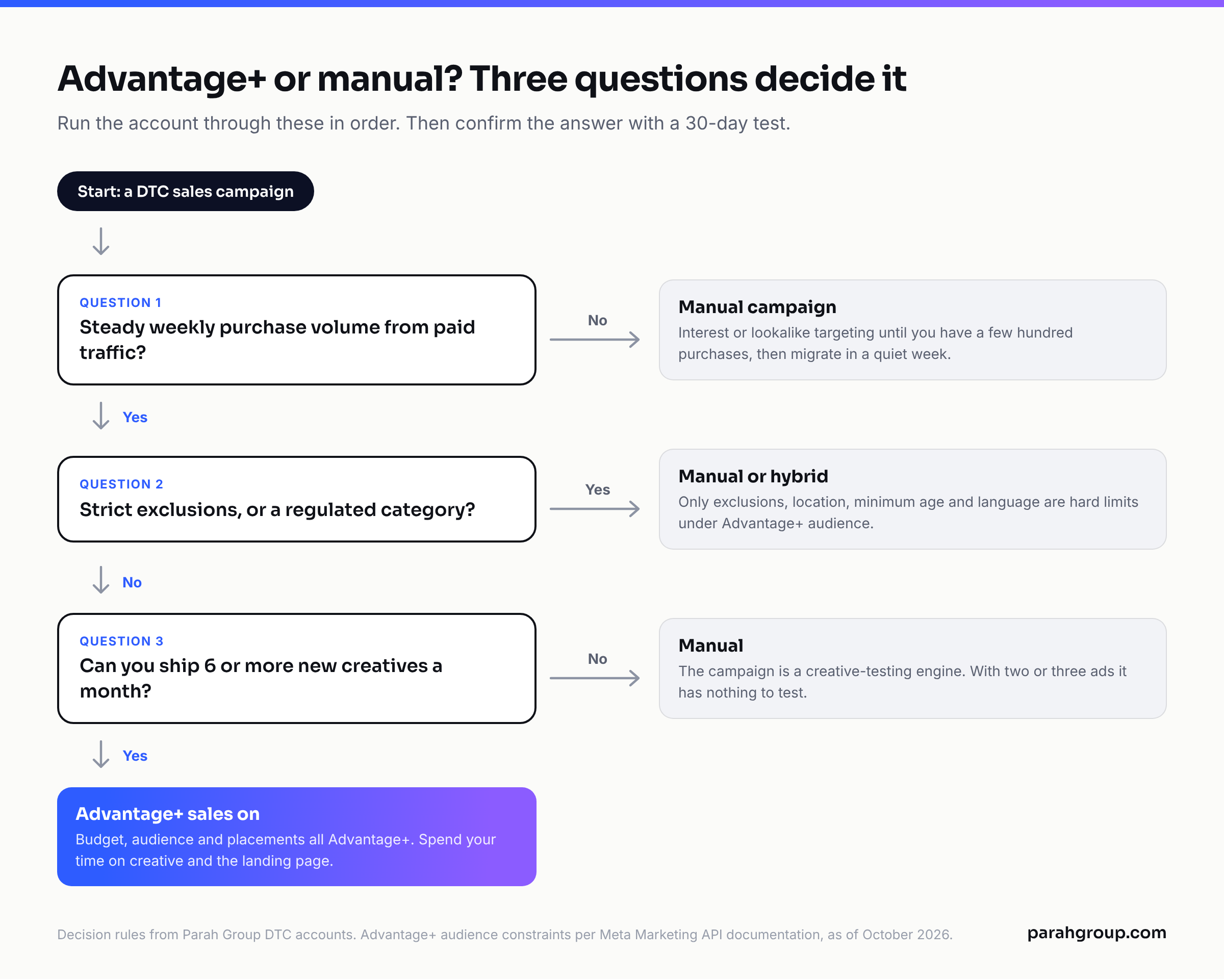
Four conditions, and you want at least three. First, event volume. The model learns from purchases. Dozens a week from paid traffic is enough to work with. A handful means Advantage+ spends the learning phase guessing, and manual targeting is you lending it your judgement until the data catches up.
Second, catalog breadth. A store with 40 SKUs across three categories gives the automation room to find which product sells to which pocket of the audience. A store with one hero product gives it nothing to choose between, and the automation collapses into a broad campaign with extra steps.
Third, creative volume. Meta allows up to 50 ads per ad set in the new structure and recommends no more than six active (Jon Loomer, Advantage+ Campaign Creation, 23 June 2025). The campaign is a creative-testing engine, and an engine with two ads in it has nothing to test. If your team ships one static a month, you are not getting what you pay for.
Fourth, budget. Advantage+ campaign budget needs enough daily spend to exit learning across its ad sets. Starved campaigns stay in learning and never optimise. At a few hundred dollars a month, manual with one ad set and a tight audience usually reaches a stable CPA faster.
Where all four line up, we default to Advantage+ on and spend our time on creative and the landing page. That is the work a Meta ads agency should be doing anyway; the targeting layer is not where the margin is any more.
When should a DTC brand run manual campaigns instead?
New accounts with thin pixel data. A store that launched last month has nothing for Advantage+ to model. Run a manual campaign with interest or lookalike targeting from your email list, get to a few hundred purchases, then switch. Meta’s docs note that migration forces a campaign back into learning, so plan the switch for a quiet week, not mid-promotion.
Strict exclusions. If you must not show ads to current subscribers, wholesale buyers, or a region with a regulatory constraint, remember that under Advantage+ audience only excluded custom audiences, location, minimum age and language hold as hard limits. Everything else is a suggestion. For a hemp, supplement or regulated category, that distinction is the difference between compliant and not, and manual gives you the certainty.
Launches. A new product, bundle or offer has no pixel history, and Advantage+ will lean on what it knows about your best sellers. A manual campaign with its own ad set, its own landing page and a hard budget tells you in a week whether the launch has legs. Then fold it into the automated campaign.
Retention and new-customer separation. The existing customer budget cap, the setting most DTC brands used to force prospecting spend, is gone. Meta’s replacement is a build, not a toggle: “create two ad sets per ad campaign that separate existing customers from new customers,” with a custom audience for existing customers in one ad set, that same audience excluded in the other, and a daily spend cap on the retention ad set. It only works if the existing-customer audience is built from first-party purchase data, not a pixel-based “purchased in 180 days” audience that misses marketplace buyers.
How should you read Advantage+ reporting without fooling yourself?
The breakdown that matters is Audience Type. In Ads Manager, Breakdown, Delivery, Audience Type gives three rows: New Customers, Existing Customers and Engaged Audience, provided you defined the latter two as custom audiences in your advertising settings (Jon Loomer, Advantage+ Shopping Campaigns guide, updated 6 March 2025). Pull it every week. A campaign reporting a 4.0 blended ROAS with 60% of purchases from existing customers is not a prospecting campaign with a 4.0 ROAS. It is a retention campaign you are overpaying for, because those customers would have bought from an email.
What the reporting will not tell you: which of your audience suggestions the model actually used. Under Advantage+ audience, your custom audiences and interests are inputs it can expand past, and there is no breakdown that says “this much spend went to the lookalike, this much to the expansion.” If you need that line, it has to be its own ad set, and the campaign stops being Advantage+. Accept that trade or stop asking the question.
Attribution windows still apply. A campaign on a 7-day click, 1-day view window claims conversions a tighter window would not. Compare against your manual campaign on the same window and against your Shopify new-customer order count. Our weekly client reporting runs on CAC, AOV, contribution margin and new-customer revenue because platform ROAS is the easiest number in the business to flatter.
If you want a second pair of eyes on how your account is actually splitting spend between new and returning buyers, that is one of the first things we pull in a free audit.
What does a 30-day Advantage+ vs manual test look like?
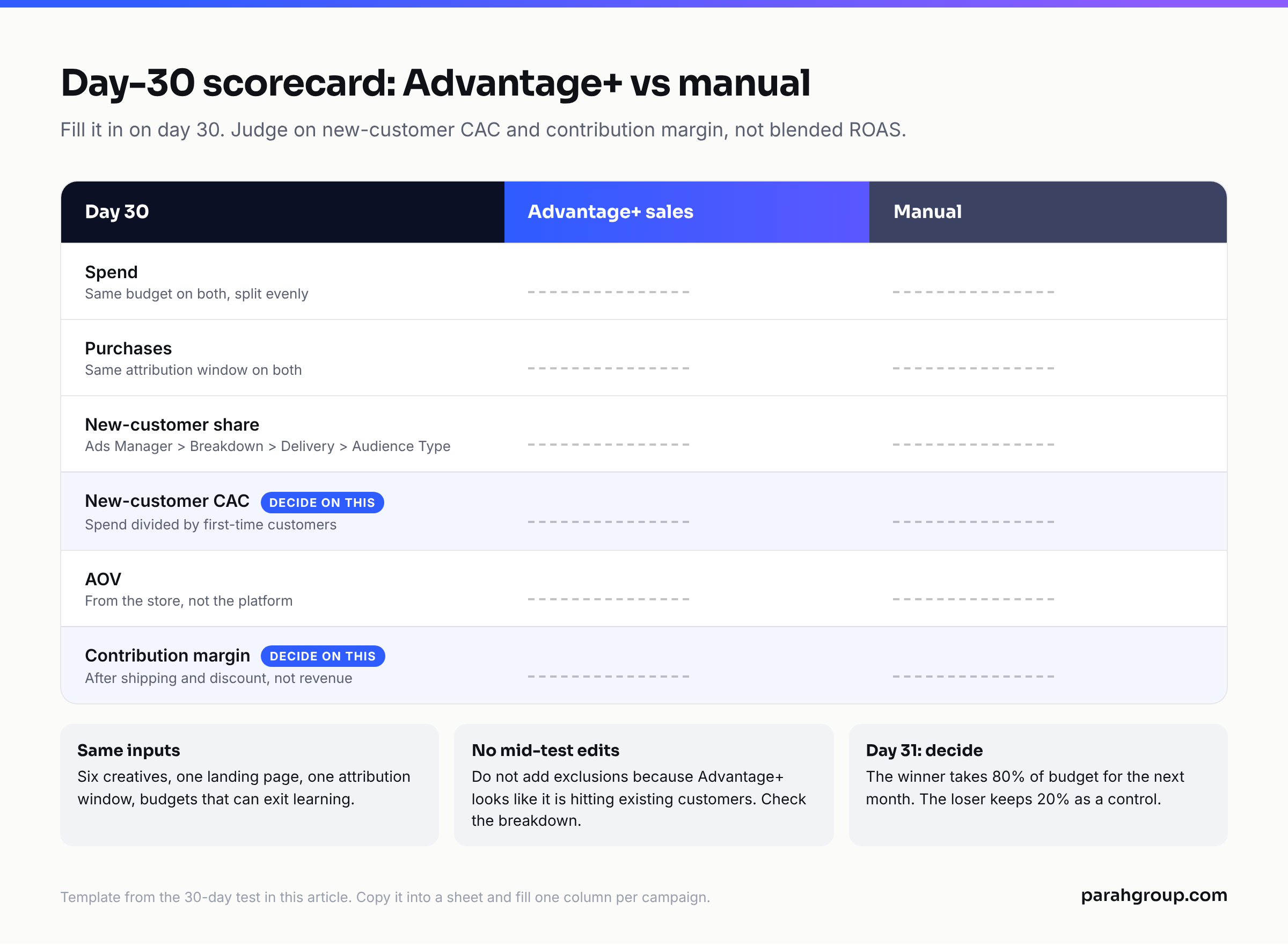
Keep it simple enough that the result is unambiguous. One Advantage+ sales campaign with all three settings on, one manual campaign with your best audience structure, the same six creatives, the same landing page, the same attribution window, budgets that can exit learning. Split spend evenly.
- Days 1 to 3: Build both. Define the existing-customer audience from first-party purchase data. Set the Audience Type breakdown as a saved report. Record baseline CAC, AOV and new-customer share from the previous 30 days.
- Days 4 to 10: Launch. No edits. Learning phase runs. Note daily spend delivery on each; if the manual campaign cannot spend its budget, that is a finding, not a bug.
- Days 11 to 20: Add two new creatives to each campaign on the same day. Log which campaign picks up the new creative faster and whether CPA moves.
- Days 21 to 30: Hold. Pull the Audience Type breakdown on day 30 for both. Compare new-customer CAC, not blended ROAS. Compare contribution margin after shipping and discount, not revenue.
- Day 31: Decide. The winner takes 80% of budget for the next month; the loser keeps 20% as a control. Re-run the test when something structural changes: a new catalog, a new offer, or a quarter of fresh pixel data.
The failure mode is adding exclusions mid-test because the Advantage+ campaign “looks like” it is hitting existing customers. Check the breakdown instead, and let the test finish.
Why is landing page conversion rate the lever Advantage+ cannot pull?
Because every Advantage+ setting operates before the click. Budget, audience, placement, creative rotation: all of it changes who sees the ad. None of it changes what happens on the page. If your paid landing page converts at 1.5% and a competitor’s at 3%, Meta’s automation cannot close that gap in any mode. It can only find cheaper clicks, and the supply is finite.
I have watched this play out on the accounts we run. Binoid, a hemp and CBD DTC brand, is a regulated category where audience controls are not optional, so the account could never be fully automated. We did not change the campaign type to fix CPA. We built a landing page program: multiple new pages a month, each testing a different angle and product, with offer tests layered on. Paid-social CPA came down 30% in four months. The campaigns did their job; the pages did the work the campaigns could not.
The maths is unforgiving. A 20% lift in page conversion rate drops CAC by roughly 17% across every campaign, every audience and every placement at once. No targeting change does that. This is why we run paid social and CRO as one program under a single paid social + CRO program rather than two vendors arguing over whose fault the CPA is. The ad side decides what Advantage+ should and should not control; the landing page side decides what the click is worth when it arrives.
On Shopify the page side gets specific fast: theme speed, PDP structure, builder load time. We cover that setup in Facebook ads for Shopify stores, and what it costs to have someone run all of this for you in our Facebook ads agency pricing breakdown.
What should you do this week?
Check whether your sales campaigns show as Advantage+ on or off. If on, pull the Audience Type breakdown and look at the existing-customer share. If off and you cannot name the reason, you are paying for control you are not using. Give any launch its own manual campaign and its own page. Then run the 30-day test.
Get a free, no-obligation audit of your ad accounts and the pages they land on. We will tell you which mode your account should be in, where the spend is leaking to existing customers, and which page is costing you the most.
Frequently asked questions
Are Advantage+ shopping campaigns the same as Advantage+ sales campaigns?
Mostly. Meta renamed Advantage+ shopping campaigns to Advantage+ sales campaigns in 2025 and rebuilt them inside the standard campaign flow. A campaign is Advantage+ when Advantage+ budget, audience and placements are all on. The old format can no longer be created through the Marketing API as of v24.0, and existing ones are being migrated.
What happened to the existing customer budget cap?
Meta removed it. The replacement is a manual build: one ad set targeting a custom audience of existing customers with a daily spend cap, and a second ad set excluding that same audience for prospecting. Campaigns that used the old cap setting cannot be migrated through the API and must be duplicated in Ads Manager.
How many creatives do Advantage+ sales campaigns need?
Meta allows up to 50 ads per ad set and recommends keeping no more than six active at once. The practical rule for DTC brands is a steady feed of new creative every month, since the campaign is a testing engine. With two or three ads it has nothing to test, and a manual campaign will do as well.
Can a new store with little pixel data run Advantage+ sales campaigns?
It can, but it usually should not. The model learns from purchase events, and a new pixel has few. Run a manual campaign with interest or lookalike targeting from your email list until you have a few hundred purchases, then migrate. Plan the migration for a quiet week, because it forces the campaign back into learning.
Does Advantage+ vs manual change my landing page conversion rate?
No. Every Advantage+ setting acts before the click: budget, audience, placement, creative rotation. None of it affects what happens on the page. A 20% lift in landing page conversion rate lowers CAC across every campaign at once, which is why the page program matters more than the campaign mode for most DTC brands.
Sources
- Meta for Developers: Advantage+ Campaign Experience for Sales, App, and Leads (as of October 2026)
- Meta Graph API changelog, version 24.0 (as of October 2026)
- Meta for Developers blog: Upcoming ASC and AAC MAPI deprecation, migration options to Advantage+ (8 October 2025)
- Meta for Developers blog: Advantage+ campaign experience for sales and app (3 June 2025)
- Meta for Developers blog: Advantage+ shopping campaigns, automated ecommerce advertising (31 October 2024)
- Jon Loomer: Advantage+ Campaign Creation, A Complete Guide (third party, 23 June 2025)
- Jon Loomer: Advantage+ Shopping Campaigns guide (third party, updated 6 March 2025)
- Jon Loomer: No More Existing Customer Budget Cap (third party, March 2025)