Pick the Shopify upsell app by placement, not by review count. For the cart drawer, Rebuy or Selleasy. For in-checkout offers, you need Shopify Plus, then Rebuy, AfterSell or Zipify OCU. For the post-purchase page, AfterSell, ReConvert or Zipify OCU. Stores under 50 orders a month should start on Selleasy’s or Wiser’s free tier.
The rest of this post explains why placement is the first filter, what Shopify allows at each step of the funnel, and which app we would run at each placement based on what we have shipped for clients.
Why should you choose a Shopify upsell app by placement?
An upsell asks for more money at a moment when the customer has already decided to spend some. Where that moment sits changes the risk. A product-page or cart offer shows before the customer has committed, so a clumsy one costs conversion. A checkout offer sits on the highest-intent page on the site, so Shopify restricts who can touch it. A post-purchase offer fires after the card is charged, so it cannot hurt conversion at all. Three different jobs, three risk profiles, and no single app is best at all three.
Shopify enforces the split. Per Shopify’s Help Center, apps built with UI extensions for the information, shipping and payment pages are only available on Shopify Plus, while app blocks on the thank-you and order-status pages are available on Basic and above (Shopify Help Center, checkout apps). Shopify’s developer docs add that only one app can be selected for post-purchase product offers, and that post-purchase offers will not display for wallet payments such as Apple Pay, Google Pay and Amazon Pay, installment providers such as Klarna and Affirm, gift-card purchases or orders without a shipping address (Shopify.dev, post-purchase product offers).
Two consequences. If you are not on Plus, “checkout upsell” in a listing means the thank-you page, not the payment page. And because only one post-purchase app can run, that slot is the one to get right; the cart is where you can stack tools.
Which Shopify upsell apps work at which placement?
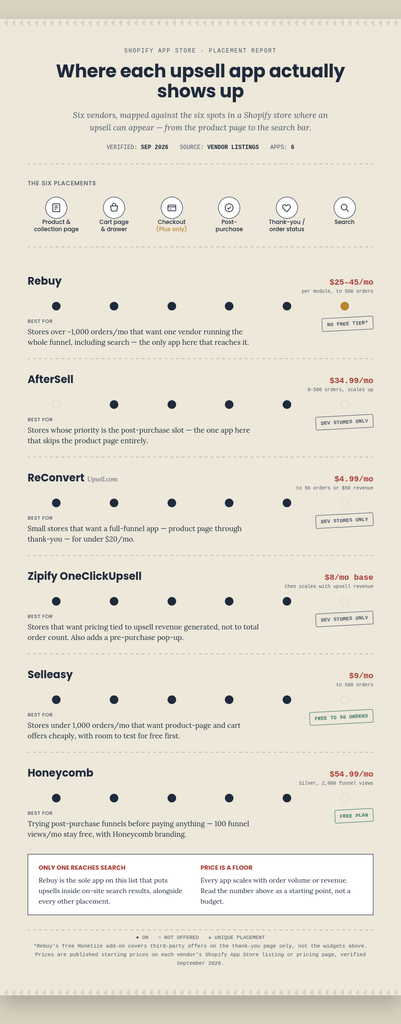
Two notes. Rebuy’s listing at apps.shopify.com/rebuy currently reads “This app is not currently available on the Shopify App Store” and points merchants to Rebuy directly, so its pricing above comes from rebuyengine.com/pricing, where four packages are sold separately with 10 percent off for annual billing. Honeycomb prices by funnel views, not orders, which is cheap for low-traffic stores and expensive for high-traffic ones.
What is the best Shopify upsell app for the cart drawer?
The cart drawer is where most of the AOV work happens, and it is where we spend most of our own testing time. It is also the placement with the broadest app choice because it runs in the theme, not in Shopify’s locked-down checkout. What you want from a cart app is a progress bar with a threshold, a slot for a free gift or add-on, cross-sell recommendations that respect what is already in the cart, and a subscription toggle if you sell replenishable products.
Rebuy Smart Cart is the most complete option. Per Rebuy’s product page, it ships a tiered progress bar, switch-to-subscription, and “Customer Also Bought”, “Recently Viewed” and “Frequently Bought Together” widgets, with Dynamic Bundles and a Bundle Builder in the same Cart & Merchandising package (Rebuy, Cart & Merchandising). The cost is that the package starts at $45 a month for 500 orders and rises with volume, and that Rebuy’s recommendation rules take real configuration time. It is the right pick when you have the order volume to justify the fee and someone to own the rules.
Selleasy is the better fit under 1,000 orders a month. It covers PDP add-ons, frequently-bought-together and cart drawer upsells for $9 to $29 a month, and its free tier up to 50 orders a month is a real free tier, not a development-store licence. What it lacks is Rebuy’s data-driven recommendations and A/B testing, so you are writing the rules by hand.
Zipify OCU and AfterSell also reach the cart. Zipify’s cart drawer is bundled into its $8 base plan. AfterSell reaches the cart through Rokt UpCart, priced separately at $29.99 a month for 200 orders per its pricing page. If the cart is your main need, neither is the natural first choice.
The number that matters here is not the app’s. We rebuilt Combat Iron Apparel’s cart around a gamified free-shipping progress bar and a free gift over a cart size, alongside a homepage redesign around social proof, fewer pop-ups and pricing changes. Conversion rate rose 35 percent in six months. The app made the bar possible. The threshold, the gift and the copy were tested, and that is where the lift came from. If you want that testing run for you, see our Shopify CRO service.
What is the best Shopify upsell app for in-checkout offers?
Start with the plan check. If you are not on Shopify Plus, skip this section. Shopify only lets UI extensions onto the information, shipping and payment pages on Plus, and every app in the table flags its checkout feature as Plus-only for that reason. A non-Plus store’s “checkout upsell” is a thank-you page offer, which is fine, but it is a different placement with a different acceptance rate.
On Plus, the checkout offer is a single line item with a one-tap add near the order summary. The versions that work are small: a sample, a warranty, a consumable, gift wrap. Anything that makes the customer re-evaluate the basket costs more in abandoned checkouts than it earns. Baymard’s running average puts documented cart abandonment at about 70 percent (Baymard Institute), and checkout is the last place to add friction.
Rebuy’s Checkout & Post-Purchase package covers checkout extensions and post-purchase offers together from $25 a month for 500 orders. Per Rebuy, checkout extensions include personalised upsells plus content blocks for reviews, testimonials and trust badges (Rebuy, Checkout & Post-Purchase). That is why Rebuy is the default for Plus stores already running Smart Cart: one set of recommendation rules from cart to thank-you page.
AfterSell sells checkout as its own module at $99 a month for 200 orders per its pricing page, on top of the post-purchase plan, so it is the more expensive route if checkout is all you need. Zipify OCU includes in-checkout upsells in its base plan as a Shopify Plus Certified Technology Partner, which makes it the cheapest way to get checkout, post-purchase and thank-you page offers from one app on Plus.
We ran Willie’s, a cannabis DTC brand, with Rebuy post-purchase, Intelligems checkout tests and a gamified cart bar. Over three months, while paid traffic scaled, subscription take rate rose 75 percent, AOV rose 25 percent and conversion rose 20 percent. The checkout tests ran through Intelligems, not the upsell app, because what you test at checkout is usually shipping thresholds and price presentation. The upsell app places the offer; the testing tool proves whether it should be there.
Which app should own the post-purchase slot?
This is the one placement where you must pick a single app. Shopify lets one app own the post-purchase page, which sits after payment and before the thank-you page, and the offer accepts with one click because the card is already authorised. That makes it the lowest-risk upsell on the site and the one we add to almost every programme. Post-purchase upsells were part of the work that added over $7,000,000 in additional annual revenue for Salt & Stone, and part of the Combat Iron and Willie’s programmes above.
AfterSell, ReConvert and Zipify OCU are the specialists. AfterSell is the most focused, with one-click upsell and downsell, Smart Funnel AI and a 30-day trial. ReConvert is the cheapest full funnel for small stores, but note its plan limits count both orders and upsell revenue, so a store doing 200 orders with strong acceptance will outgrow the $19.99 tier fast. Zipify OCU’s revenue-scaled pricing suits stores that want the fee to track results. Honeycomb’s free plan is the only way to run a one-click post-purchase funnel at zero cost, capped at 100 funnel views a month with branding. Rebuy holds the slot well if you already run Smart Cart and want one rules engine end to end. We compare these in more depth in our one-click post-purchase tools roundup.
Is there a good free Shopify upsell app?
Yes, with limits. Selleasy is free up to 50 orders a month and covers PDP and cart offers. Wiser is free for 0 to 50 orders and includes post-purchase and thank-you page upsells alongside its recommendation widgets. Honeycomb’s free plan gives you a full post-purchase funnel for 100 funnel views a month with Honeycomb branding on the offer. Rebuy Monetize is free but is a different thing: it places third-party brand offers on your thank-you page and pays you per transaction, which Rebuy estimates at $0.20 to $0.35 or more per order.
The honest guidance is that “free” runs out at 50 orders a month on every app that offers it, and that AfterSell, ReConvert and Zipify only offer free plans to development stores. If you are doing 300 orders a month, budget $20 to $60 a month for a specialist or $45 and up for Rebuy, and treat the fee as a testing cost. At Shopify’s reported average cart of $114.70 during BFCM 2025 (Shopify, BFCM 2025 data), a $50 monthly fee is paid back by one extra accepted offer a week.
How do you decide, and what should you test first?
Work through it in this order.
- Plan. Not on Plus: rule out in-checkout offers and choose between cart and post-purchase. On Plus: all three placements are open.
- Volume. Under 50 orders a month: Selleasy or Wiser free. Under 1,000: Selleasy for the cart, AfterSell or ReConvert for post-purchase. Over 1,000: Rebuy for the cart and, if you want one vendor, post-purchase too.
- Team. Rebuy rewards someone who owns the rules weekly. If nobody will, a simpler app with hand-written offers outperforms an unconfigured engine.
- First tests. Free-shipping threshold in the cart bar, then a single consumable offer post-purchase, then a checkout add-on if you are on Plus. Measure AOV and conversion together; a cart offer that lifts AOV 8 percent and drops conversion 5 percent lost money.
The apps are the easy part. The lift comes from the offer, the threshold and the sequence, and those need a testing programme behind them. That is what we run for Shopify and DTC brands through our ecommerce CRO service. If you want us to audit your current cart, checkout and post-purchase setup and tell you which placement to fix first, book an intro call.
Frequently asked questions
What is the best Shopify upsell app overall?
There is no single best app because placements differ. For stores over about 1,000 orders a month, Rebuy covers cart, checkout and post-purchase from one rules engine. Under that, Selleasy for cart and PDP offers plus AfterSell or ReConvert for post-purchase costs less and needs less configuration. Choose by placement first, then by volume.
Do I need Shopify Plus for checkout upsells?
Yes for offers on the information, shipping and payment pages. Shopify only allows checkout UI extensions on those pages on Plus. Post-purchase offers and thank-you or order-status page offers work on Basic and above, so non-Plus stores still have two strong placements after the cart.
Can I run more than one upsell app on Shopify?
You can run several in the theme and on the thank-you page, but Shopify only lets one app own the post-purchase page. Most stores pair a cart app with a post-purchase specialist. Watch for duplicated scripts slowing the site; we have removed redundant apps for clients as part of speed work.
Is there a completely free Shopify upsell app?
Selleasy and Wiser are free up to 50 orders a month, and Honeycomb has a free plan capped at 100 funnel views with branding. Rebuy Monetize is free but shows third-party offers rather than your own products. AfterSell, ReConvert and Zipify OCU only offer free plans to development stores.
Why do post-purchase offers not show for some customers?
Shopify’s docs state post-purchase offers do not display for wallet payments such as Apple Pay, Google Pay and Amazon Pay, for installment providers such as Klarna and Affirm, for gift-card purchases, or for orders without a shipping address. Expect a meaningful share of orders to skip the page regardless of which app you use.
How much AOV lift should a Shopify upsell app produce?
It depends on the offer more than the app. Post-purchase upsells added about 10 percent to AOV for Optimize Minerals, and Willie’s saw AOV rise 25 percent across a programme that included Rebuy post-purchase and a gamified cart bar. Cart offers can lift AOV further but must be tested against conversion, not measured alone.