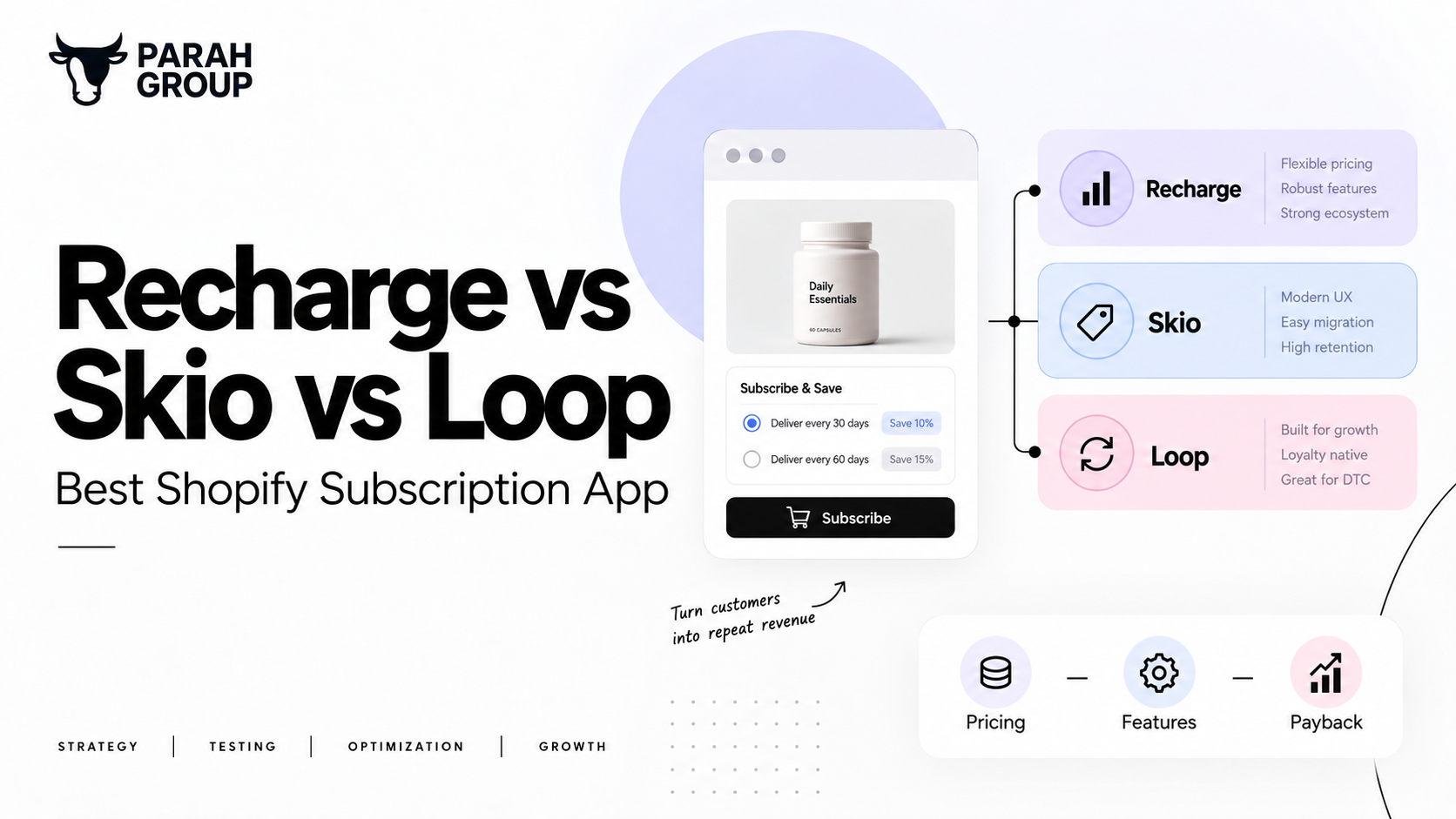
Loop is the cheapest to run at $99 or $399 a month with a 1% or 0.75% fee. Skio is the most complete at $499 a month annual plus 1% + 20¢. Recharge is the most established at $99 or $499 plus 1.49% or 1.34% + 19¢. All three do passwordless login, cancel flows and bundles. Your take rate will be set by the PDP offer, not the app.
Subscription optimisation is in scope on every program we run. The one number that separates a subscription business that compounds from one that does not is take rate: the share of first orders that choose subscribe-and-save. Take rate is testable, and the app matters less to it than the PDP offer, the price anchor and the post-purchase upsell. This post compares the three apps honestly on price and features as of September 2026, then shows what actually moves take rate.
Recharge vs Skio vs Loop: what do they cost as of September 2026?
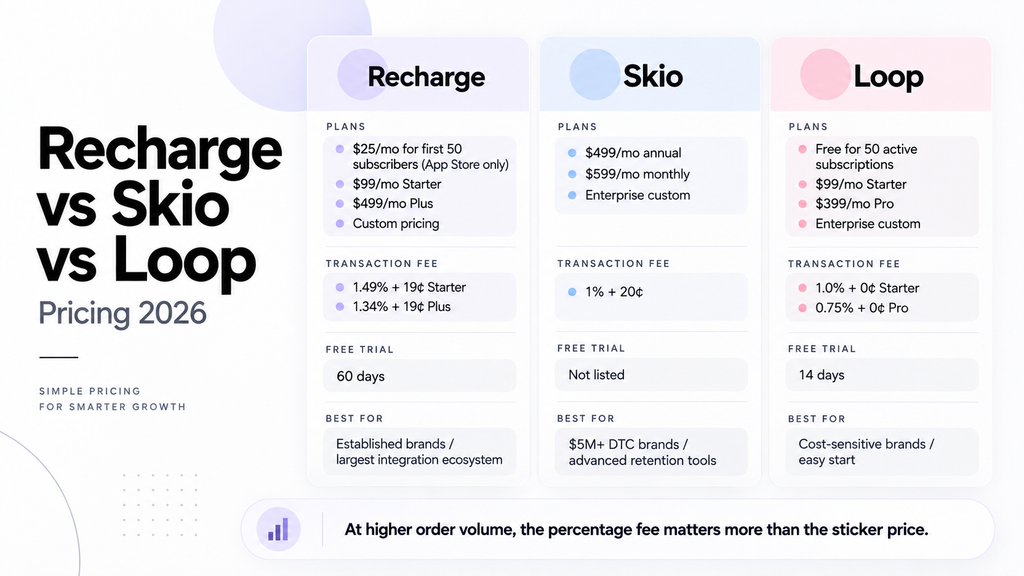
All three publish prices. All three charge a platform fee plus a percentage of subscription order value, and the percentage is the number that grows with you. Here is what each vendor’s own pricing page and Shopify App Store listing say.
| App | Pricing | Transaction fee | Passwordless | Churn tools | Migration | Best for |
|---|---|---|---|---|---|---|
| Recharge | $25/mo (first 50 subscribers, no transaction fee, App Store only); Starter $99/mo; Plus $499/mo; Custom volume-based. 60-day free trial | Starter 1.49% + 19¢; Plus 1.34% + 19¢ with scalable rates | Yes, all plans | Smart Cancellation Prevention, failed payment recovery | End-to-end migration on Plus only | Established brands that want the largest integration ecosystem and benchmarks |
| Skio | Scale $499/mo annual or $599/mo monthly; Enterprise custom. No free trial listed | 1% + 20¢ on orders involving a subscription | Yes, “Passwordless Login & Quick Actions” | Multi-Step Cancel Flow Builder, Payment Recovery Campaigns, Journeys, SkioSMS | “Comprehensive Migration”, “Zero-Downtime Migration” | $5M+ DTC brands that want retention tooling in one place |
| Loop | Free (50 active subscriptions, App Store); Starter $99/mo; Pro $399/mo; Enterprise custom. 14-day free trial | Starter 1.0% + 0¢; Pro 0.75% + 0¢; Enterprise negotiable | Portal is self-serve; login method not specified by tier on the pricing page | Cancellation prevention and personalised cancel flows, failed payment recovery, surprise-and-delight flows on Pro | Free migration on all paid plans | Cost-sensitive brands, and anyone under 50 subscriptions who wants to start free |
Worked example, 2,000 subscription orders a month at $60. Recharge Plus: $499 + 1.34% of $120,000 ($1,608) + 2,000 x 19¢ ($380) = about $2,487 a month. Skio Scale annual: $499 + 1% ($1,200) + 2,000 x 20¢ ($400) = about $2,099. Loop Pro: $399 + 0.75% ($900) + $0 = about $1,299. At that volume Loop is roughly half the cost of Recharge. At 200 orders the gap shrinks to the platform fee. Rerun the maths with your own AOV before you decide; the percentage matters more than the sticker.
Which subscription app has the best churn and cancellation tools?
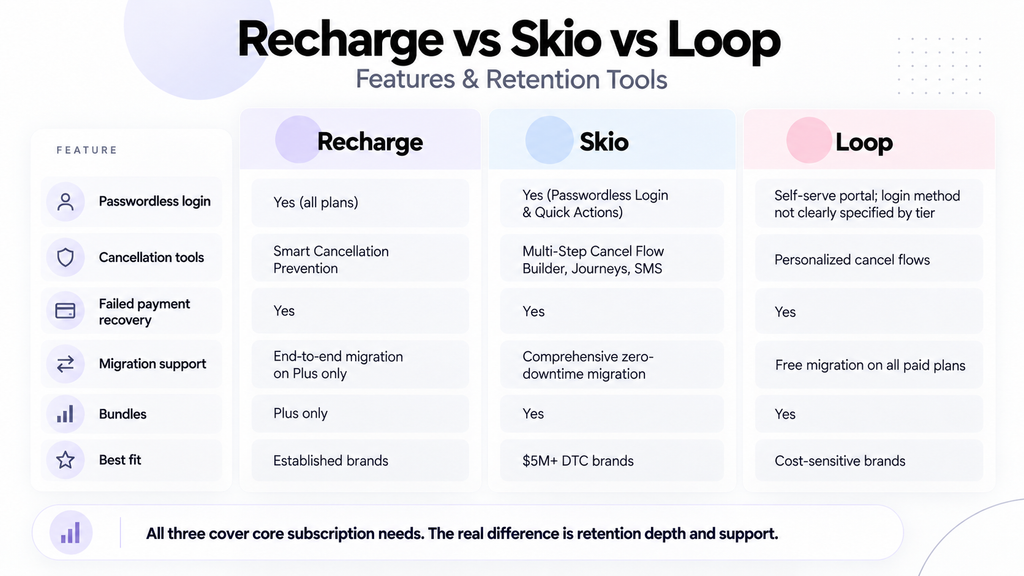
The three are closer than their marketing suggests. Every one of them now ships a cancellation flow with reasons and save offers, failed-payment retry, and a customer portal where subscribers skip, swap and reschedule without emailing you.
Recharge calls its flow Smart Cancellation Prevention and includes it on every plan, alongside failed payment recovery, analytics and industry benchmarks. Bundles and tiered discounts, the JavaScript SDK and the Storefront API are Plus only.
Skio lists a Multi-Step Cancel Flow Builder, Payment Recovery Campaigns with timing optimisation, lifecycle Journeys and one- and two-way SMS on Scale. That is the broadest retention set in one plan, and it is why Skio is the usual pick once a brand has more than a few thousand subscribers and a retention owner on staff.
Loop puts cancellation prevention, failed payment recovery and subscription bundles on Starter, and adds surprise-and-delight flows, targeted campaigns, prepaid and gifting, and API access on Pro.
What the feature list does not tell you is which save offer works. A pause option, a skip, a swap, a discount and a downgrade are all different treatments, and the order you present them changes the save rate. That is a test, and any of these apps lets you run it. The mistake we see is brands buying the more expensive app for its cancel-flow builder and then never touching the default configuration.
Do Recharge, Skio and Loop all use native Shopify checkout?
Yes. Recharge’s pricing page lists “Unified checkout on Shopify” on Starter and Plus, and its App Store listing says it works with Checkout. Skio’s listing says it integrates with Shopify checkout, checkout extensions and customer accounts through Shopify Flow. Loop’s listing says it works with Checkout natively. The era of redirecting subscription customers to a separate checkout domain is over for all three, which removes the single biggest historic reason take rate collapsed on subscription PDPs.
That matters because checkout is where the money leaks. Shopify reported Shop Pay handled 32% of BFCM 2025 orders, and Baymard documents cart abandonment at about 70%. A subscription app that stayed on native checkout keeps Shop Pay, keeps your checkout tests, and keeps your abandonment recovery intact.
Passwordless login is now table stakes. Recharge includes passwordless customer login on Starter and Plus. Skio lists Passwordless Login & Quick Actions on its App Store listing. Loop’s pricing page does not specify the login method by tier, so confirm it on your demo. Passwordless matters for retention because a large share of cancellations are not decisions; they are subscribers who wanted to skip a month, could not log in, and cancelled from the email instead.
How much does migration cost, and should it stop you switching?
Migration is the reason most brands stay on the wrong app. The good news is that all three now sell it. Recharge offers end-to-end migration support on Plus. Skio lists comprehensive, zero-downtime migration on Scale. Loop offers free migration on all paid plans. Ask each vendor on the demo exactly how subscription contracts and stored payment methods move; all three now sell that as a service rather than leaving it to you.
The decision rule we use: switch if the fee delta at your current volume pays for the migration project in under six months, or if you need a specific retention feature the current app cannot do. Do not switch to fix take rate. Take rate is a PDP and offer problem, and the three apps render the same purchase-option widget in Shopify’s theme editor. Moving from one to another will not change what a first-time visitor sees on the product page.
If your subscription numbers are flat and you are wondering whether the app is the problem, our Shopify CRO work usually finds the answer on the PDP, not in the admin.
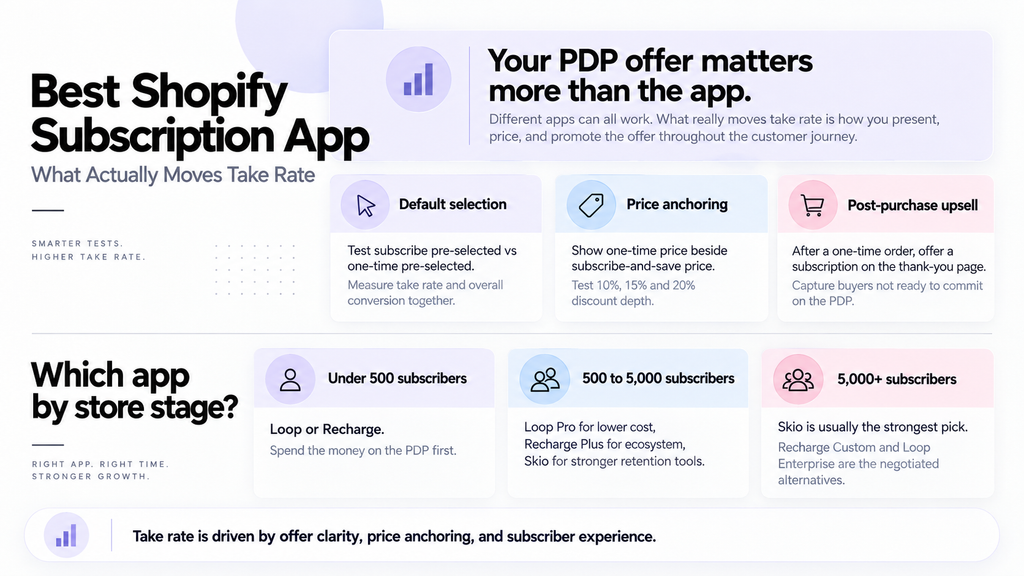
Why does the PDP offer matter more than the app for take rate?
Take rate is the percentage of first orders where the customer picks subscribe-and-save over one-time. It is a conversion rate with its own funnel and it responds to the same levers: default selection, price anchoring, framing, and friction.
For Optimize Minerals, a supplements brand, we took subscription take rate from 25% to 55–60% in six months and tripled the subscriber base. The app was not swapped. The work was on the PDP: which option is pre-selected, how the discount is anchored against the one-time price, whether the per-serving cost is shown, how the frequency options are labelled, and what the cancel-anytime language says. Paid landing pages for the same brand converted 40% better and post-purchase upsells added about 10% to AOV, which compounds with the higher take rate.
For Willie’s, a cannabis DTC brand, take rate rose 75% in three months while paid traffic scaled, alongside AOV +25% and conversion +20%. The stack was Rebuy for post-purchase, Intelligems for checkout tests, and a gamified cart bar. For Momentous, take rate rose 10% and the same program found that trust and scientific authority beat social proof for that audience; the treatment that lifted subscriptions was authority-led, not discount-led.
Three tests that work on any of the three apps:
- Default selection. Subscribe pre-selected versus one-time pre-selected. Measure take rate and overall conversion together; a pre-selected subscription that drops first-order conversion is a net loss.
- Price anchoring. Show the one-time price struck through beside the subscription price, and the per-unit or per-serving cost. Test the discount depth: 10%, 15% and 20% behave differently by category.
- Post-purchase subscription upsell. After a one-time order, offer to convert it to a subscription on the thank-you page. We run this through Rebuy. It captures buyers who were not ready to commit on the PDP and it does not touch checkout conversion.
Which subscription app should you pick by store stage?
Under 500 subscribers. Loop’s free tier covers 50 active subscriptions, then Starter at $99 with a 1% fee and no per-order charge. Recharge’s $25 App Store plan covers the first 50 subscribers with no transaction fee, then Starter at $99. Either is fine. Spend the money on the PDP.
500 to 5,000 subscribers. Loop Pro at $399 and 0.75% is the cheapest to run and has the churn tools most brands use. Recharge Plus at $499 and 1.34% + 19¢ costs more but brings the bundle builder, migration support and the largest partner ecosystem. Skio Scale at $499 annual and 1% + 20¢ sits between them on fees and above both on retention tooling.
5,000+ subscribers or a retention owner on staff. Skio. The cancel-flow builder, journeys, SMS and segmentation in one plan reduce the number of other apps you need. Recharge Custom and Loop Enterprise are the negotiated alternatives, and at this volume the percentage fee is the negotiation.
The honest summary of recharge vs skio: Skio is newer, cheaper per transaction, and more complete on retention; Recharge is more established, more integrated, and more expensive per order. Loop undercuts both. None of them will fix a 20% take rate. A tested PDP will.
If you want take rate treated as a number to be tested rather than a setting to be configured, see how the CRO Program covers subscription optimisation alongside the rest of the funnel, or book an intro call. Bring your current take rate and subscriber count; we will tell you in one call whether the app or the PDP is the constraint.
The app matters less than the offer around it. For Willie’s Remedy Seed Co., subscription take rate rose 75 percent in three months through checkout tests, post-purchase offers and cart changes. Supplement brands face the same trade-offs, which is why subscription testing sits at the center of our supplement marketing agency work.
Subscriptions not sticking?
Parah Group tests subscription offers, checkout and post-purchase flows on live traffic.
Frequently asked questions
Is Skio cheaper than Recharge?
Per order, yes, as of September 2026. Skio Scale is $499 a month annual with a 1% + 20¢ fee. Recharge Plus is $499 a month with 1.34% + 19¢. On 2,000 orders a month at $60 that is about $2,099 for Skio against $2,487 for Recharge. Recharge’s $99 Starter is cheaper on platform fee but carries 1.49% + 19¢.
What is the best Shopify subscription app for a small brand?
Loop or Recharge. Loop’s App Store free tier covers 50 active subscriptions and Starter is $99 a month at 1% with no per-order charge. Recharge’s $25 plan covers the first 50 subscribers with no transaction fee. Skio has no published entry tier below $499 a month. Under 500 subscribers the app is not your constraint.
What is a good subscription take rate on Shopify?
It depends on category and offer, so treat your own baseline as the benchmark. We have taken a supplements brand from 25% to 55–60% in six months by testing the PDP default, price anchoring and post-purchase upsell, without changing the app. If you are under 30% on a consumable, the PDP offer is almost certainly the first test.
Can I migrate from Recharge to Skio or Loop without losing subscribers?
Yes. Skio lists zero-downtime, comprehensive migration on Scale, Loop offers free migration on all paid plans, and Recharge includes end-to-end migration on Plus. Ask each vendor how contracts and stored payment methods move. Budget a project, not an afternoon, and switch only if the fee saving or a specific retention feature justifies it.
Do subscription apps support passwordless login?
Recharge includes passwordless customer login on Starter and Plus. Skio lists Passwordless Login & Quick Actions on its Shopify listing. Loop’s pricing page does not specify the login method by tier, so confirm it before you buy. Passwordless matters because a subscriber who cannot log in to skip a month cancels instead.