For most ecommerce brands, Facebook and Instagram ads should carry the core budget and TikTok should be tested alongside them. Meta reaches more U.S. adults and has deeper conversion data; TikTok usually buys cheaper impressions and works best for products that can be shown working in a few seconds. The right split depends on your product, creative supply and margins.
Planning paid social across both platforms? See how Parah Group runs Facebook ads and TikTok ads as one program, together with the landing pages behind them.
TikTok vs Facebook ads at a glance
The comparison below uses each platform’s own documentation plus the largest published benchmark datasets we could find. Where a figure comes from a vendor’s customer data rather than the platform, we say so.
| Facebook and Instagram (Meta) | TikTok | |
|---|---|---|
| U.S. adults who use it | Facebook 71%, Instagram 50% (Pew, 2025) | 37%, up from 21% in 2021 (Pew, 2025) |
| Median CPM, Aug 2025 to Jul 2026 | $15.06 across 40,000+ brands (Triple Whale) | $4.08 across 5,900+ brands (Triple Whale) |
| Minimum budget | Varies by country and objective; at least 5x your cost per result goal | Campaign above $50 a day, ad group above $20 a day |
| Creative that tends to win | Clear product and offer, proof, strong first frame | Native, creator-led video; Spark Ads on organic posts |
| In-app commerce | Shops and catalog ads, with checkout on your own site | TikTok Shop, with GMV Max as the only Shop Ads campaign type |
| Best for | Most DTC categories, retargeting, considered purchases | Visual, demonstrable, impulse-priced products |
Reach: who you can actually find
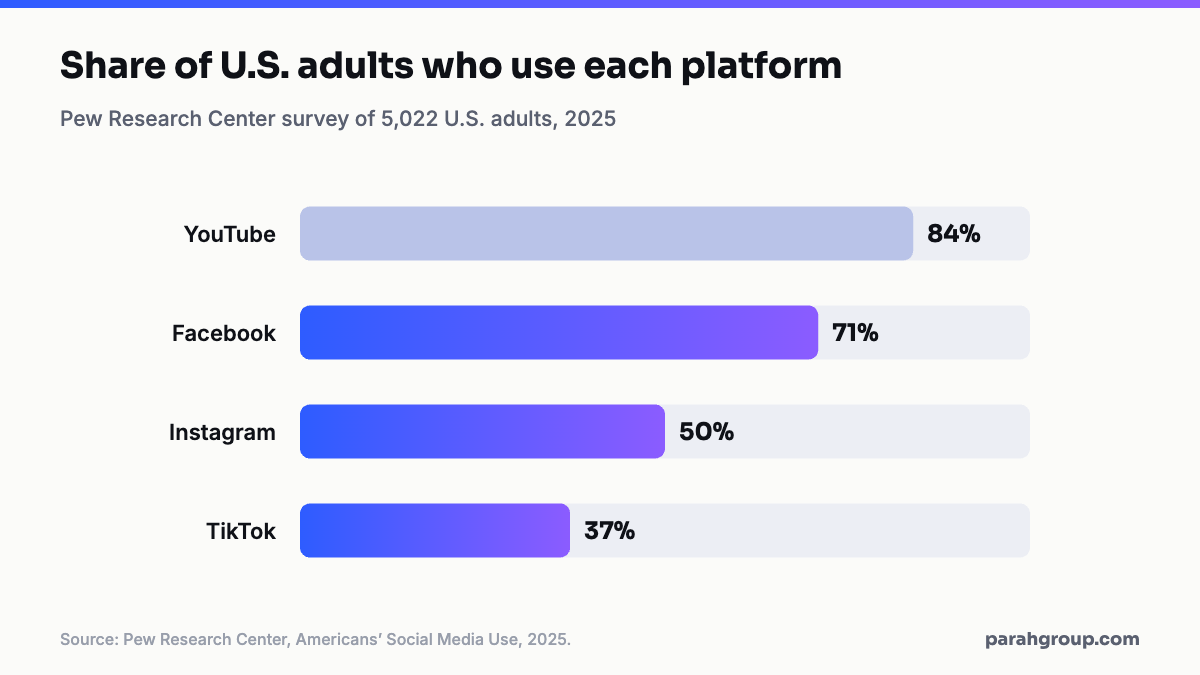
Meta still reaches more of the U.S. market. In Pew Research Center’s 2025 survey of 5,022 U.S. adults, 71 percent said they use Facebook and 50 percent Instagram, compared with 37 percent for TikTok. TikTok’s share has grown fast, from 21 percent in 2021, and in a separate Pew survey 24 percent of U.S. adults said they use it daily.
Advertising audiences tell the same story. DataReportal’s Digital 2026 report, using figures from each platform’s ad tools, shows TikTok ads reaching 55.7 percent of U.S. adults at the end of 2025, against 71.4 percent for Facebook and 64.1 percent for Instagram. Globally, Meta reported 3.60 billion daily active people across its apps in June 2026.
Reach is not the whole story, though. TikTok’s audience skews younger and spends its time in a single, full-screen feed, which is why the same product can perform very differently on each platform.
Cost: CPMs, minimums and what you really pay
Impressions are much cheaper on TikTok. Triple Whale’s TikTok benchmarks put the median CPM at $4.08 across more than 5,900 brands for August 2025 to July 2026, down from $5.71 the year before. Its Facebook benchmarks put Meta’s median CPM at $15.06 across more than 40,000 brands for the same period, up about 13 percent. These are medians from ecommerce brands that use Triple Whale, so treat them as directional.
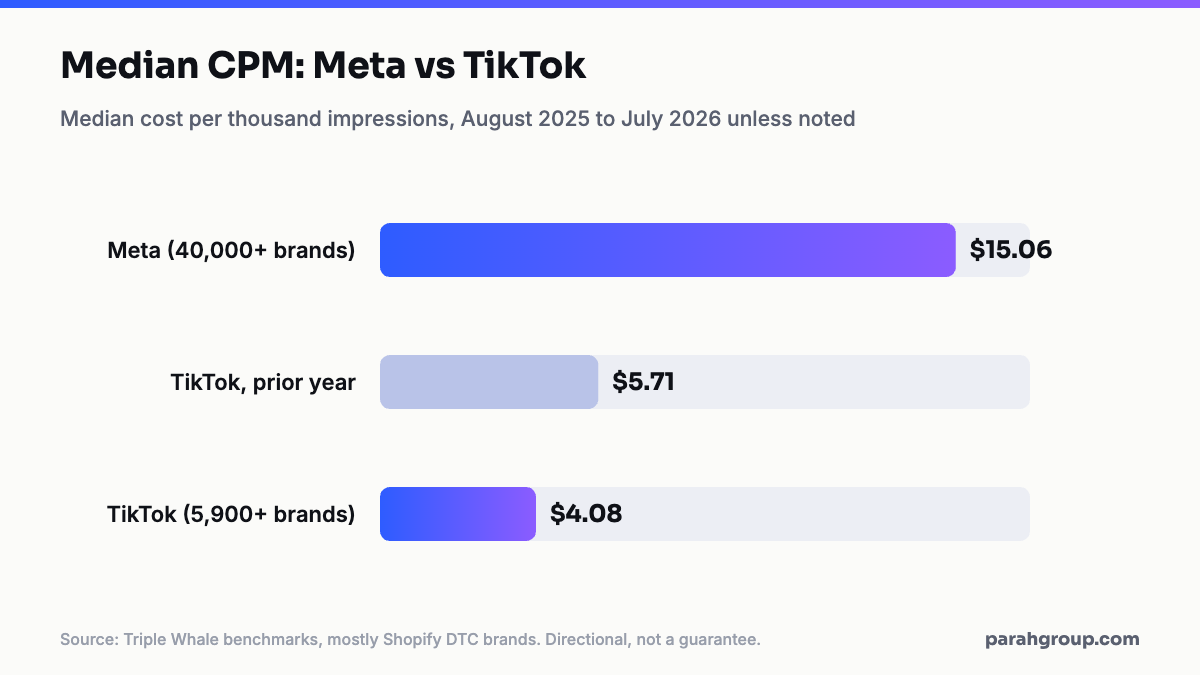
Meta’s prices are also rising at the platform level: in its second quarter of 2026, Meta reported that the average price per ad rose 12 percent year over year. Minimums differ too. TikTok’s budget rules require a campaign daily budget above $50 and an ad group budget above $20. Meta’s minimum budget guidance varies by country and objective, and recommends a daily budget of at least five times your cost per result goal. For a line-by-line breakdown of TikTok budgets, CPMs and fees, see how much TikTok ads cost.
A cheaper impression only matters if it turns into a profitable customer. In the same Triple Whale data, median cost per acquisition was $17.07 on TikTok and $38.99 on Meta, a gap of about 2.3 times against 3.7 times for CPM. Median return on ad spend was still lower on TikTok, 1.51 against 1.88, because average order values were lower. Your numbers will differ, so compare platforms on cost per acquisition and margin.
Want to know which platform suits your products?
Parah Group offers a free audit of your ad accounts and the pages they send traffic to.
Creative: what each platform rewards
TikTok rewards content that looks like TikTok. TikTok reports that Spark Ads in Video Shopping Ads, which boost organic posts from your account or a creator, delivered a 30 percent higher completion rate, 142 percent higher engagement rate and 43 percent higher conversion rate than non-Spark ads. TikTok does not publish the dataset or date behind those numbers. In our experience, creator-led native video usually beats polished brand ads.
Meta is more forgiving of a clear product shot and a strong offer, and its automation does more of the targeting. Meta reports a 20 percent improvement in cost per acquisition for advertisers using Advantage+ sales campaigns, and cites Nielsen’s finding that creativity drives 56 percent of a campaign’s sales return.
- On TikTok: hook in the first one to two seconds, show the product in use, brief creators, and expect creative to fatigue faster.
- On Meta: lead with the product and the offer, use proof early, and feed automation enough variety to find winners.
- On both: judge creative on cost per acquisition and new-customer revenue, not views.
Commerce: TikTok Shop vs selling on your own site
TikTok can keep the whole purchase in the app through TikTok Shop. Since July 2025, GMV Max has been the default and only supported campaign type for TikTok Shop Ads. TikTok set its U.S. referral fee at 6 percent per order in April 2024. Several seller guides report a rise to 8 percent for most categories from August 2026, so check the rate in Seller Center before you model margins.
Selling in-app removes friction but costs you the customer relationship and your own landing page. Meta campaigns, by contrast, usually send traffic to your store, where you control the page, the offer and the post-purchase flow. We model both paths before recommending TikTok Shop, because fees, fulfillment rules and the loss of first-party data all count.
What happens after the click decides the winner
Most comparisons stop at the ad. In our experience the bigger difference is after the click: a TikTok visitor is less patient than a Meta visitor, so a slow, desktop-first product page costs more on TikTok than anywhere else.
When Parah Group built custom landing pages for STRNG Seeds’ paid traffic, alongside multi-packs, free gifts over a cart size and post-purchase upsells, revenue per visitor rose 90 percent in six months. The arithmetic is simple: a landing page that converts 30 percent better cuts cost per acquisition by about 23 percent, on either platform, without touching the ads.
For TikTok traffic in particular, the page needs a few things a standard product page often lacks:
- The product in use on the first screen, ideally the same creator or scene as the ad.
- The claim from the video repeated in words, because many people watch with the sound off.
- Price, shipping and delivery time visible without scrolling.
- Express checkout, so the order completes before the visitor swipes back.
How to split budget between Facebook and TikTok
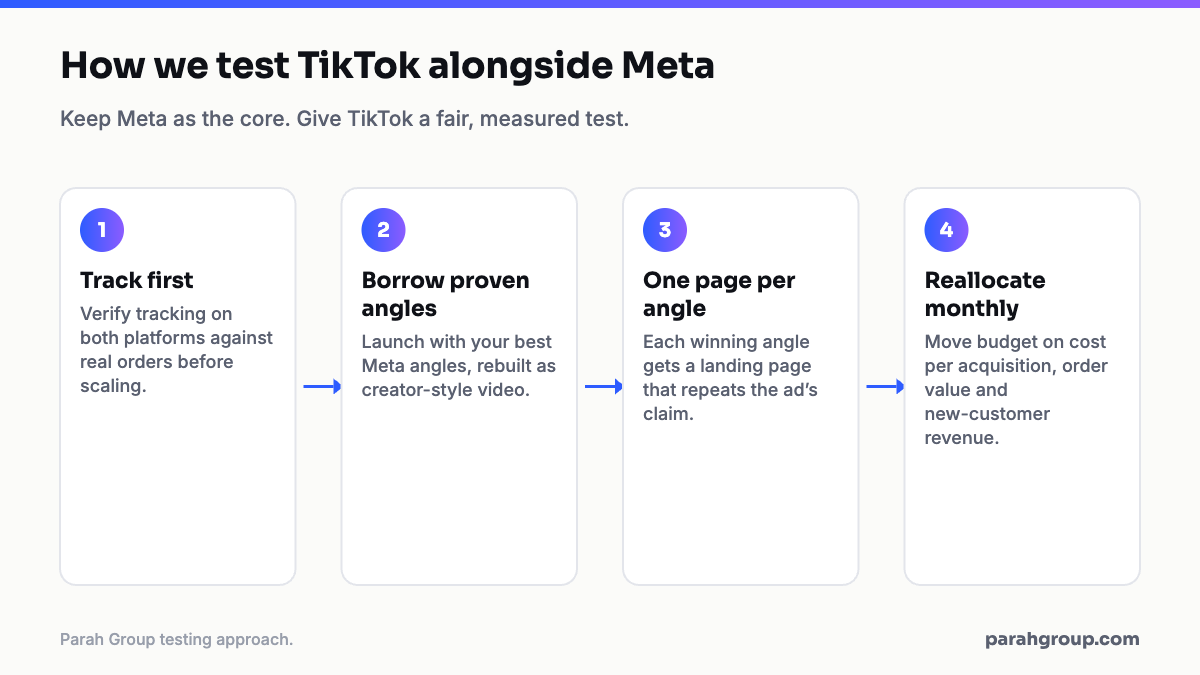
There is no universal ratio. A sensible way to start is to keep Meta as the core of the budget, then give TikTok a test budget that clears its minimums and runs long enough to judge, usually several weeks. Borrow the angles already winning on Meta, adapt them into native TikTok creative, and send TikTok traffic to pages built for it.
- Set up and verify tracking on both platforms against real orders before scaling.
- Launch TikTok with your best Meta angles, rebuilt as creator-style video.
- Give each winning angle its own landing page, with the claim from the ad repeated above the fold.
- Compare platforms monthly on cost per acquisition, average order value and new-customer revenue.
- Move budget to whichever platform wins that month, and keep testing the other.
If you want this run for you, our paid social agency runs Meta and TikTok as one program, and the landing page design team builds the pages each platform needs. For fee models, see Facebook ads agency pricing.
Run Meta and TikTok as one program
Budget follows the lowest cost per acquisition each month, and the same team builds the pages the ads land on.
Frequently asked questions
Are TikTok ads cheaper than Facebook ads?
Impressions usually are. In Triple Whale’s data for August 2025 to July 2026, the median CPM was $4.08 on TikTok across more than 5,900 brands and $15.06 on Meta across more than 40,000. Cheaper impressions do not guarantee a cheaper customer, so compare cost per acquisition, not CPM.
Should a new ecommerce brand start with TikTok or Facebook?
Most should start where their buyers and their conversion data are, which for many DTC brands is Meta, then test TikTok once tracking, creative supply and landing pages are in place. Brands whose product can be shown working in a few seconds are the exception and can lead with TikTok.
What is the minimum budget for TikTok ads?
TikTok requires a campaign daily budget above $50 and an ad group daily budget above $20. Meta’s minimums vary by country and objective; with a cost per result goal, Meta advises a daily budget of at least five times that goal.
Do TikTok Spark Ads work better than regular ads?
TikTok reports that Spark Ads in Video Shopping Ads delivered a 30 percent higher completion rate, 142 percent higher engagement rate and 43 percent higher conversion rate than non-Spark ads. TikTok does not publish the dataset behind those figures, so test them on your own account.
Can I run both Facebook and TikTok ads?
Yes, and most brands should once spend allows. Running both lets you adapt winning angles across platforms and move budget each month to whichever produces the lowest cost per acquisition.