Pinterest ads cost whatever you bid in an auction, not a fixed rate. As of October 2026, Pinterest publishes no rate card; the bid floor for a US click campaign is $0.10. Third-party benchmarks put median CPM near $5 and median CPC near $1.50, with most advertisers paying under $8 per conversion.
The useful answer depends on three things most cost guides skip: which objective you buy under, because each is billed differently; where the click lands, your own page or a marketplace listing you cannot track; and which attribution window you judge the number through. Pinterest users plan weeks ahead, so the same campaign can look expensive on day 7 and cheap on day 30. Every figure below is sourced and linked.
How Pinterest charges you: pricing by objective
Pinterest sells ads through an auction, and what you pay for changes with the objective. Pinterest’s campaign objectives article lists five, and the billing unit follows the goal:
- Brand awareness: you set a maximum cost per thousand impressions (CPM) and pay whether or not anyone clicks.
- Video completion: optimized for completed views, which Pinterest defines at the 95 percent completion marker.
- Consideration: you set a maximum cost per click (CPC). This is the traffic objective, and the only one that works when you cannot put tracking on the destination.
- Leads: you set a target average cost per action (CPA), and Pinterest optimizes toward form fills or sign-ups tracked by the Pinterest tag or API.
- Sales: a target CPA bid optimized toward checkout events. Shopping ads built from a product catalog run here; the older Conversions and Catalog sales labels were folded into Leads and Sales, as Shopify’s July 2026 guide notes.
Pinterest’s set your bid article gives two routes. Custom bids set the maximum you will pay per action. Performance+ bids are managed automatically “several times a day” to get “the most Pin clicks at the lowest possible cost per result while also spending your entire budget.” Performance+ covers consideration, leads, sales and brand awareness; ROAS bidding needs a Sales or Leads objective plus checkout events carrying order value.
Two details from the same page matter for planning. Every campaign has a bid floor that varies by country and format; Pinterest’s example is a CPC campaign across the US, UK and Canada with floors of $0.10, £0.07 and $0.10, where the account pays the highest, $0.10. And “you will only pay the minimum amount required at any given time no matter what you set your bid to.” A high bid is a ceiling, not a price.
Pinterest’s manage your spend article lets you set a daily or lifetime spend limit at campaign level and pause at any time to stop accruing cost. The Pinterest pages we could fetch do not state a minimum daily budget, so we are not quoting one; the constraint that binds is the bid floor above.
Pinterest ad cost benchmarks, by objective
Pinterest publishes no averages, so every number below is a third-party range with source and date attached. Treat it as the spread to expect, not a quote.
Pinterest ads cost by objective, as of October 2026 (third-party benchmarks)
| Objective | How you are billed | Sourced benchmark range | Best for |
|---|---|---|---|
| Brand awareness | Max CPM bid | Median CPM $5.10, P25 $2.60, P75 $9.80 (Benchmarketing (https://www.benchmarketing.org/benchmarks/pinterest-ads), Q1 2023 to Q4 2024). 52% of 270 marketers paid $1.50 or less per 1,000 impressions (WebFX survey (https://www.webfx.com/social-media/pricing/how-much-does-pinterest-advertising-cost/)). | Seasonal launches two to three months before the peak; new DTC brands building saved Pins before a sales push. |
| Video completion | Cost per completed view | No reliable public range found; Pinterest’s advertise page lists CPM or CPV bidding for awareness-stage video. | Product demos and how-to content where the view itself is the goal. |
| Consideration (traffic) | Max CPC bid; US bid floor $0.10 | Median CPC $1.50, P25 $0.70, P75 $2.90 (Benchmarketing). 43% of marketers paid 20 cents or less per click (WebFX). Retail 50 to 70 cents, beauty 40 to 60 cents, home decor 50 to 80 cents (Shopify (https://www.shopify.com/blog/pinterest-ads), citing AdBacklog). | Etsy and marketplace sellers who cannot install tracking; testing creative before switching to Sales. |
| Leads | Target CPA bid | 66% of marketers paid $8 or less per conversion; 12.9% paid more than $16 (WebFX). | Quiz funnels, waitlists, lead magnets with a form on your own page. |
| Sales (including shopping ads from a catalog) | Target CPA or ROAS bid | Median conversion rate 0.80%, median ROAS 2.3x, P25 1.1x, P75 4.0x (Benchmarketing). Retail CPA roughly $7 to $8, home decor $10 and up (Shopify, citing AdBacklog). | DTC stores with the Pinterest tag or Conversions API live and a product feed connected. |
Read the spread, not the median. Benchmarketing’s top quartile pays almost four times the CPM of the bottom quartile, and WebFX has 43 percent of respondents under 20 cents a click while 11 percent pay more than $3. Cheap clicks come from Pins that look native to the feed in categories people already search (home, food, beauty, gifting); expensive ones come from repurposed Meta creative in categories nobody plans for. One caveat: the WebFX survey found 59 percent of companies spend $500 or less a month, so its medians say little about what a $30,000-a-month DTC brand pays once it scales past the cheap inventory.
Why the attribution window changes what Pinterest ads “cost”
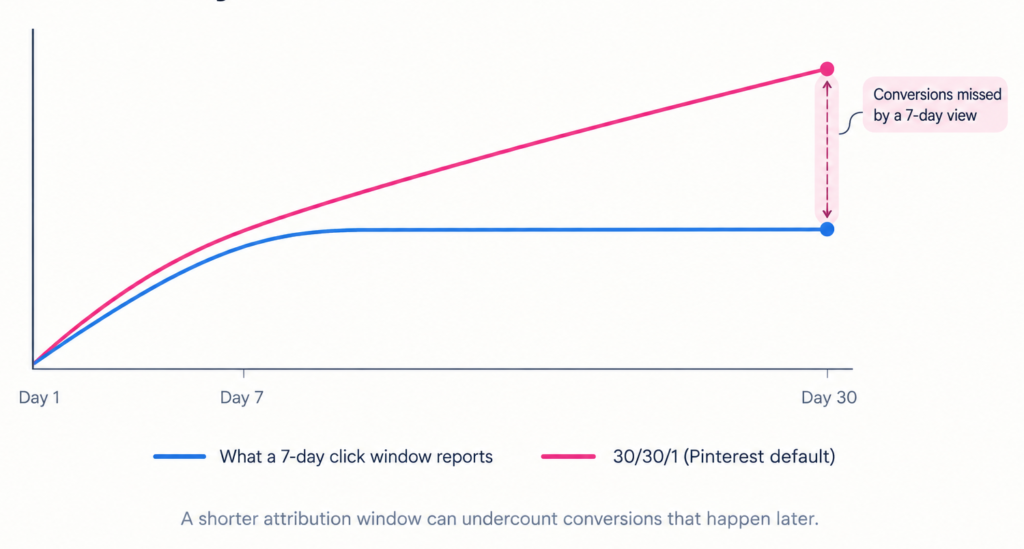
A brand that exports Pinterest and Meta at a 7-day click window will see Pinterest’s CPA at two or three times Meta’s and cut it. That is the wrong window. Pinterest’s default is 30-day click, 30-day engagement, 1-day view, written 30/30/1 in Ads Manager. Pinterest’s community team explains the parts in this attribution window thread: a view counts when the ad appears on screen; an engagement counts when the user interacts, including saving the Pin, clicking it, clicking out or scrolling a carousel. The engagement window is the Pinterest-specific part. Someone saves your Pin to a kitchen reno board, comes back three weeks later and buys. On a 7-day click window that sale does not exist. On 30/30/1 it does.
The window is wider because the behavior is slower. Pinterest’s 2026 marketing moments guide says seasonal searches “start building momentum months before the season arrives” and advises: “If the moment peaks in June, launch in April.” Its users are more than twice as likely as non-users to invest time preparing for seasonal moments. Pinterest’s audience page adds 640 million monthly active users and 96 percent of top searches unbranded. Unbranded, early and saved for later is the whole profile; a one-week window measures the wrong thing.
The honest comparison runs the same window on every channel and accepts that Pinterest’s number keeps improving for three to four weeks after spend. Judge Pinterest CPA at day 30 of a cohort, not day 7, and check blended new-customer revenue against total spend rather than platform ROAS alone.
Pinterest ads for Etsy sellers: listing or landing page?
The Etsy version of this question has two halves most guides muddle.
First, you may already be paying for Pinterest ads without running any. Etsy’s Offsite Ads program promotes listings on Google, Facebook, Instagram, Pinterest and Bing, per Etsy’s Seller Handbook. Nothing is paid upfront; when a shopper clicks one of those ads and buys within 30 days, Etsy charges 15 percent of the order for shops under $10,000 in trailing-12-month sales, or 12 percent once you pass $10,000, after which participation is mandatory. The fee is capped at $100 per attributed order, per FeeProofed’s July 2026 breakdown. That is a Pinterest ad cost expressed as a share of revenue rather than a CPC, and it sits underneath any budget you add.
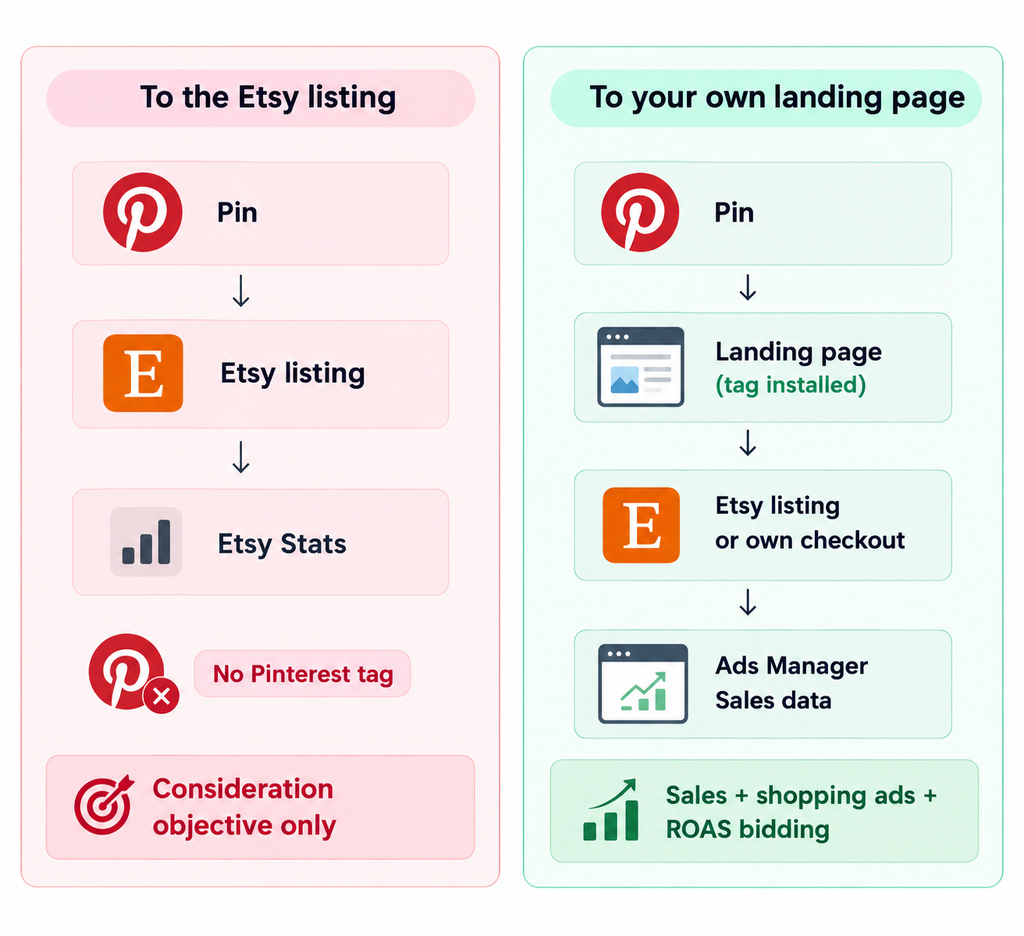
Second, if you run your own Pinterest ads, the destination decides the objective you can buy. Pinterest’s website claiming article says you must own the domain and be able to edit the source code to claim it, and that you are “unable to claim most social accounts and online stores hosted on marketplaces like Etsy, eBay and Amazon.” The same code-access problem applies to the Pinterest tag, which records checkouts, add-to-carts and leads. No tag means no conversion events, so Sales and Leads have nothing to optimize toward. Traffic sent straight to an Etsy listing is limited to Consideration: you pay per click, see clicks and saves in Ads Manager, and infer sales from Etsy Stats.
That works at small budgets and stops working when you want Pinterest’s bidding to find buyers rather than clickers, because it cannot see who bought. The alternative is a landing page on a domain you own, tag installed, that presents the product and sends the buyer on to the Etsy listing or your own checkout. You pay for a page and add a step; in return you get the Sales objective, ROAS bidding, catalog shopping ads and a measurable cost per purchase.
Etsy seller options for Pinterest ads
| Route | Objectives available | What you can measure | What it costs |
|---|---|---|---|
| Etsy Offsite Ads (default) | Managed by Etsy | Attributed orders in Etsy Stats | 12% or 15% of attributed order value, $100 cap per order |
| Own Pinterest ads to the Etsy listing | Brand awareness, Consideration only | Impressions, clicks, saves; sales inferred | CPC auction from a $0.10 US floor; no CPA data |
| Own Pinterest ads to a landing page you own | All five, including Sales with shopping ads | Checkout events, CPA, ROAS at 30/30/1 | CPC or CPA auction plus a page build |
Whether the page pays depends on your Etsy conversion rate and margin; see what a good conversion rate on Etsy looks like.
Pinterest ads for business: what actually moves the cost
Across the DTC accounts we have audited, the cost of Pinterest ads is set less by the bid than by four decisions made before launch.
Objective match. Buying Consideration when you want sales pays for clicks from people Pinterest has no reason to think will buy; buying Sales before the tag has recorded enough checkouts leaves the algorithm guessing. The usual sequence is two to three weeks of Consideration to seed the tag and find creative that earns saves, then Sales with Performance+.
Creative that belongs on Pinterest. Vertical 2:3 images, a text overlay that reads like a search (“small kitchen storage ideas”), no Shop now badge. With 96 percent of top searches unbranded, the Pin should answer what was typed. Repurposed Meta creative is the fastest route to the expensive end of every range above.
Timing against the planning curve. Launching in the peak month buys the most expensive impressions after planners have already saved their ideas. Pinterest’s “peaks in June, launch in April” guidance exists because CPMs are lower and saves accumulate while demand builds.
The landing page. The one lever that lowers cost per acquisition without touching the auction. A Pinterest click arrives with a half-formed plan and a specific image in mind. A homepage written for warm organic traffic does not finish that plan; a page that repeats the Pin’s promise, answers the coldest visitor’s questions in order and gives one next step does. For Binoid, the landing page program cut paid social CPA by 30 percent in four months. For Optimize Minerals, paid-traffic landing pages converted 40 percent better than the site pages they replaced during the move from organic into paid.
That is why we run media buying and pages together rather than as two vendors pointing at each other. Our Pinterest ads agency service covers account structure, creative testing and bidding; landing pages for paid traffic build and test what the click lands on; and the wider paid social + CRO program runs Pinterest alongside Meta, TikTok and Snapchat on one attribution standard. Pricing is scoped per brand on a call; no pricing is published.
A budget worked through
A DTC home goods brand with a $60 average order and 40 percent contribution margin has about $24 to spend per order. At the Benchmarketing medians (CPC $1.50, conversion rate 0.80 percent) an order costs roughly $187. At the WebFX low band (CPC $0.20) and the same conversion rate it costs $25, break-even. Double the page to 1.6 percent and the order costs $12.50 at the low-band CPC or $94 at the median. The lesson: the CPC range is wide enough that creative and category fit decide whether Pinterest is viable at all, and once you are in the cheap half, the page’s conversion rate moves CPA more than any bid change. Test for four to six weeks at a level that produces 50 or more checkouts, judge at day 30, and keep Consideration and Sales in separate campaigns.
Frequently asked questions
How much do Pinterest ads cost per month?
There is no fixed fee. You set a daily or lifetime spend limit and pay per impression, click or action in an auction. WebFX’s survey found 59 percent of companies spend $500 or less a month; a DTC brand running Sales campaigns usually needs several thousand a month for Pinterest’s bidding to learn.
What is the minimum budget for Pinterest ads?
The Pinterest pages we fetched in October 2026 do not publish a minimum daily budget. What Pinterest does publish is a bid floor that varies by country and format; a US CPC campaign has a $0.10 floor. Spend limits are set per campaign and can be paused at any time.
Is Pinterest advertising cheaper than Facebook?
Usually per impression and per click: third-party ranges put Pinterest’s median CPM around $5, against Meta CPMs commonly reported near $9. Per sale depends on category, landing page and attribution window; at a 7-day click window Pinterest almost always looks more expensive than it is.
Can Etsy sellers run Pinterest ads?
Yes, with a limit. You cannot claim an Etsy shop or install the Pinterest tag on it, so ads sent to a listing can only use Brand awareness or Consideration. For the Sales objective, shopping ads or ROAS bidding, send traffic to a landing page you own with the tag installed. Etsy’s Offsite Ads already promote listings on Pinterest for a 12 or 15 percent fee on attributed orders.
What is a good CPC for Pinterest ads?
Benchmarketing reports a $1.50 median with the best quartile under $0.70; WebFX has 43 percent of advertisers at 20 cents or less. Retail and home categories commonly sit at 50 to 80 cents. Under $1 in a shopping category is healthy; above $2 usually signals creative that does not match what people search.
What attribution window should I use for Pinterest ads?
Start with Pinterest’s default, 30-day click, 30-day engagement, 1-day view, and judge each spend cohort at day 30. When comparing with Meta or TikTok, apply the same window everywhere. The engagement window matters because saving a Pin and buying three weeks later is normal on Pinterest.
Want to know what your Pinterest ads cost per new customer? Get a free, no-obligation audit of your ad accounts and the pages they land on. We will show you the right window to judge by, where spend is leaking and what the landing page is costing you.