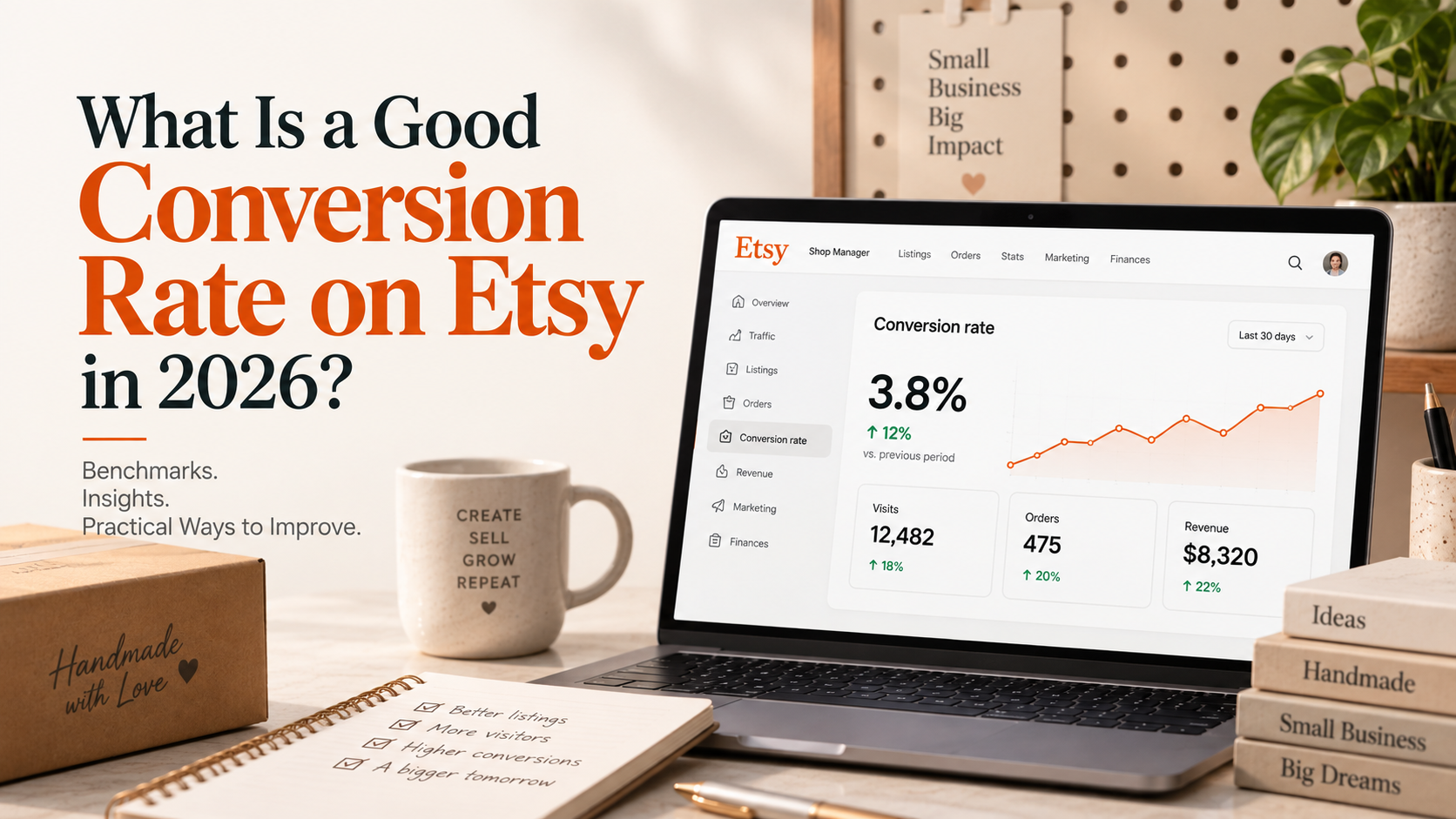
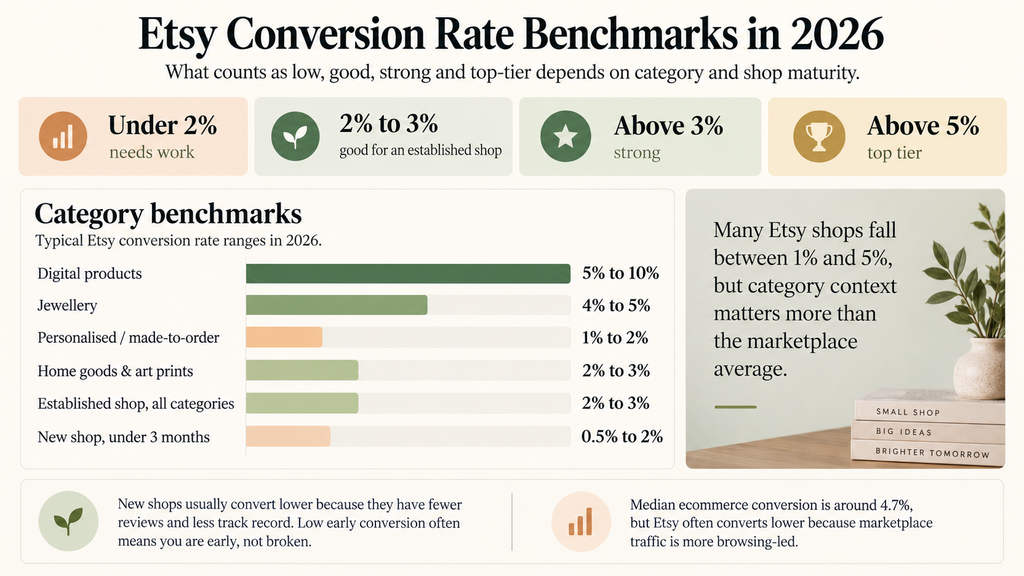
A good conversion rate on Etsy is 2% to 3% for an established shop. Above 3% is strong, above 5% puts you in the top tier, and under 2% usually means photos, pricing or reviews need work. Category matters more than the overall average, so compare yourself to your own niche rather than to Etsy as a whole.
Sending ad traffic to an Etsy shop or your own store? See our Pinterest ads agency program for Etsy and Shopify brands.
The benchmarks, by category
Etsy’s own seller guidance notes that many shops see conversion between 1% and 5%, which is a range wide enough to be unhelpful without category context.
Broken down, the picture is clearer. Published 2026 benchmarks put digital products at 5% to 10%, jewellery around 4% to 5%, and custom or made-to-order items closer to 1% to 2%, with home goods and art prints toward the lower end. Other analyses put jewellery near 4.56% and home goods around 2.82%.
| Category | Typical range |
|---|---|
| Digital products | 5% to 10% |
| Jewellery | 4% to 5% |
| Personalised and made-to-order | 1% to 2% |
| Home goods and art prints | 2% to 3% |
| Established shop, all categories | 2% to 3% |
| New shop, under three months | 0.5% to 2% |
New shops sit lower for a structural reason. A shop under three months old commonly converts at 0.5% to 2% simply because it has few reviews and no track record, and the rate climbs into the 2% to 4% range as review volume builds. If you are new, you are not broken, you are early.
For context against the wider market, median ecommerce conversion across 1,055 audited tests sits near 4.7%. Etsy shops convert lower on average partly because marketplace traffic is browsing rather than arriving with intent.
Where to find your actual number
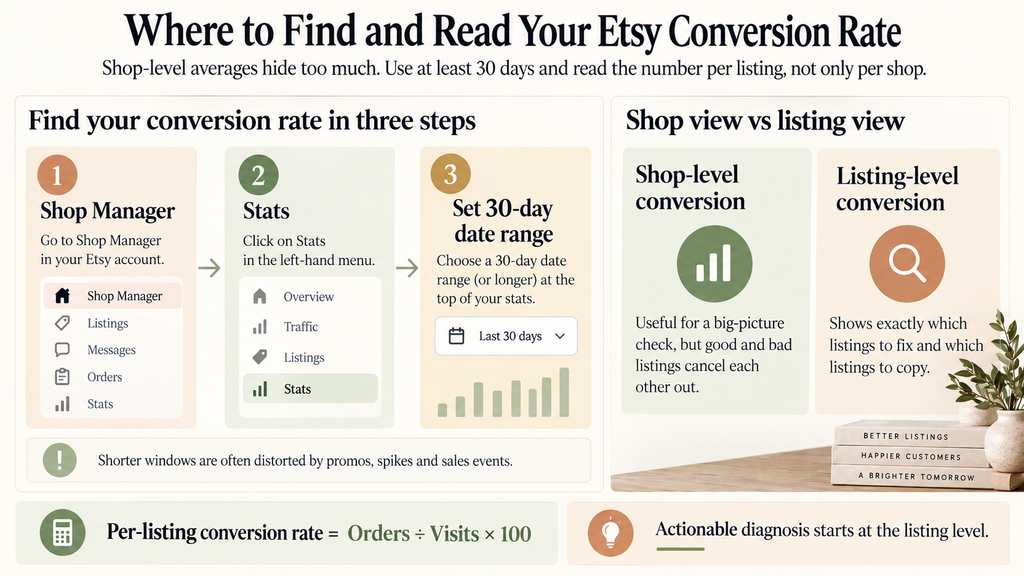
Shop Manager, then Stats, then set the date range. Etsy shows the rate directly.
Use at least thirty days. Shorter windows are misleading because sales events, promotions and traffic spikes distort them. You can also calculate it per listing: orders divided by visits, multiplied by 100.
Do the per-listing version. Shop-level conversion averages a good listing and a bad one into a number that hides both. The listing-level view tells you which items to fix and which to copy.
The levers that move it
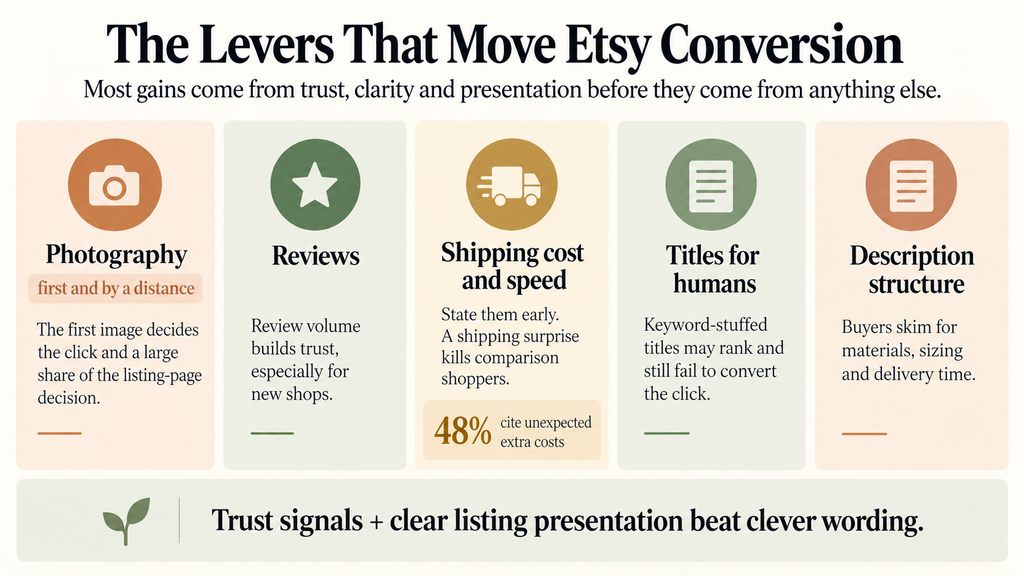
Photography, first and by a distance. The first image decides the click from search and a large share of the decision on the listing page. Use every image slot: lifestyle shots, scale references, close-ups on materials.
Reviews. They are the trust mechanism for a marketplace where the buyer does not know you. Review volume is the main reason new shops convert lower, and it is the main reason patience is part of the strategy.
Shipping cost and speed, stated early. This is not Etsy-specific. Baymard’s meta-analysis of fifty studies attributes 48% of cart abandonments to unexpected extra costs at checkout. On a marketplace where a buyer is comparing five open tabs, a shipping surprise is fatal.
Titles written for humans. Keyword-stuffed titles rank and then fail to convert the click they earned.
Description structure. Buyers skim for materials, sizing and delivery time. If those are buried in a paragraph, they leave.
What this looks like from the DTC side
Worth being straight about the source of this one: our client work is DTC and Shopify rather than Etsy, so the number below comes from a different context and the mechanism is what transfers, not the figure.
At a DTC supplements brand, a single shipping threshold test produced two million dollars in profit. It did not change how many people bought. It changed what they put in the basket. Etsy gives you less control over that mechanism, which is precisely the limitation worth understanding before you invest heavily in marketplace optimisation.
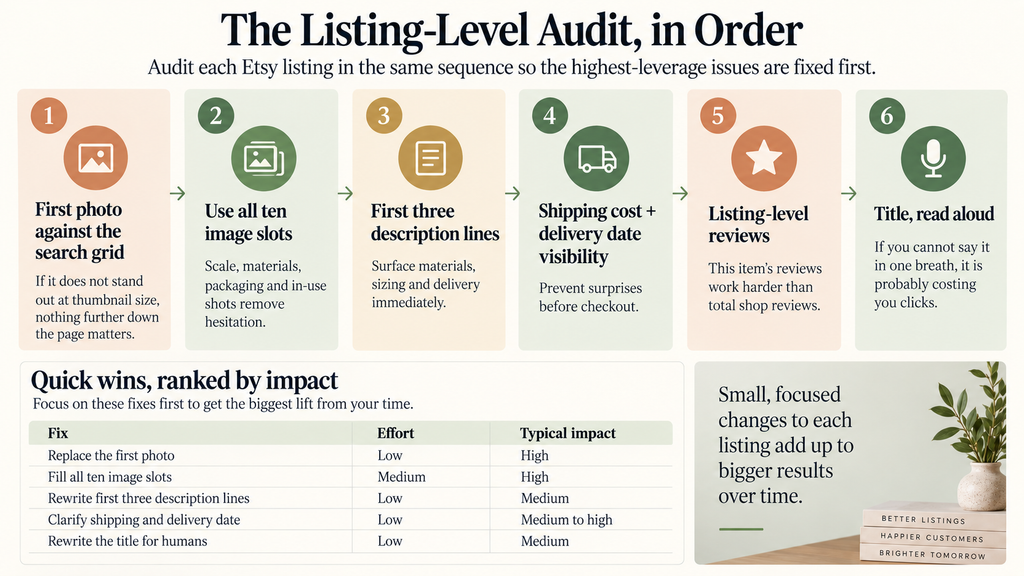
The listing-level audit, in order
Shop-level conversion is an average that hides both your best and worst listings. Work at the listing level and in this order.
One: the first photo, against the search grid. Your listing does not compete on its own page, it competes in a grid of forty thumbnails. Open the search results for your main keyword and find your listing among the competition. If it does not stand out at thumbnail size, nothing further down the page matters. The first product photo is the single most important factor in both the click and the sale.
Two: image slots used. Etsy gives you ten. Most sellers use four. Scale reference, materials close-up, packaging, and the product in use each remove a specific hesitation.
Three: the first three lines of the description. Buyers skim for materials, sizing and delivery. If those three facts are not in the first three lines, they are effectively absent.
Four: shipping cost and delivery date visibility. The single largest documented cause of abandonment across ecommerce is unexpected extra cost at checkout, cited by 48% of shoppers.
Five: reviews on the listing, not just the shop. Listing-level review counts do more work than shop totals, because the buyer is evaluating this item.
Six: the title, read aloud. Clear human-readable titles outperform keyword-stuffed ones. If you cannot say it in one breath, it is costing you the click it just earned.
| Fix | Effort | Typical impact |
|---|---|---|
| Replace the first photo | Low | High |
| Fill all ten image slots | Medium | High |
| Rewrite first three description lines | Low | Medium |
| Clarify shipping and delivery date | Low | Medium to high |
| Rewrite the title for humans | Low | Medium |
How to know whether a change worked
This is where Etsy sellers are structurally disadvantaged, and it is worth saying plainly rather than pretending otherwise.
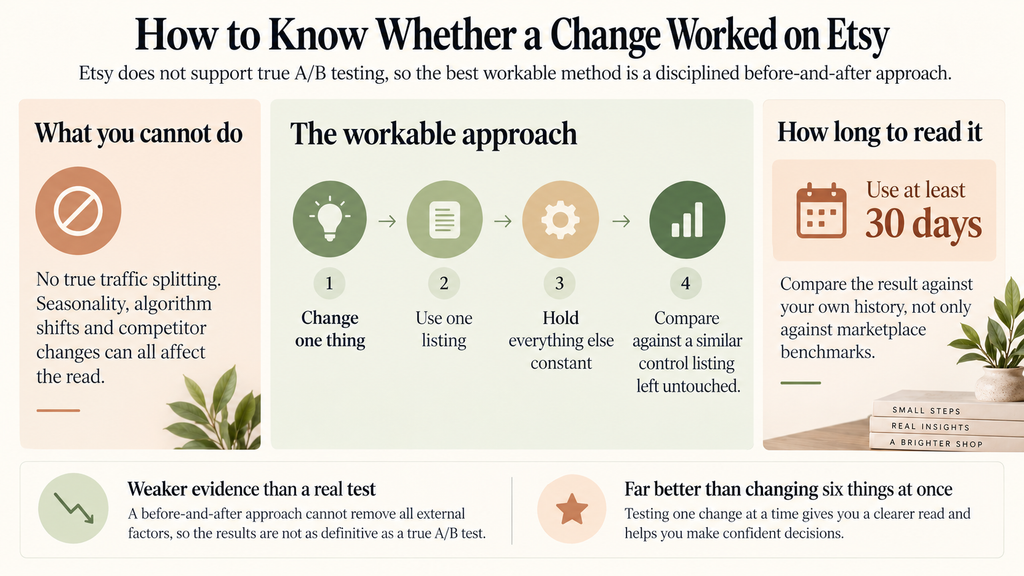
You cannot A/B test on Etsy. There is no traffic splitting, so every change is a before-and-after measurement confounded by season, algorithm shifts and whatever your competitors did that week.
The workable approach is to change one thing at a time on one listing, hold everything else constant, and compare against a control listing in the same category that you deliberately leave alone. It is weaker evidence than a real test and it is far better than changing six things at once and attributing the result to whichever one you liked best.
Use at least thirty days, since shorter windows are distorted by sales events and traffic spikes. And compare your rate against your own history rather than against a benchmark, because your category, price point and shop age make the published averages only loosely relevant to you.
The honest limit of Etsy optimisation
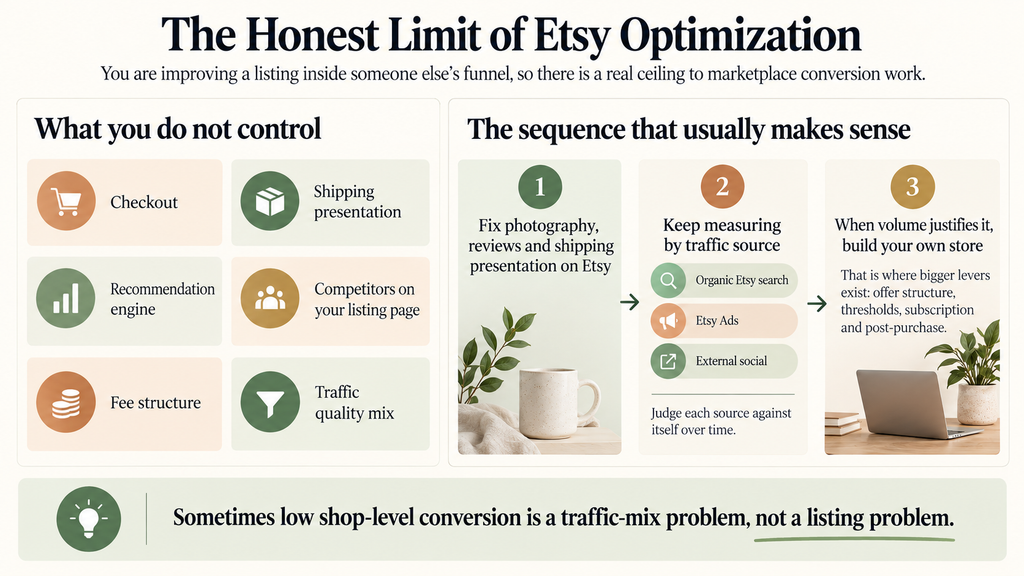
You are optimising inside someone else’s funnel. You do not control the checkout, the shipping presentation, the recommendation engine showing competitors on your own listing page, or the fee structure.
That ceiling is real. Marketplace conversion work is worth doing and it stops paying at a certain point, which is when brands move to their own store and take control of the parts that produce the largest effects: offer structure, thresholds, subscription and post-purchase.
The sequence most sellers should follow is to fix photography, reviews and shipping presentation on Etsy first, because those are cheap and they work. Then, once volume justifies it, build the store where the bigger levers exist.
Outgrown the marketplace? Ecommerce CRO covers the offer and checkout levers you only get on your own store.
Traffic quality, before you blame the listing
Low conversion is not always a listing problem. Sometimes the listing is fine and the traffic is wrong.
Etsy Ads, external social traffic and organic Etsy search convert at very different rates, and a shop running ads on broad terms will see shop-level conversion fall while absolute sales rise. That is not a conversion problem, it is a mix change, and treating it as a listing failure sends you rewriting copy that was working.
Split by traffic source in Shop Manager before diagnosing anything. If organic Etsy search converts well and paid does not, the issue is keyword targeting rather than photography. If external social traffic converts poorly, that is normal, since social traffic is browsing rather than buying.
Judge each source against itself over time. A shop-level number that mixes three sources with different intent is not a metric you can act on.
If you plan to add paid traffic from Pinterest, read our guide to Pinterest ads for Etsy sellers first. It covers how Offsite Ads already use Pinterest, setup, costs and the limits Etsy sellers hit.
If you also sell on your own Shopify store, the same rule applies off Etsy: paid traffic only converts as well as the page it lands on. That is why our Pinterest ads agency work plans the ads and the landing pages together.
Selling on Etsy and your own store?
Parah Group runs Pinterest ads and builds the pages they land on, so saves turn into orders.
Frequently asked questions
What is a good conversion rate on Etsy?
2% to 3% for an established shop. 3% to 5% is strong and above 5% is top tier. Under 2% usually points at photography, pricing or review volume.
Why is my Etsy conversion rate so low?
If the shop is under three months old, low is normal, commonly 0.5% to 2% while reviews accumulate. If it is established, check photography first, then shipping cost visibility, then whether your titles are written for search rather than for people.
How do I find my Etsy conversion rate?
Shop Manager, then Stats, then set a date range of at least thirty days. Also calculate it per listing, because the shop-level average hides your best and worst items.
Is Etsy conversion lower than a normal ecommerce store?
Usually, yes. Marketplace traffic browses rather than arriving with intent, and median ecommerce conversion sits nearer 4.7% across audited tests.
Next step: Website Conversion Optimization covers what changes when you own the whole funnel.