If you are sending paid traffic to Shopify, pick Replo when a designer owns the pages and you ship several a month; pick PageFly when budget is tight and you want built-in A/B testing under $40; pick Shogun when the team needs a CMS with versioning and scheduling. Judge all three on CPA and revenue per visitor, not on the editor.
What does a paid-traffic landing page actually have to do?
A landing page for paid social or search has one job: turn a click you paid for into a purchase or a lead at a cost you can live with. That is the whole scorecard. The builder is a means to that, and a cheap one relative to media spend.
Across the landing page programs we run, the pages that win on CPA share the same bones:
- The offer is above the fold on a phone, with the price and the discount visible without scrolling. Adobe reported that 57.5% of Cyber Monday 2025 online sales were on mobile (Adobe, 2 Dec 2025). Paid social skews higher than that.
- One call to action, repeated. Not a menu, not three product links, not a newsletter box.
- Social proof next to the decision, not in a carousel at the bottom. Star rating under the headline, one specific review beside the CTA, a press or certification strip if you have one.
- Ad-to-page message match. The headline repeats the angle of the ad the visitor clicked. If the ad promised a bundle, the page opens on the bundle.
- A page that loads fast on a mid-range Android on cellular. Replo’s own speed guidance puts a good Largest Contentful Paint at under 2.5 seconds and a good Time to Interactive at under 5 seconds on average mobile hardware (Replo support). Every builder can hit that, and every builder can miss it if you drop in six autoplay videos.
For Binoid, a hemp and CBD brand, we shipped multiple landing pages per month testing angles and products alongside offer tests. Paid-social CPA fell 30% in four months. More on that work on our CBD and hemp marketing page. None of that came from the builder. It came from having a new page in test every week.
Which builder is the best Shopify landing page builder on price and limits?
All prices below are as of September 2026, from each vendor’s own pricing page or Shopify App Store listing. Check before you commit.
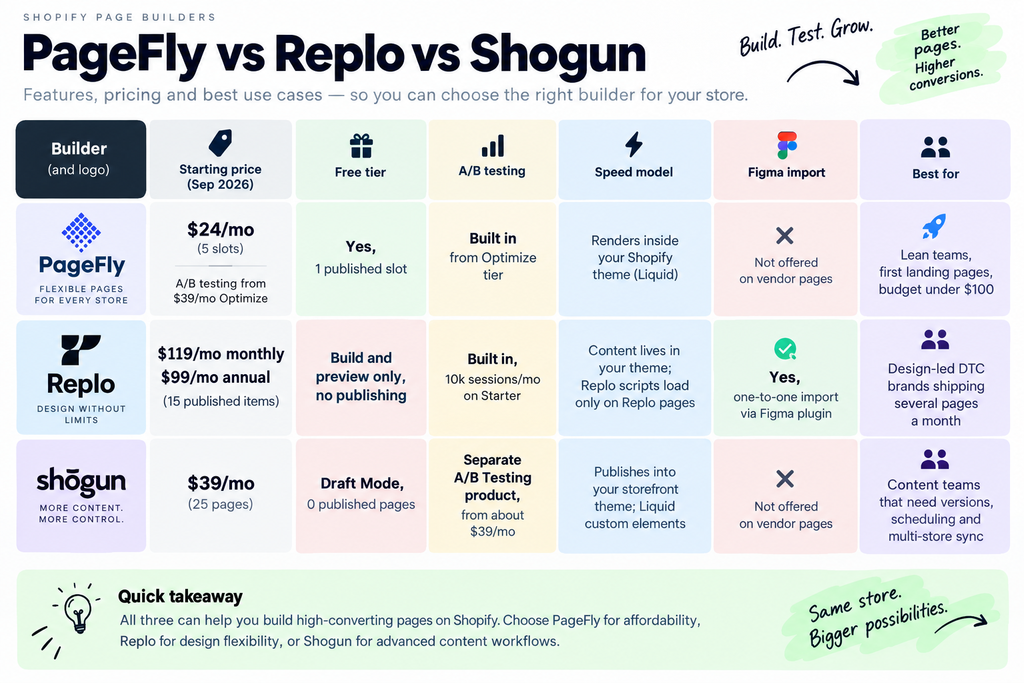
PageFly has a free plan with one published page or section slot. Builder starts at $24/month for 5 slots and rises to $34/month for 15. Optimize starts at $39/month for 20 slots and goes to $94/month for 75, and this is the tier that adds A/B testing, heatmaps and funnel analytics. Accelerate is $99/month with unlimited pages, Power is $199/month, and enterprise tiers run $299 to $999/month. Extra slots on the lower tiers are $5 per 5 (PageFly Help Center). One caution: the Shopify App Store listing shows A/B testing on the $24 Builder plan, while PageFly’s own pricing page and help centre put it on Optimize. Confirm in the app before you buy for testing.
Replo has a free tier that lets you build and preview but publish nothing. Starter is $119/month billed monthly or $99/month billed annually, for 15 published items, one Shopify store, 10,000 A/B testing sessions a month and unlimited team members. Pro is $599/month billed monthly or $499/month annually, with unlimited pages and sections, five stores and 50,000 A/B testing sessions. Extra stores on Starter are $99/month each and extra published items are $100/month per 20 (Replo on the Shopify App Store, replo.app/pricing).
Shogun has a free Draft Mode with zero published pages. Build is $39/month, or $31/month annually, for 25 published pages. Grow is $199/month, or $159/month annually, with unlimited pages, content scheduling and global sections. Advanced is $499/month, or $399/month annually, adding multi-store syncing, custom CMS collections and custom code elements. A/B testing is a separate Shogun product with its own tiers starting around $39/month for three active tests (getshogun.com/pricing, Shogun on the Shopify App Store).
Is A/B testing built in, and does it matter?
It matters more than any editor feature. A landing page you cannot test is a guess.
Replo bundles page-level A/B testing into Starter with a 10,000 session monthly allowance, which is enough for a single high-traffic page or a handful of smaller ones. PageFly includes testing from the Optimize tier at $39/month. Shogun sells testing separately, which is a nuisance on the invoice but not a problem if you already run a dedicated testing tool.
The practical point: builder-native A/B testing is fine for page A against page B on the same URL. It is not a testing program. It usually will not read revenue per visitor with proper confidence, will not test price or shipping thresholds, and will not test a landing page against a product page. For those, we run A/B testing as a program with Intelligems, Shoplift, VWO or Convert on top of whichever builder the client already has. The builder makes the variant. The testing tool decides the winner.
For Optimize Minerals, a supplements brand, paid landing pages built and tested this way lifted conversion 40%. The builder was a detail. The weekly cadence of variant, test, read, replace was the work.
Which builder is fastest on mobile?
None of the three hosts your page on a separate domain. That is the most important speed fact and it is the same for all of them. PageFly pages render inside your Shopify theme as Liquid, Replo writes page templates and sections into your theme as .liquid files and loads its scripts only on Replo-built content (Replo support), and Shogun publishes experiences back into your storefront theme with Liquid custom elements. Your page is a Shopify page, served by Shopify’s CDN, with Shopify’s cart and checkout underneath it.
Two consequences. First, checkout compatibility is not a differentiator. Add to cart goes to the native cart, express checkout works, Shop Pay works. Shopify reported that 32% of BFCM 2025 orders used Shop Pay (Shopify, 2 Dec 2025), so a builder that broke express checkout would be disqualifying. None of these do. Hosted builders that sit off your domain are where that risk lives, and that is a different category.
Second, page speed is mostly your fault, not the builder’s. PageFly’s own documentation says the app does not impact store PageSpeed and then spends the rest of the article on image weight, recommending pages under 2 MB (PageFly Help Center). Replo says the biggest gain in customer speed reports comes from lazy-loading images below the fold. Both are right. The variables that move Core Web Vitals on a landing page are image size, video autoplay, font count, and how many other apps inject scripts on every page. For Urban Carry Holsters, a site audit that removed apps and scripts was part of a program that added over $1,000,000 in annual revenue in six months. No builder switch would have done that.
One real difference: Replo loads its runtime only on Replo pages, so a Replo landing page adds no weight to your product pages. After installing PageFly or Shogun, run Lighthouse on a non-builder page before and after and remove anything injected where it should not be.
Which builder fits a designer-led team versus a lean team?
Replo is built for brands with a designer in Figma. Its integrations page promises one-to-one Figma import to launch pixel-perfect pages (replo.app/integrations), it allows unlimited team members from Starter, and Pro adds a private Slack channel and dedicated implementation support. If your creative team works in Figma and you want the page to match the ad in a day, Replo is the shortest path. The cost is that 15 published items on Starter fills fast when you are testing angles, and extra pages are $100/month per 20.
PageFly is the pragmatic choice for a lean team. Under $40/month buys A/B testing, heatmaps, 320-plus templates, and a slot model that punishes hoarding old pages, which is healthy. It does not advertise Figma import or team seats, so a designer rebuilds rather than imports. For a store under $20,000 a month in ad spend running two or three pages at a time, PageFly is enough, and the money saved is better spent on media or on landing page testing done properly.
Shogun is the choice when landing pages are one part of a content operation. Scheduling, page versions, global sections and multi-store sync matter to a marketing team with a calendar. A media buyer who needs a page by Thursday does not care. Shogun’s tiers are priced like Replo’s without the Figma workflow, and testing is extra. If you are on Shogun for the CMS, keep it. If you are choosing today purely for paid traffic, PageFly or Replo fit better.
And if you run one hero product and want a single page you never touch again, a theme template section with a custom Liquid block is faster and free. Builders earn their subscription when you ship and test pages weekly.
For Black Friday the page is the same and the pressure is higher. Shopify merchants sold $14.6 billion over BFCM 2025, up 27% year on year, with an average cart of $114.70 (Shopify). Every visitor is comparing you to three tabs. The BFCM landing page needs the sale offer above the fold with a real countdown, one CTA, a bundle or gift that raises cart value, and specific proof: “12,400 five-star reviews” beats “loved by thousands”. Build it in October, test the offer framing on evergreen traffic in early November, lock it by mid-November. If you have not started, our BFCM Readiness Sprint exists for exactly that.
How does Parah test landing pages weekly?
The cadence matters more than the tool. Every Monday we review CPA, conversion rate and revenue per visitor by landing page and ad angle. We pick the hypothesis with the biggest expected upside, build the variant in whatever builder the client runs, QA it on real devices, and launch by Wednesday. Tests run until we have a read on revenue per visitor, not just conversion rate, because a page that converts 5% better at a 10% lower AOV lost. Winners roll out, losers get written up, and next week we go again.
For Bounce Nutrition, a supplements brand, that loop across landing pages, offers and social proof cut paid-social CAC by 20% in three months. For LA Custom Blinds, a lead-gen home services business, the same loop with reviews, video testimonials and first-time-customer offers cut cost per lead by 30% in five months. Both ran on ordinary builders. What they had was a page in test every week.
If you would rather have that loop run for you, our Shopify CRO program includes landing page design, build, QA and testing as one workstream.
So: Replo if you have a designer, ship pages weekly and can afford $119/month plus overages. PageFly if you want testing and heatmaps under $40/month and will rebuild designs by hand. Shogun if landing pages sit inside a content operation that needs scheduling and versioning. Then stop comparing builders and start comparing pages. The builder is a $40 to $600 decision. The program behind it is what moves CPA.
If you want us to run that program, book an intro call. We will look at your current landing pages and paid data, tell you which builder to keep, and show you what we would test first. Book an intro call.
Frequently asked questions
Is PageFly good for landing pages on Shopify?
Yes, especially for lean teams. As of September 2026 PageFly starts at $24/month for 5 published slots, and the Optimize tier from $39/month adds A/B testing, heatmaps and funnel analytics. Pages render inside your Shopify theme so checkout and Shop Pay work normally. It does not advertise Figma import, so designers rebuild layouts in the editor.
Which is better for paid ads, Replo or PageFly?
Replo if a designer produces ad creative in Figma and you ship several landing pages a month; its one-to-one Figma import and unlimited team seats justify the $119/month monthly price. PageFly if you are under $20,000 a month in ad spend and want testing and heatmaps for under $40. Both keep native Shopify checkout.
Does Shogun include A/B testing?
Not in the page builder plans. As of September 2026, Shogun sells A/B testing as a separate product, listed from about $39/month for three active tests, with higher tiers for more tests. Build at $39/month, Grow at $199/month and Advanced at $499/month cover the builder itself. Budget for testing separately or run a dedicated testing tool.
Do Shopify landing page builders slow down your store?
Not by themselves. PageFly, Replo and Shogun all render pages inside your Shopify theme rather than hosting them elsewhere. Speed problems come from oversized images, autoplay video, extra fonts and apps injecting scripts on every page. Check that a builder’s runtime only loads on builder pages, lazy-load below-the-fold images and keep pages under 2 MB.
Should a paid-traffic landing page have navigation?
Usually no, or a minimal header with the logo only. You paid for the click and the page has one job. Every extra link is an exit. Keep one call to action, repeat it at the top, after the proof section and at the bottom, and put the offer, price and a review above the fold on mobile.
How many landing pages should a Shopify brand test per month?
At least one new page or major variant in test every week if you are spending meaningfully on paid social. The brands where we cut CPA by 20 to 30% all shipped multiple pages a month and read results on revenue per visitor, not just conversion rate. Fewer than two tests a month and the program is not really running.