For most stores the best Shopify bundle app is the one that matches your bundle mechanic. Fixed kits: start with Shopify’s free Bundles app. Volume discounts and multi-packs: Bundler (free tier) or Kaching Bundles. Mix-and-match with a real builder: Fast Bundle or Rebuy. Amplify (formerly PickyStory) is for larger stores that want bundles, cart and post-purchase in one contract.
What are the three bundle mechanics, and which one raises AOV?
Pick the mechanic before you pick the app.
Fixed kits. A set of two or more products sold as one SKU at one price: a starter set, a gift box, a “complete routine”. Simple to merchandise and fulfil. The weakness is inventory: Shopify’s help centre states bundle availability is determined by the component with the lowest inventory level.
Mix-and-match / build-a-box. The customer chooses N items from a set and gets a price or discount for completing the box. This is the highest-AOV mechanic when the catalogue supports it (flavours, scents, colours) because the customer does the merchandising work and rarely stops at the minimum. It needs a builder UI on the storefront and correct component-level inventory deduction at checkout.
Volume and multi-pack discounts. Buy two, save 10%; buy three, save 15%; or a discrete “3-pack” variant at a lower unit price. On consumables this is the lowest-effort AOV lever there is. It lives on the PDP and the customer does not have to learn a new concept.
Grab Green is our reference case for the third mechanic. AOV rose 80% through bundling, and the program was mostly multi-packs, value badges on the larger sizes, price testing on the packs and a cart-slider free-shipping progress bar to pull people over the threshold. STRNG Seeds ran the same play on PDPs: multi-packs on the product page, free gifts over a cart size and post-purchase upsells, and revenue per visitor rose 90% in six months. Neither program needed a build-a-box app. Both needed testing.
How do Shopify’s native bundles and inventory rules constrain apps?
Bundle apps on Shopify now sit on Shopify’s own bundle primitives rather than discount-code hacks and hidden products. Good for accuracy, bad for flexibility. Shopify’s Help Center lists the constraints as of September 2026:
- Your store must use the Online Store channel or a custom storefront, and an upgraded checkout. Stores still on checkout.liquid customisations are out.
- Bundles are not compatible with purchase options: subscriptions, pre-orders and try-before-you-buy. They are also incompatible with the Shopify Subscriptions app. Subscription bundles need an app that works outside the native bundle object, tested end to end.
- Bundles cannot contain other bundles, cannot be used in exchanges, and do not support import, export or bulk editing. A SKU change means deleting and recreating the bundle.
- Availability follows the lowest-stock component. Components with inventory tracking off or “continue selling when out of stock” are excluded from the calculation. Inventory updates in real time.
- The Shopify Bundles app itself allows up to 30 components in a fixed bundle, up to 150 in a dynamic bundle, a maximum of 3 options and 100 variants per bundle, and up to 2,000 units per component. It only works on the Online Store and headless storefronts. When a component’s price changes, the bundle price does not update automatically. Discounts apply to the parent bundle and are allocated to components by weighted price before tax.
Two things follow. “Inventory sync” is a platform feature for apps built on Shopify’s bundle and Cart Transform APIs; the question is whether the app uses them or still relies on discount codes and duplicate SKUs. And the 100-variant cap is why apparel brands hit a ceiling on fixed kits: a hoodie-and-joggers set in six sizes and four colours each is 576 combinations. Mix-and-match builders handle that; fixed kits do not.
If bundle logic is tangled up with subscriptions, cart offers and post-purchase upsells, that is a systems problem before it is an app problem. It is the kind of thing we untangle in Shopify CRO engagements before any test goes live.
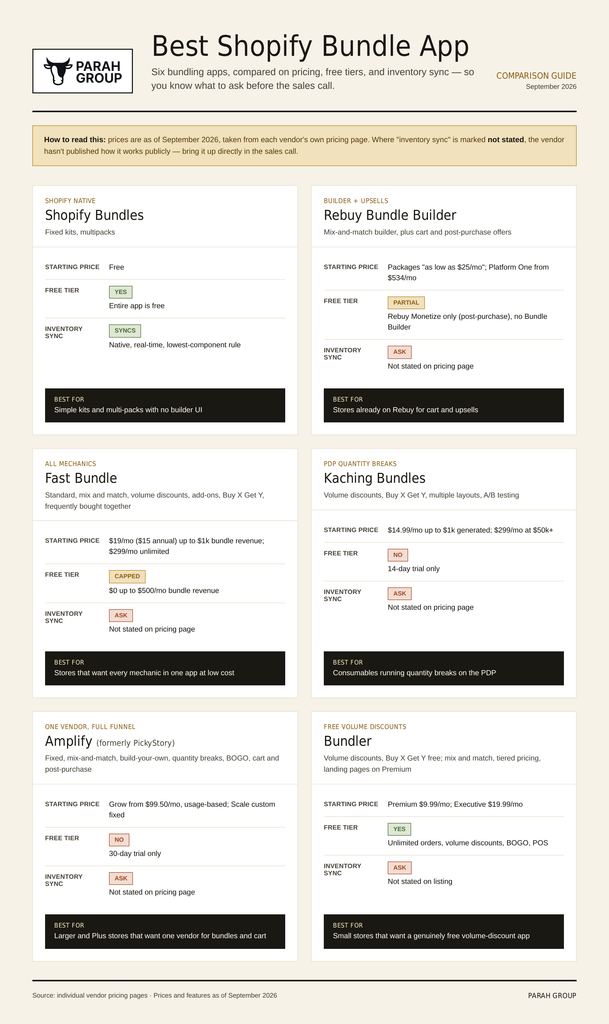
Best Shopify bundle app: comparison table
Which app fits which store?
Shopify Bundles. Free, first-party, and uses the native bundle object with real-time inventory. It does fixed kits and multi-packs only, does not import product imagery automatically and has no storefront builder. The App Store listing sits at a 2.8 rating from 573 reviews as of September 2026, mostly from merchants who expected a storefront tool. For a starter kit or a 3-pack it is enough. Start here before paying anyone.
Rebuy Bundle Builder. Rebuy’s pricing page lists Bundle Builder inside the Cart and Merchandising package, priced per order volume from 250 to 50,000+ orders a month, “as low as $25/mo for one package”. Platform One, the all-inclusive plan, starts at $534 a month at the volume shown. The free Monetize plan is post-purchase only and does not include bundles. We run Rebuy post-purchase for clients (Willie’s paired it with Intelligems checkout tests and a gamified cart bar: subscription take rate +75%, AOV +25% in three months). The bundle builder makes sense if you already pay for the cart, not as a standalone bundle purchase.
Fast Bundle. The broadest mechanic coverage at the lowest price. All six bundle types on every plan, a free plan capped at $500 a month in bundle revenue, and paid tiers keyed to bundle revenue: $19 up to $1k, $49 up to $3k, $139 up to $10k, and $299 (or $249 annual) unlimited. Enterprise adds subscription-app integration and POS, which matters given the native subscription incompatibility.
Kaching Bundles. Volume discounts and Buy X Get Y with polished PDP layouts and built-in A/B testing of the offer. Pricing is usage-based on revenue the app attributes to itself: $14.99 a month up to $1k, rising in steps to $299 at $50k+. There is no free plan; there is a 14-day trial. Good fit for quantity breaks on a consumable without a developer. Read the attribution rules first, because “revenue generated” decides your bill.
Amplify (formerly PickyStory). pickystory.com now redirects to heyamplify.com. The product covers fixed bundles, mix-and-match, build-your-own, quantity breaks, BOGO and cart, checkout and post-purchase upsells. Grow starts at $99.50 a month usage-based for stores up to about $30k a month; Scale is a custom fixed monthly price on a one-year commitment with a success manager and Slack access. No free plan, 30-day trial. It is a Rebuy competitor more than a bundle app.
Bundler. The free plan is real: unlimited orders, volume discounts, Buy X Get Y, PDP upsells and POS support at $0. Mix-and-match and tiered bundles need Premium at $9.99 a month; analytics need Executive at $19.99. The listing holds a 4.9 rating from 2,670 reviews and carries the Built for Shopify badge as of September 2026. If “shopify bundle app free” is the search that brought you here, this is the answer for volume discounts.
How do you test bundle offers instead of guessing?
Bundles move conversion rate, AOV and margin at once. App dashboards report AOV and ignore the other two.
- Test the mechanic first. Control: single unit. Variant A: 3-pack at 10% off. Variant B: three-tier quantity-break table. Run it with a price-testing tool (we use Intelligems on Shopify) so it randomises by visitor and reports profit per visitor, not just AOV.
- Test the discount depth. Grab Green’s price testing on multi-packs is where much of the AOV gain came from. A 10% pack discount and a 20% pack discount can produce the same take rate and very different margin. You will not know until you test.
- Test the badge. “Best value” on the larger size, savings per unit, or a plain price. Value badges on larger sizes were part of Grab Green’s program and cost nothing to ship.
- Measure downstream. Return rate, subscription take rate and repeat purchase timing. A 6-pack that delays the second order by four months is not always a win.
Baymard’s benchmark puts average cart abandonment at about 70%. A bundle that adds a step to the cart can push that up; a multi-pack selector on the PDP does not touch the cart at all. That is the argument for starting with volume before build-a-box.
Should you run bundles for Black Friday?
Yes, and build them in October. Shopify reported BFCM 2025 sales of $14.6 billion with an average cart of $114.70. Bundles are the cleanest way to lift that cart number without stacking a sitewide percentage on top of it. Gift kits, a BFCM bundle priced just over your free-shipping threshold, and multi-pack discounts that beat the sitewide offer by a few points all work. Adobe measured 57.5% of Cyber Monday online sales on mobile, so the bundle widget has to render and add to cart cleanly on a phone. Load-test it. Our BFCM readiness sprint exists because the wrong week to discover a bundle widget fails on a slow mobile connection is the week of Thanksgiving.
The decision: consumables, put multi-packs and a value badge on the PDP with Shopify Bundles or Bundler and test the discount depth. Catalogues with choice, pick Fast Bundle or Rebuy for a builder and test it against a fixed kit. If you want the offer design, the test and the margin analysis done by a team that has run this on 8- and 9-figure stores, that is our ecommerce CRO program. Bring your AOV and margin by SKU and we will tell you which mechanic to test first. Book an intro call.
Frequently asked questions
Is there a free Shopify bundle app?
Yes. Shopify Bundles is free and handles fixed kits and multi-packs on the native bundle object. Bundler has a free plan with unlimited orders, volume discounts and Buy X Get Y. Fast Bundle is free up to $500 a month in bundle revenue. Rebuy, Kaching and Amplify offer trials instead of free plans, as of September 2026.
Do bundles work with Shopify subscriptions?
Not natively. Shopify’s Help Center states bundles are not compatible with purchase options, including subscriptions, pre-orders and try-before-you-buy, or with the Shopify Subscriptions app. Some third-party apps (Fast Bundle’s Enterprise tier, for example) advertise subscription-app integration. Test the full cart and checkout with a real subscription before launching a subscribe-and-save bundle.
How does bundle inventory sync work on Shopify?
Apps that use Shopify’s native bundle and Cart Transform APIs inherit Shopify’s rule: a bundle is available only while its lowest-stock component is in stock, inventory updates in real time, and components with tracking disabled are ignored. The Shopify Bundles app tracks bundle stock as a total, not by location. Apps that still use discount codes and duplicate SKUs need their own sync, so ask.
Which bundle type increases AOV the most?
Volume and multi-pack discounts on consumables are the fastest lift because they sit on the PDP and need no new concept. Grab Green’s AOV rose 80% mostly through multi-packs, value badges and price testing. Mix-and-match wins on catalogues with real choice but adds friction. Fixed kits are best for gifting and starter sets. Test rather than assume.
How many products can a Shopify bundle contain?
In the Shopify Bundles app, a fixed bundle can include up to 30 components and a dynamic bundle up to 150, with a maximum of 3 options and 100 variants per bundle and 2,000 units per component, as of September 2026. Apparel brands hit the variant cap quickly, which is a reason to use a mix-and-match builder for multi-size, multi-colour sets.