
Set your free shipping threshold at roughly 15% to 30% above your current average order value, then test it. Below your AOV you are discounting orders that would have happened anyway. Far above it and shoppers stop trying to reach it. The right number comes from your order value distribution and your margin, not from a rule of thumb.
Why shipping cost decides so many orders
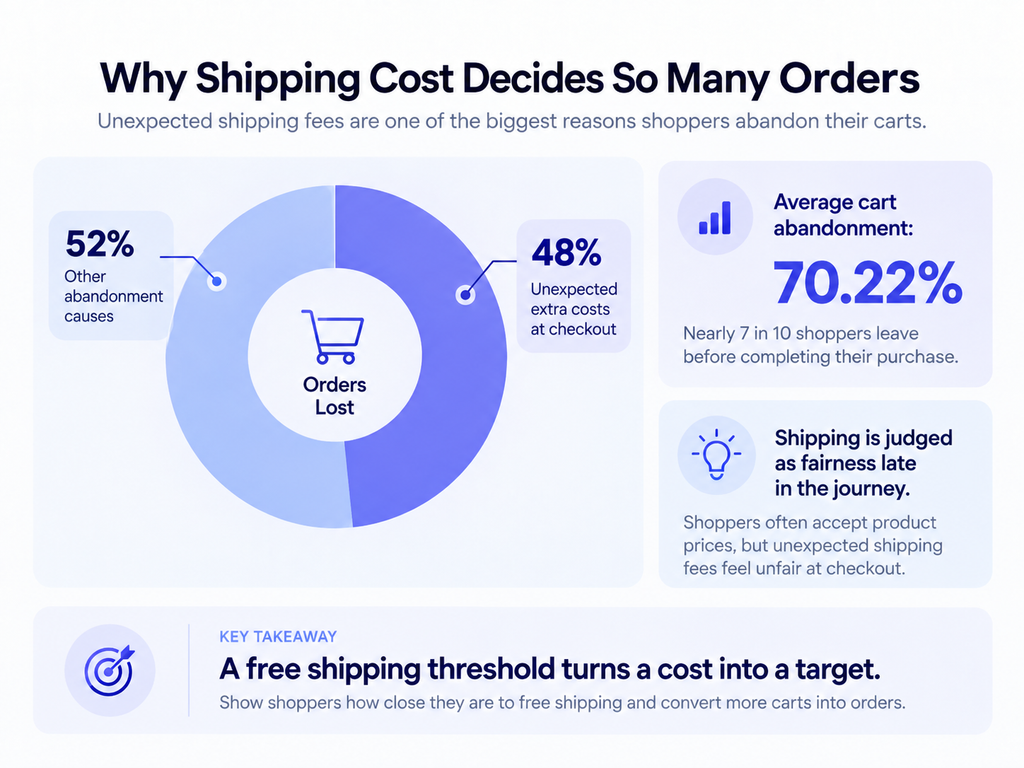
Shipping is not a line item to shoppers. It is a fairness judgment, and it is made late.
Baymard’s meta-analysis of fifty studies puts average cart abandonment at 70.22%, with 48% of abandonments caused by unexpected extra costs at checkout. That is the largest single documented cause, and it is almost entirely about shipping and tax appearing after the shopper has committed emotionally.
A threshold changes the frame. Instead of a cost the shopper resents, it becomes a target they can hit. That reframing is why the mechanism moves order composition rather than order count, and why it shows up in revenue per visitor far more clearly than in conversion rate.
The calculation, done properly
Start with your order value distribution rather than your average. The average hides the shape.
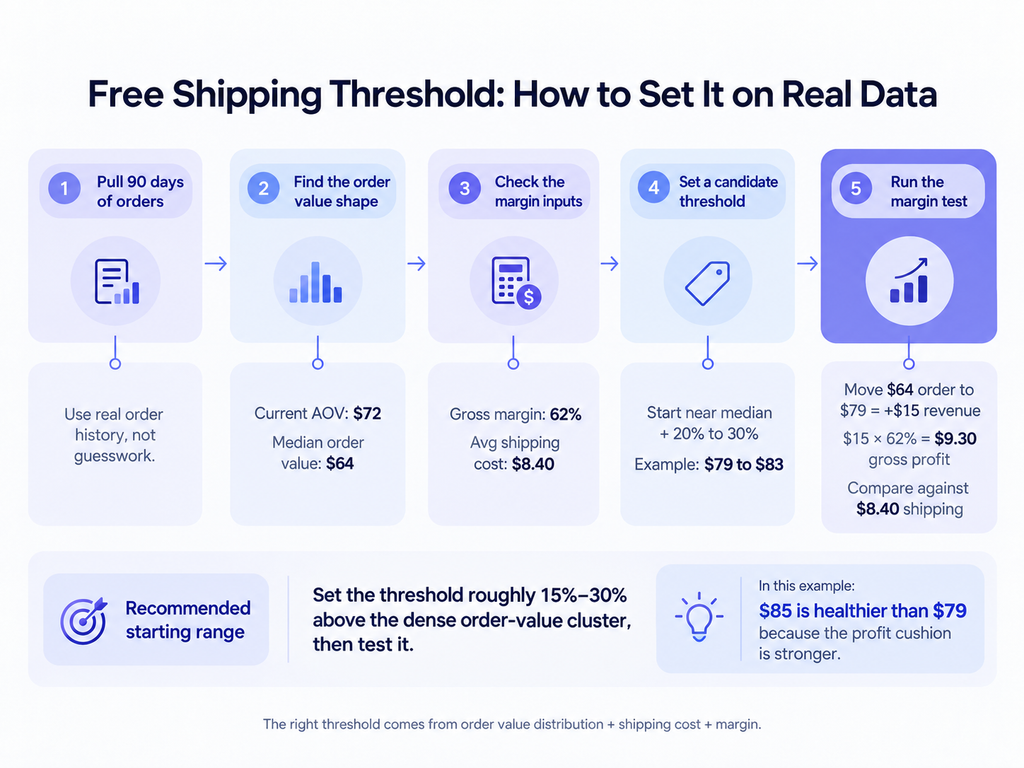
Pull ninety days of orders and bucket them by value. You are looking for where the mass sits and where it thins out. A store with a $60 average might have a dense cluster between $45 and $70 and a long thin tail above $120. The threshold belongs just above the dense cluster, where a shopper needs to add one more item rather than three.
| Input | Where to get it | Example |
|---|---|---|
| Current AOV | Last 90 days, excluding promotions | $72 |
| Median order value | Same data, median not mean | $64 |
| Gross margin % | Finance, not your gut | 62% |
| Average shipping cost | Carrier invoices, not the quoted rate | $8.40 |
| Candidate threshold | Median plus 20 to 30% | $79 to $83 |
Then check it survives the margin test. At a $79 threshold and $8.40 shipping, you need the incremental order value to cover the shipping you just gave away. Moving a $64 order to $79 adds $15 of revenue at 62% margin, or $9.30 of gross profit, against $8.40 of shipping. That is thin. At $85 it works comfortably. Run this before you pick a number.
Why the common rules fail
“Set it 30% above AOV.” The average is skewed by a small number of large orders. Use the median.
“Match your competitor.” Their margin, cost base and product mix are not yours. A brand selling $30 consumables and one selling $200 equipment cannot share a threshold.
“Free shipping on everything.” It converts well and it can quietly destroy margin, because the cost lands on every order including the small ones you least want to subsidise. It shows up nowhere in revenue per visitor and everywhere in contribution margin.
How to test it without losing money
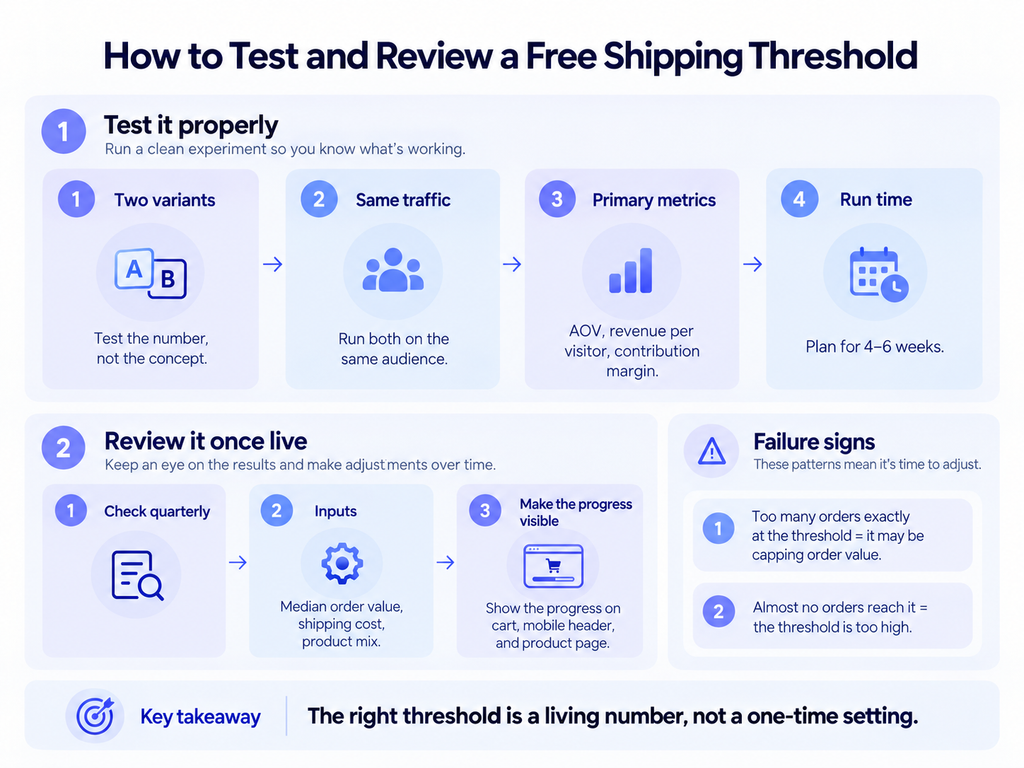
Test the threshold, not the concept. Two variants, one number apart, running on the same traffic.
Expect the effect to appear in average order value and revenue per visitor before it appears in conversion rate, and expect conversion rate to fall slightly in the winning variant. That is normal and it is why the metric choice matters. Winners in DRIP’s experiment data produced a median 1.88% conversion lift against a 2.77% revenue per visitor lift, and threshold tests sit at the extreme end of that divergence.
Report contribution margin alongside both. A threshold test is one of the few changes where the conversion number and the profit number can point in opposite directions for a genuinely good reason.
Give it time. The median test in DRIP’s data ran 42 days, and threshold effects need enough orders to see the distribution shift, not just the headline average.
Make the progress visible
A threshold nobody knows about is a threshold nobody reaches. Put the remaining amount in the cart drawer, in the header on mobile, and on the product page after add-to-cart.
This is where the mobile gap bites. Mobile carries around 78% of ecommerce traffic and converts at roughly two-thirds the desktop rate, and a progress bar that renders below the fold on a phone is doing nothing. Check it on a real device before you call the implementation done.
Three threshold structures, and when each wins
A single flat number is the default and it is not always the right shape.
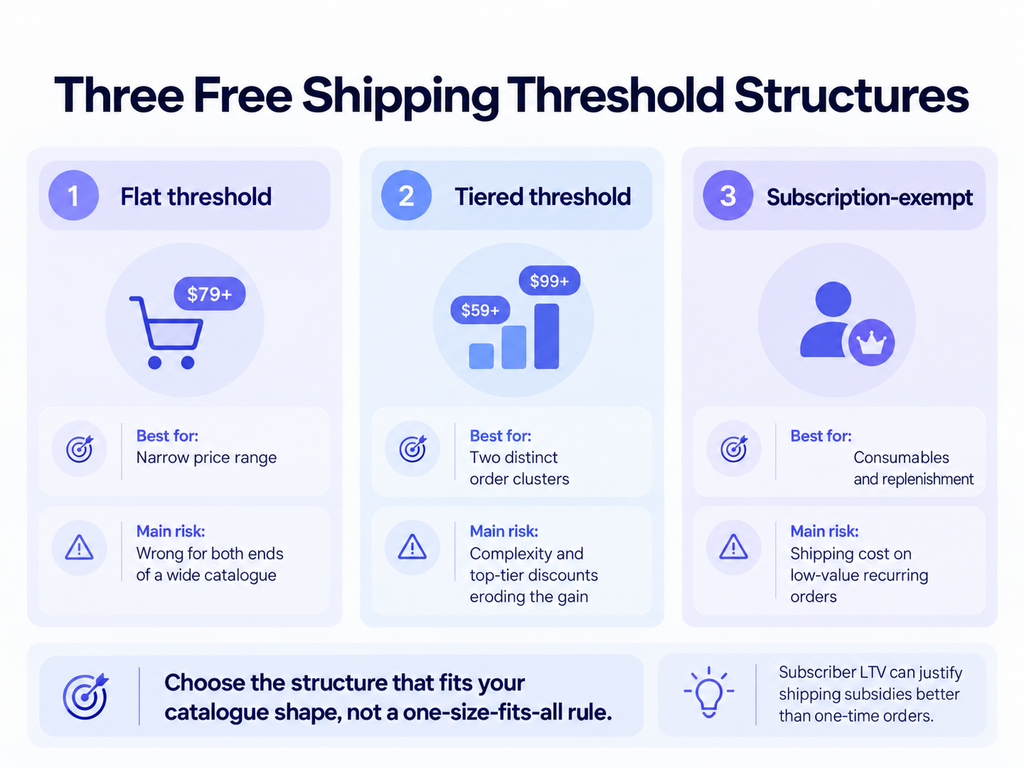
Flat threshold. One number, sitewide. Simple to communicate, simple to build, and it works when your catalogue has a narrow price range. It fails on catalogues spanning $15 accessories and $200 kits, because a threshold that makes sense for one is absurd for the other.
Tiered. Free shipping at one level, an additional incentive higher up. A gift or an upgrade at the second tier rather than a discount, because a discount at the top tier undoes the margin the threshold just created. Tiering works when your order distribution has two clusters rather than one.
Subscription-exempt. Free shipping on every subscription order regardless of value, with a threshold for one-time purchases. This is the strongest structure for consumables, because it prices the behaviour you want rather than the basket size. Subscriber lifetime value runs between $350 and $800 against $168 for one-time buyers, which usually justifies absorbing shipping on the recurring orders outright.
| Structure | Best for | Main risk |
|---|---|---|
| Flat | Narrow price range | Wrong for both ends of a wide catalogue |
| Tiered | Two distinct order clusters | Complexity, and top-tier discounts eroding the gain |
| Subscription-exempt | Consumables and replenishment | Shipping cost on low-value recurring orders |
What to do when the maths does not work
Sometimes the calculation says no threshold clears your margin. That is a genuine result and it points somewhere useful.
It usually means your average order contains too few items, which is a bundling problem rather than a shipping one. Build the bundle first, watch the distribution move, then set the threshold against the new shape.
The alternative failure is that shipping simply costs too much relative to price. Renegotiating carrier rates or changing packaging is unglamorous and it is the actual fix. No threshold structure rescues a business shipping a $22 product for $9.
What this was worth
At a DTC supplements brand we work with, a single shipping threshold test produced two million dollars in profit.
It is worth being precise about why, because the number on its own is not instructive. The test did not increase how many people bought. It moved order composition, so a large share of orders that would have landed just below the threshold landed just above it instead. On a high-margin consumable, that difference compounds across every order for as long as the threshold stays in place.
That is the general lesson. Threshold work is not interface polish. It is offer design, and offer design produces effects large enough to see clearly even at modest traffic levels.
Not sure where your threshold should sit? The CRO Program audit includes the order value distribution work above before any test gets designed.
Reviewing it once it is live
A threshold is not a set-and-forget decision. It decays as your catalogue and costs move.
Review it quarterly against three inputs: your current median order value, your current average shipping cost, and your product mix. A threshold set when your median was $64 is wrong once the median reaches $78, and it will be silently wrong for months before anyone notices, because the number still looks deliberate.
Watch for the two failure signatures. If a large share of orders land exactly at the threshold and almost none above it, the threshold is capping order value rather than lifting it, and the next tier is worth testing. If almost no orders reach it at all, it is set too high and is functioning as a shipping charge with extra steps.
The quarterly review takes twenty minutes and it is the difference between a threshold that keeps working and one that quietly stops.
One last check before you commit to a number. Model it against your worst-case basket, not your average one. If a customer can reach the threshold with your lowest-margin products, some will, and the threshold will be subsidising exactly the orders you least want to grow. If that scenario is realistic on your catalogue, exclude those products from counting toward the threshold and say so plainly on the page.
Frequently asked questions
What is a good free shipping threshold?
Roughly 15% to 30% above your median order value, adjusted so the incremental gross profit exceeds your average shipping cost. There is no universal number, because the calculation depends on your margin.
Does free shipping increase conversion rate?
Usually yes, and it can still lose money. Unconditional free shipping subsidises every order including small ones. A threshold captures most of the conversion benefit while shifting order value upward.
Should the threshold change during peak season?
Often yes. Shopify’s average BFCM cart was $114.70 against $85 annually, so a threshold set for normal trading may sit below what shoppers would spend anyway during peak.
How long should a threshold test run?
Long enough to see the order value distribution shift, which is usually longer than a conversion test. Plan for four to six weeks and decide the sample size before launch.
Next step: Ecommerce CRO sets out how offer structure, checkout and post-purchase get tested as one sequence.