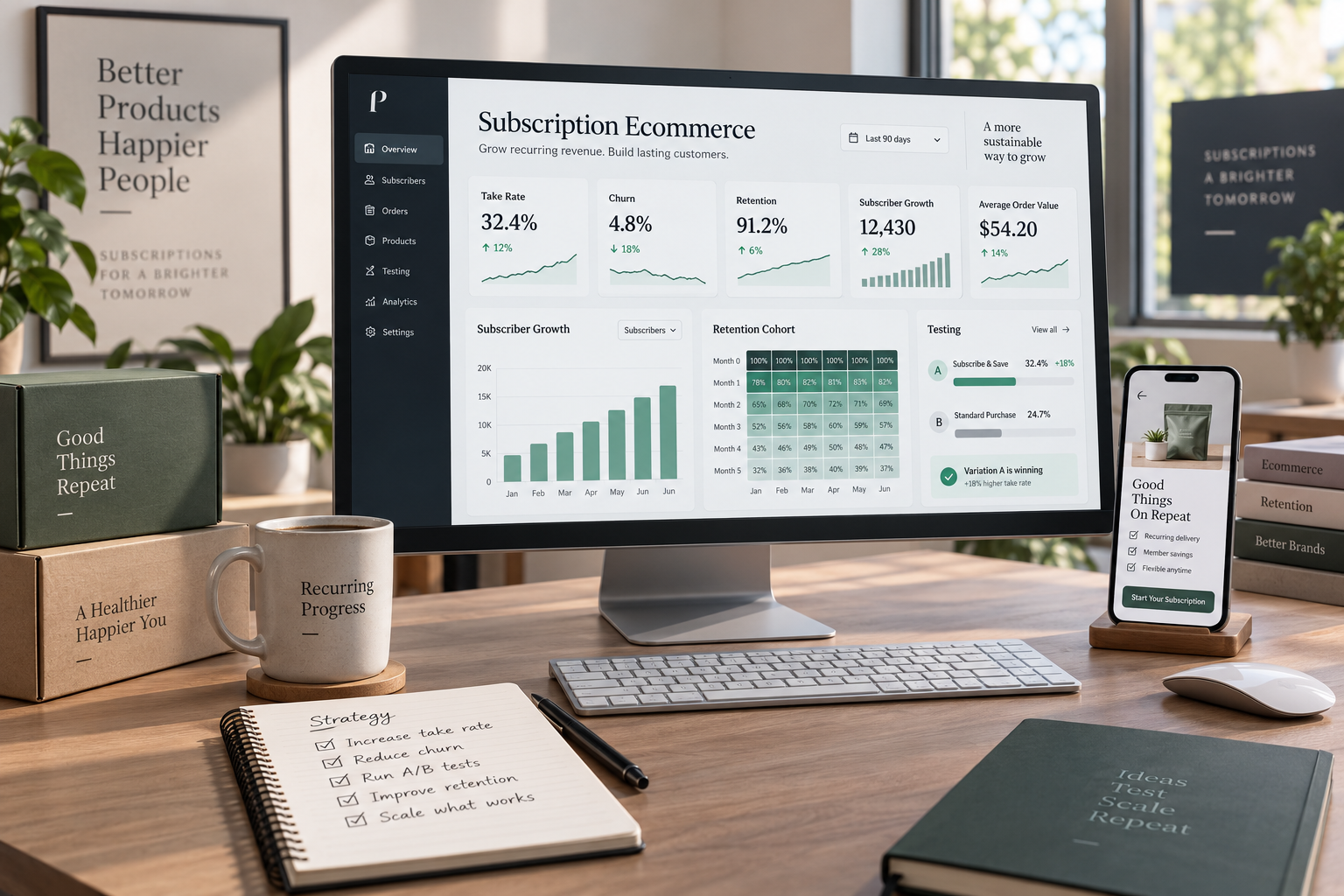
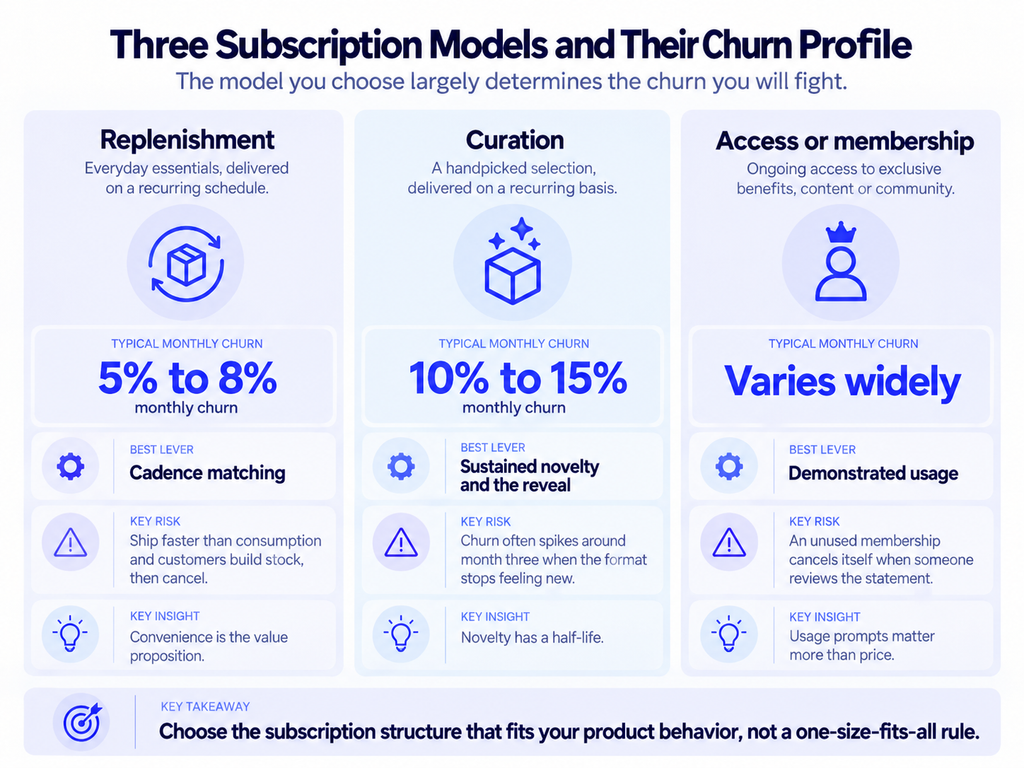
Subscription ecommerce lives or dies on two numbers: take rate, the share of buyers who choose the subscription, and churn, the share who leave each month. Most brands obsess over the first and never measure the second properly. A 60% take rate with 15% monthly churn is worth less than a 30% take rate with 6%.
The benchmarks worth measuring against
Subscription commerce on Shopify has grown roughly 35% year over year, with subscriber lifetime value between $350 and $800 against $168 for one-time buyers. That LTV gap is the entire commercial case, and it is also why brands overestimate how easily it is captured.
Churn is the constraint. Monthly churn averages 7% to 12%, with replenishment models lowest at 5% to 8%. At 10% monthly churn the median subscriber lasts under a year, which changes the payback maths on acquisition considerably.
Baseline conversion is lower for subscription businesses too. Across 1,055 audited tests, ConversionTeam found median conversion of 3.6% for subscription against 4.7% for standard ecommerce. Asking for a recurring commitment costs you conversion at the moment of purchase, which you recover over the customer lifetime rather than at checkout.
| Metric | Typical range | What to worry about |
|---|---|---|
| Take rate at checkout | 15% to 35% | Under 15% means the offer is not being seen or not compelling |
| Monthly churn | 7% to 12% | Above 12% means the product cadence is wrong |
| Replenishment churn | 5% to 8% | The easiest model to run well |
| Subscriber LTV | $350 to $800+ | Against $168 for one-time buyers |
| Second billing survival | The number that matters | Most cancellations happen here |
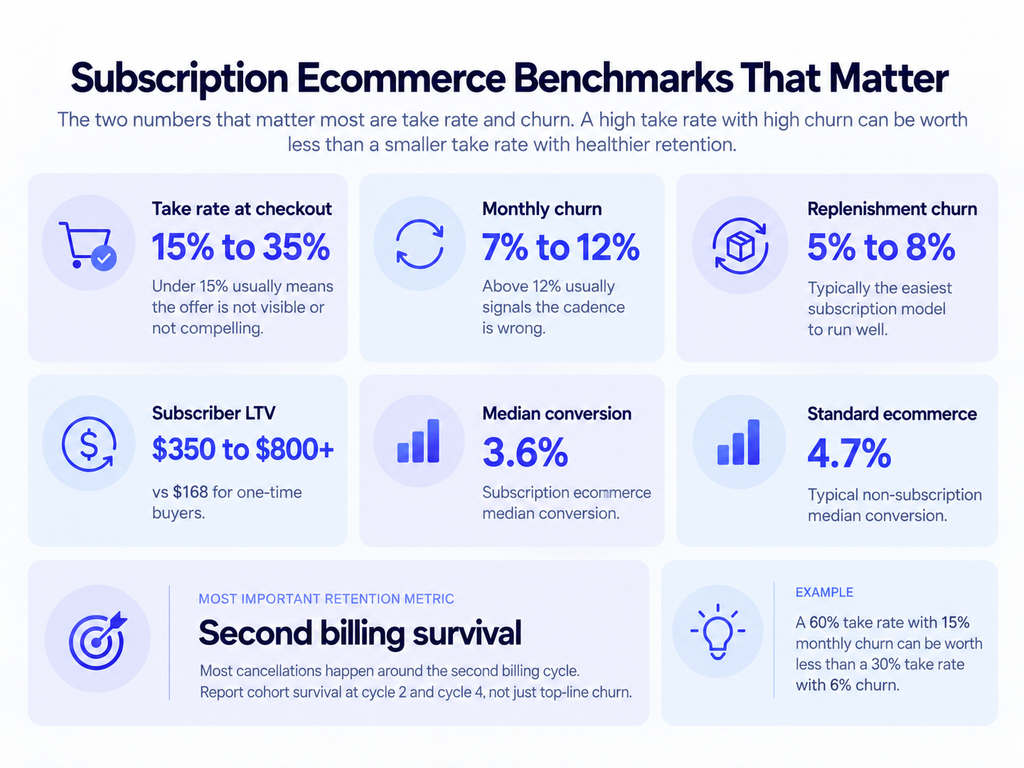
Where take rate is actually decided
Not on a landing page. In a few seconds of interface at the point of purchase.
The default selection. Whether subscribe or one-time is pre-selected is the single highest-impact variable most brands never test. It is also the one with the clearest ethical line: pre-selecting subscription is legitimate, hiding the one-time option is not.
The saving, expressed properly. “Save 15%” and “Save $4.50 per delivery” perform differently, and which one wins depends on price point.
Cadence choice. Too many options paralyse. Too few and the cadence does not match how the customer actually uses the product. Start with three and test the middle one.
Cancellation clarity. Counter-intuitively, making cancellation obviously easy raises take rate. The friction people fear is being trapped, not being billed.
The post-purchase offer. For customers who chose one-time, the confirmation screen is a second chance that costs you nothing, because the order is already banked.
Where churn is actually decided
The second billing cycle. This is where the majority of cancellations land. The customer has now paid twice and is evaluating whether the cadence matches consumption. If you ship a 30-day supply on a 30-day cycle, any customer who misses a few days accumulates stock and cancels.
Skip and pause. Flexible skip or pause functionality reduces churn by 25% to 35%. Brands resist it because it looks like revenue deferred. It is churn prevented.
Failed payments. A meaningful share of what brands record as churn is expired cards. Dunning is unglamorous and it recovers real money.
The first thirty days. Onboarding communication after the first delivery predicts the second billing outcome more than anything on the product page.
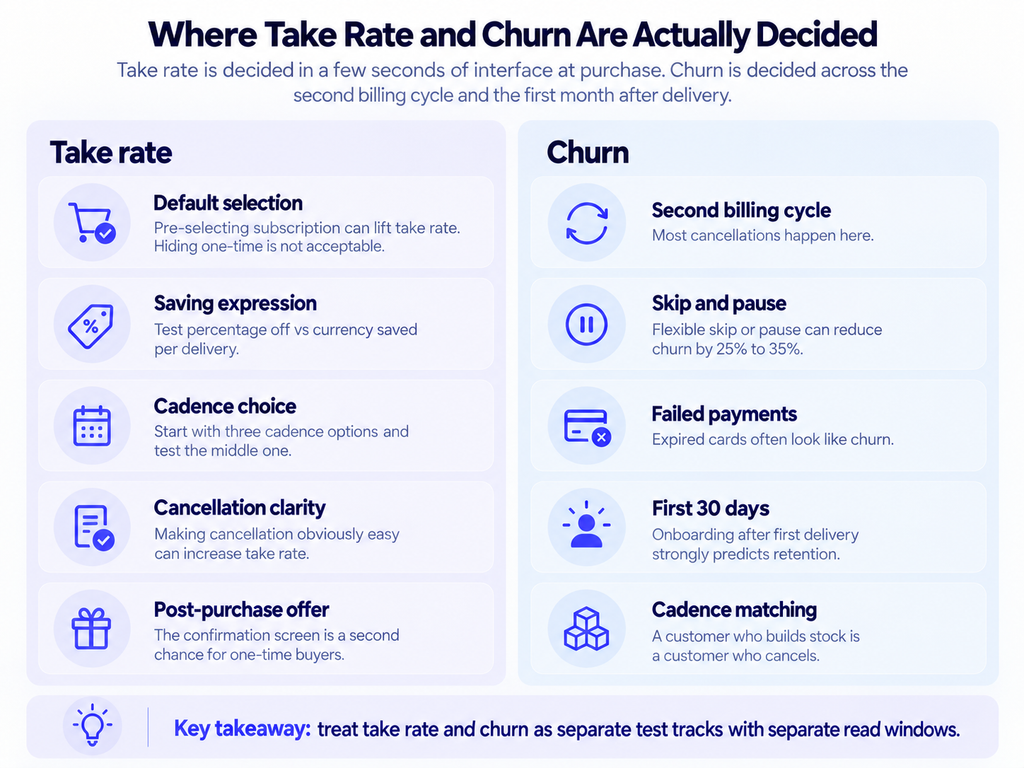
The three models, and the churn profile each carries
Not all subscriptions behave alike, and the model you chose largely determines the churn you will fight.
Replenishment. The customer buys the same consumable repeatedly. Lowest churn of the three at 5% to 8% monthly, because the value proposition is convenience rather than discovery. The failure mode is cadence: ship faster than consumption and the customer accumulates stock and cancels. Almost every replenishment churn problem is a cadence problem wearing a pricing costume.
Curation. A changing selection each period. Higher churn, because the customer is buying novelty and novelty has a half-life. The retention lever is the reveal, not the discount, and the churn cliff usually arrives at month three when the format stops being new.
Access or membership. Recurring benefits rather than recurring goods. Churn depends entirely on whether the benefit is used. An unused membership cancels itself the first month somebody reviews their statement, so usage prompts matter more than price.
| Model | Monthly churn | Dominant lever |
|---|---|---|
| Replenishment | 5% to 8% | Cadence matching |
| Curation | 10% to 15% | Sustained novelty and the reveal |
| Access | Varies widely | Demonstrated usage |
The number nobody reports and everybody needs
Take rate and churn get measured. The metric that actually predicts whether the programme is working is survival past the second billing cycle.
The first billing is the purchase. The second is the decision. A subscriber who reaches the third charge behaves entirely differently from one who has been billed once, and averaging them into a single churn figure hides the transition where almost all the damage happens.
Report it as a cohort: of the subscribers acquired in a given month, what share are still active at cycle two, and at cycle four. Two cohorts in and the shape of the curve tells you whether a take-rate win was real or whether you simply pulled forward cancellations.
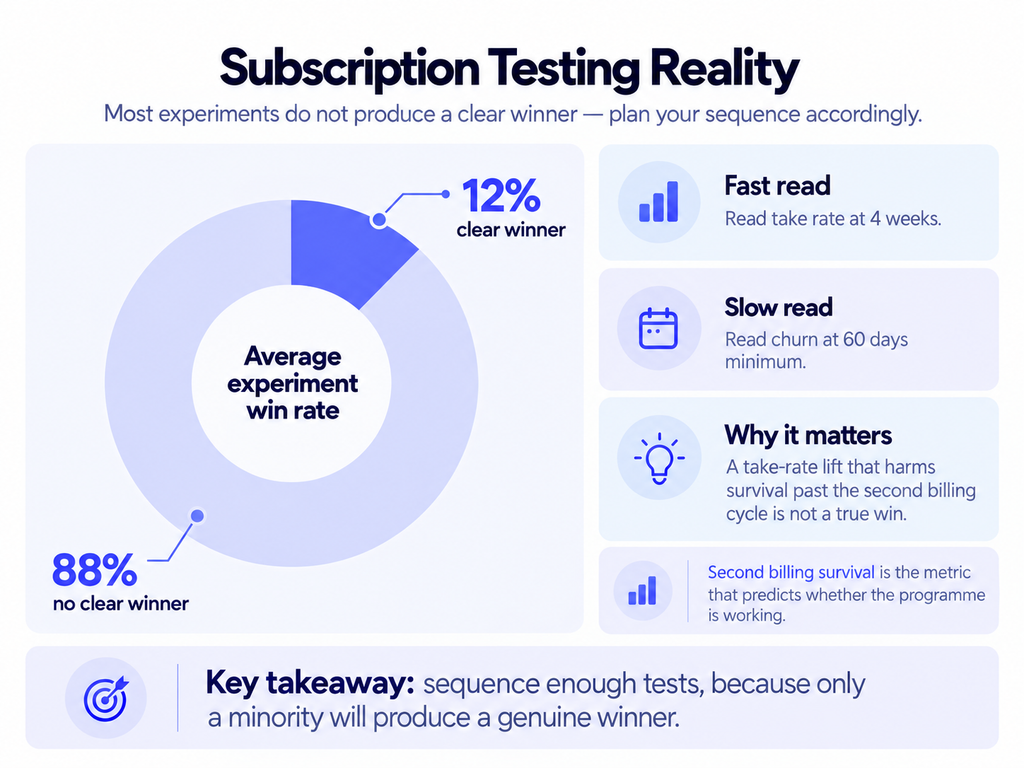
This also changes how you judge tests. A default-selection test that lifts take rate by fifteen points and drops cycle-two survival by twenty is a loss, and you cannot see it in any measurement window shorter than sixty days.
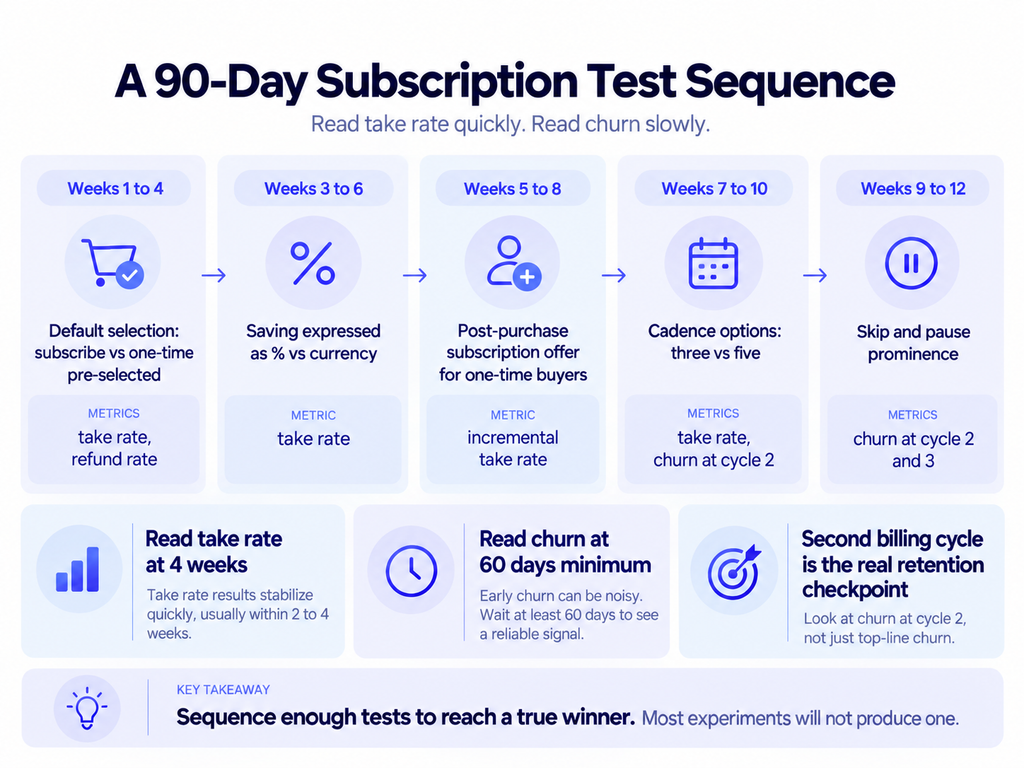
A 90-day test sequence
| Weeks | Test | Metric |
|---|---|---|
| 1 to 4 | Default selection, subscribe vs one-time pre-selected | Take rate, refund rate |
| 3 to 6 | Saving expressed as % vs currency | Take rate |
| 5 to 8 | Post-purchase subscription offer for one-time buyers | Incremental take rate |
| 7 to 10 | Cadence options, three vs five | Take rate, churn at cycle 2 |
| 9 to 12 | Skip and pause prominence | Churn at cycle 2 and 3 |
Read take rate at four weeks. Read churn at sixty days minimum, because a fourteen-day read tells you nothing about the billing cycle that actually decides it. Most tests will not produce a winner: Optimizely’s analysis of over 127,000 experiments puts the average win rate near 12%, so sequence enough of them to reach one.
What a full sequence produced
At a supplements brand we work with, subscription take rate moved from 25% to between 55 and 60% over six months, roughly tripling the subscriber base.
Two things are worth extracting from that. The timeline was six months, not six weeks, because churn tests cannot be read faster than the billing cycle allows. And the gains came from offer structure and post-purchase flow rather than from any redesign of the product page. The subscription decision is made in a small amount of interface, and testing that small amount repeatedly is what moves it.
A cannabis DTC brand we worked with reached 75% growth in subscription take rate inside three months, alongside 25% on average order value and 20% on conversion, while paid spend was scaling underneath.
Running subscriptions without a testing programme? The CRO Program treats take rate and churn as separate test tracks with separate read windows.
Where to start if you have no subscription yet
Do not launch with a discount as the entire proposition. A percentage off is the easiest offer to build and the easiest for a customer to leave, because nothing except price is holding them.
Start with cadence. Work out how fast customers actually consume the product, from reorder intervals in your own order data rather than from the label. Set the default cycle to that interval, then offer skip and pause prominently from day one rather than adding them later when churn forces the issue.
Then add one non-price benefit. Early access, a member price on the rest of the range, or free shipping on every subscription order. Something that makes leaving cost more than the discount.
Launch it as a post-purchase offer before you put it at checkout. It cannot cost you the first order, it gives you a take-rate baseline, and it tells you whether the proposition works before you spend anything on checkout development.
Frequently asked questions
What is a good subscription take rate?
Between 15% and 35% of buyers at checkout is a normal range. Under 15% usually means the offer is not visible enough at the decision point rather than that customers do not want it.
What is a normal churn rate for ecommerce subscriptions?
Monthly churn averages 7% to 12%, with replenishment models at the low end around 5% to 8%. Anything consistently above 12% usually points at a cadence mismatch rather than a pricing problem.
Does subscription hurt my conversion rate?
Slightly, yes. Subscription businesses show a median conversion of 3.6% against 4.7% for standard ecommerce. You recover it across the customer lifetime, where subscriber LTV runs several times higher than one-time buyers.
When should I measure the result of a subscription test?
Take rate at four weeks. Churn at sixty days minimum, so the second billing cycle is included. The second cycle is where most cancellations happen.
Next step: Shopify CRO covers how subscription, post-purchase and checkout tests get sequenced on a Shopify store.