
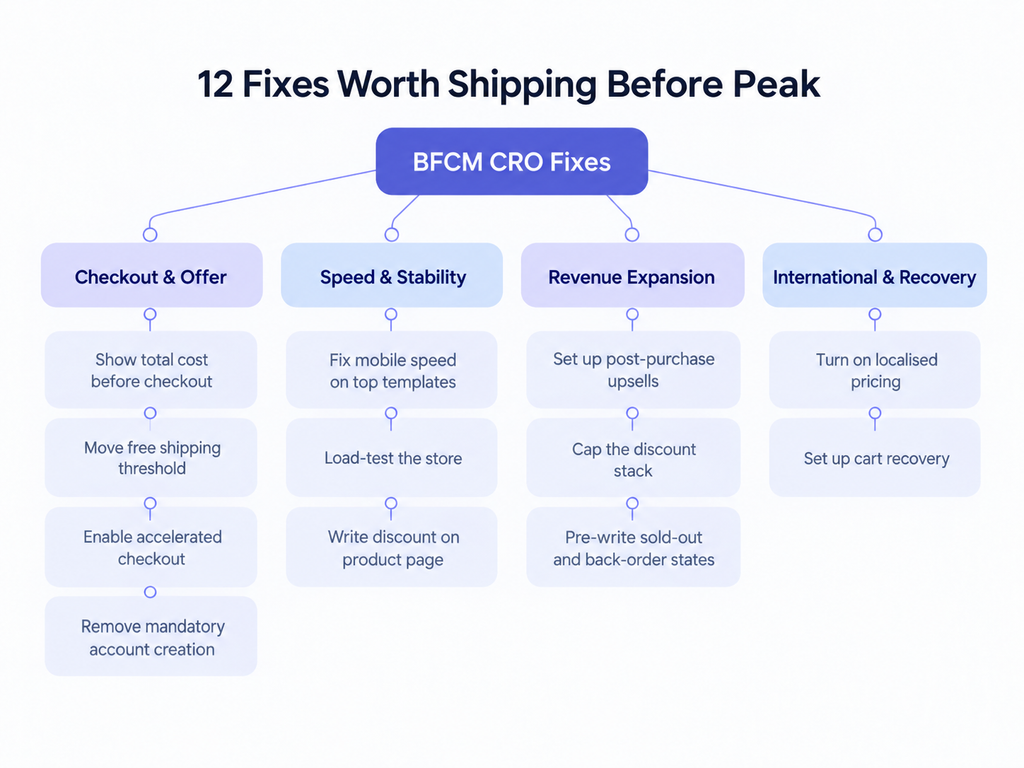
Stop shipping new tests around 7 November. Anything launched after that will not reach significance before peak, and a half-read test running through Black Friday is worse than no test at all. Between now and then, twelve fixes are worth the time. Four popular ones are not.
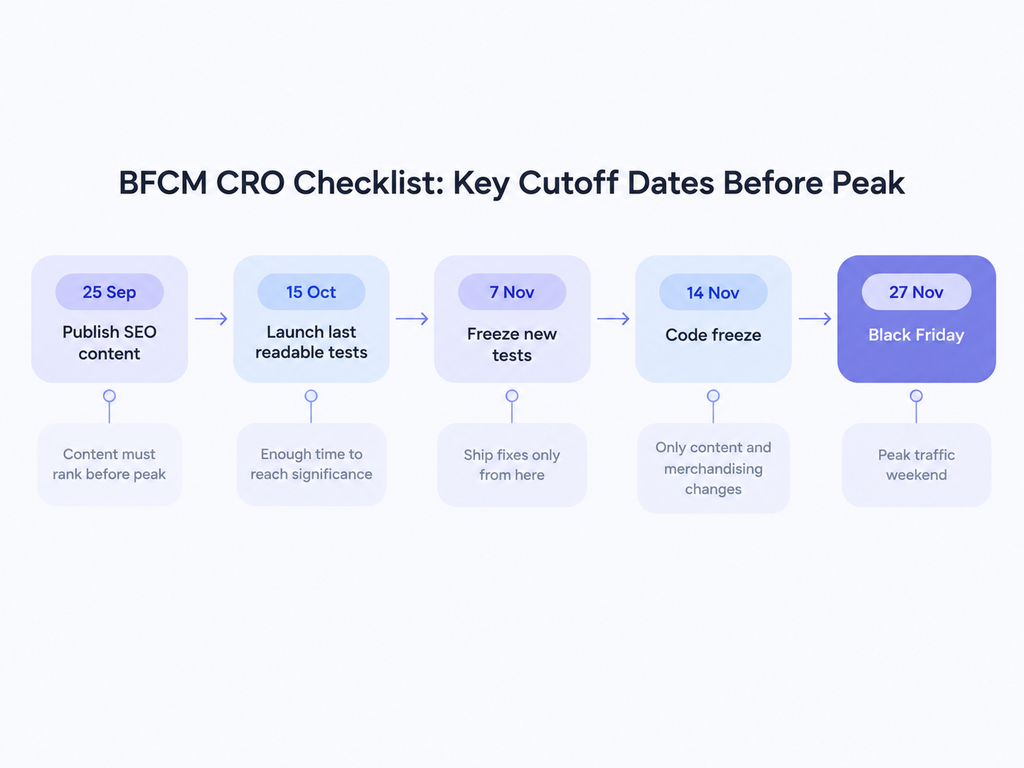
The cutoff dates that govern everything else
Work backwards from the weekend. Black Friday 2026 falls on 27 November.
Test results need time. Across DRIP’s experiment database the median test ran 42 days, and benchmarks collected by roast.page put the median nearer 23 days. Take the optimistic figure and a test launched in mid-November still reads out in December.
| Date | What closes |
|---|---|
| 25 September | Last date to publish content that needs to rank for peak |
| 15 October | Last date to launch a test you intend to read before BFCM |
| 7 November | Hard freeze on new tests. Ship fixes only. |
| 14 November | Code freeze. Nothing but content and merchandising changes. |
| 27 November | Black Friday |
The 7 November freeze is the one teams break and regret. A test running at 50/50 through the highest-traffic weekend of the year means half your peak traffic saw the variant you were not confident enough to ship.
The twelve fixes, ranked by return
- Put total cost on the page before checkout. The single largest documented cause of abandonment. Baymard’s meta-analysis of fifty studies attributes 48% of abandonments to unexpected extra costs at checkout. During peak, when shoppers are comparing across five tabs, the surprise is fatal rather than annoying.
- Set or move your free shipping threshold. Shopify’s average cart during BFCM 2025 was $114.70, against an $85 annual average. If your threshold sits below your peak AOV, you are giving away shipping on orders that would have cleared it anyway.
- Enable accelerated checkout. Shop Pay usage jumped 58% year over year during BFCM, and analysis of Shopify data puts the conversion improvement at up to 50% against guest checkout, and 91% on mobile. This is a toggle, not a project.
- Remove mandatory account creation. Another 19% of abandonments in Baymard’s data. Guest checkout with an account prompt after payment gets you both.
- Fix mobile page speed on your top three templates. Mobile takes 76% of BFCM traffic but only 69% of orders, converting at 3.1% against 4.8% on desktop. Google and Deloitte’s study of 30 million mobile sessions associated a 0.1 second load improvement with an 8.4% rise in retail conversion.
- Load-test the store. Shopify’s network peaked at $5.1 million per minute during BFCM 2025. Your share of that arrives in about ninety minutes. Audit your apps and remove anything you are not actively using.
- Write the discount into the product page, not just the cart. The most common BFCM discount tier is 20% off, used by 31% of stores. If yours is only visible at checkout, you are competing on an offer the shopper never saw.
- Set up post-purchase upsells. They cannot cost you the order you just took, which makes them the only genuinely asymmetric change on this list. Our own accounts run around 10% added to average order value from post-purchase offers, and the mechanism does not care what week it is.
- Cap the discount stack. Decide now whether codes combine with automatic discounts. Finding out on Friday morning is expensive.
- Pre-write the sold-out and back-order states. Peak is when these fire. Most stores have never seen their own out-of-stock experience.
- Turn on localised pricing for the US, UK, Australia, Germany and Canada. 16% of Shopify BFCM orders were cross-border in 2025.
- Set up cart recovery before the weekend, not during it. Bounce rate actually falls during BFCM, to 42% against a 55% ecommerce average, so the traffic is more engaged than usual. Recovering it is worth more than usual too.
The four things to leave alone
A site redesign. Obvious, and brands still attempt it in October. A redesign changes hundreds of variables with no way to read which one moved revenue.
A new checkout app. Anything touching payment goes in during a quiet month, not this one.
Deep discounting to match competitors. Only 8% of stores go past 40% off. Matching the loudest brand in your category usually means matching a business with a different cost base.
A test you cannot read. If it will not reach sample size by 20 November, it is not a test, it is an unvalidated change shipped to peak traffic.
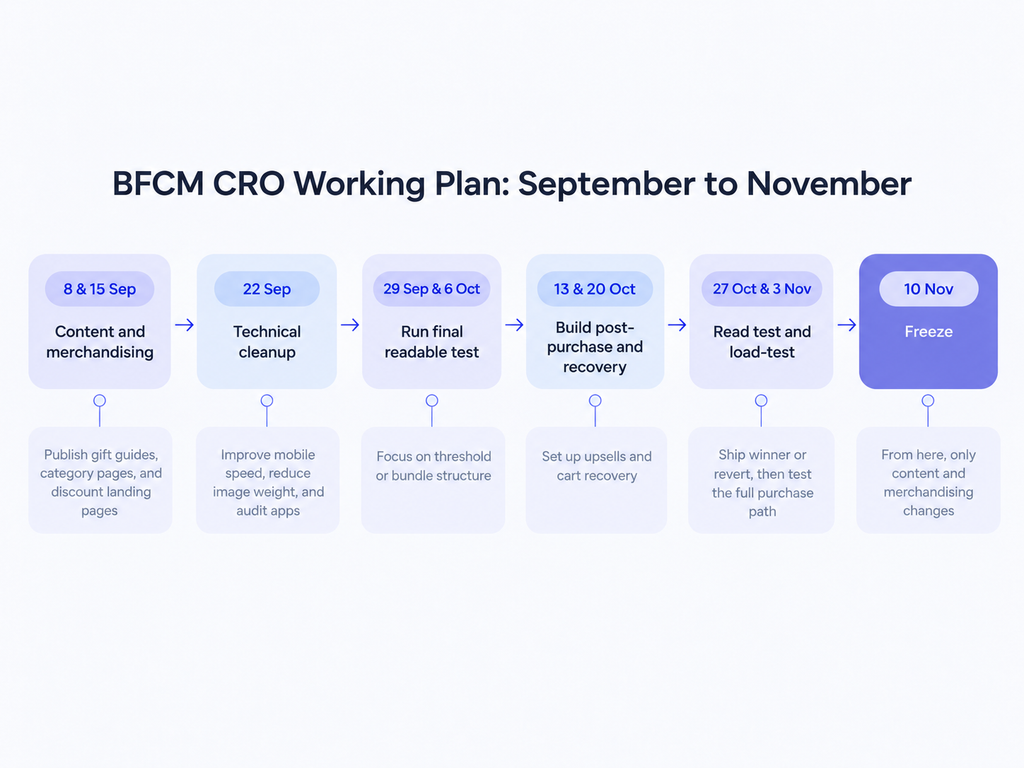
A four-week working plan
Weeks are the right unit here, because the constraint is calendar rather than capacity.
Weeks of 8 and 15 September. Content and merchandising. Anything that needs to rank has to publish by 25 September, so gift guides, category pages and the discount landing page go up now. Set the free shipping threshold and write the discount into product pages. Neither needs a test to justify, because both are offer decisions with known mechanisms.
Week of 22 September. Technical. Mobile speed on the top three templates, image weight, and an app audit. Remove anything not actively earning its place, because every script is a tax paid on the highest-traffic weekend of the year. Only around 42% of mobile sites pass all three Core Web Vitals, and peak is when that gap costs the most.
Weeks of 29 September and 6 October. The last window for tests you intend to read. One test, not three, on the highest-traffic template. Threshold or bundle structure is the best use of the slot because the effect is large enough to detect quickly.
Weeks of 13 and 20 October. Post-purchase and cart recovery build. Neither needs testing to ship, and both are additive.
Weeks of 27 October and 3 November. Read the test. Ship the winner or revert. Then load-test and walk the full purchase path on a real phone, on mobile data, with a full basket.
Week of 10 November. Freeze. Content and merchandising only from here.
What breaks on the day, and the rollback plan
Something will. Decide in advance who calls it and what they revert to.
The three failures that recur every year:
The discount does not stack the way anyone expected. Codes combine with automatic discounts and margin disappears, or they refuse to combine and support drowns. Test every combination in a staging environment before November, and write down the intended behaviour so the person watching at 6am knows what wrong looks like.
An app takes the site down under load. Shopify’s network peaked at $5.1 million per minute during BFCM 2025 while processing 2.2 trillion edge requests. Your infrastructure is fine. The seventh app you installed in 2024 and forgot about may not be. Know which apps can be disabled without breaking checkout, and have that list written down rather than in someone’s head.
Inventory runs out and the page does not say so. Peak is when out-of-stock states fire, and most brands have never seen their own. Walk it before the weekend.
The rollback rule is worth stating plainly because nobody wants to make this decision at speed: one named person can revert any change without a meeting, and the default action on any doubt is to revert rather than debug. A store running last week’s configuration profitably beats a store being fixed live during the highest-traffic hours of the year.
What one shipping change was worth
The largest single result we have measured came from this category. At a DTC supplements brand, a shipping threshold test produced two million dollars in profit. It did not change how many people bought. It changed what they put in the basket, which is exactly the mechanism that peak amplifies.
That is the argument for spending your remaining weeks on offer structure rather than interface polish. Order composition changes are large enough to see in a short window. Button changes are not.
Running peak without a testing programme? The CRO Program starts with an audit of exactly these twelve items against your live store.
What to do the week after
The weekend generates the best dataset you will get all year, and most brands close the laptop and lose it.
Before the traffic decays, record five things. Conversion by device, so you have a clean peak-versus-normal comparison. Average order value against your threshold, which tells you whether the threshold was set correctly. Post-purchase upsell take rate. The top five products by revenue, not by units. And every support ticket theme, because peak volume surfaces friction that normal trading hides.
That last one is the most valuable and the least collected. A hundred tickets in four days is more customer research than most brands gather in a quarter, and the themes point directly at January’s test roadmap.
Then resume testing in the first week of December. December traffic is still elevated and still buying, and the freeze that protected peak has no reason to extend past it. Brands that restart in January give up a month of unusually good sample sizes.
One caution on reading peak data. Conversion during BFCM runs far above baseline, with average Black Friday conversion reaching 5.86% against an annual ecommerce average near 2.8%. Do not benchmark your normal trading against your peak numbers, and do not assume a change that worked under peak intent will work in February. Discount-driven urgency does a lot of work in those figures that your product page will not do alone in the new year.
One more note on the freeze. It applies to tests, not to fixes. If something is visibly broken on 20 November you fix it, because a broken checkout is not a variable you are protecting, it is revenue leaving. The freeze exists to stop optimism, not to stop maintenance, and the distinction is worth stating to whoever is watching the store that week.
Frequently asked questions
When should I stop testing before Black Friday?
Around 7 November. Tests need weeks to read, and a test running through peak splits your highest-value traffic between a control and a variant you were not confident enough to ship.
Should I raise my free shipping threshold for BFCM?
Usually yes, if it currently sits below your peak average order value. Shopify’s BFCM average cart was $114.70 against $85 annually, so a threshold set for normal trading is often below what shoppers would have spent anyway.
Is mobile or desktop more important during BFCM?
Mobile carries more traffic and converts worse. In 2025 it took 76% of BFCM traffic and 69% of orders, at 3.1% conversion against 4.8% on desktop. Mobile speed work has the highest return of any technical fix in the final weeks.
How deep should my discount be?
The most common tier is 20% off, used by roughly a third of stores. Only 8% go beyond 40%. Depth is a margin decision, not a conversion decision, and threshold or bundle offers often move revenue per visitor further than a bigger percentage.
Next step: Ecommerce CRO covers how the offer, checkout and post-purchase layers get tested as one programme rather than as a seasonal scramble.