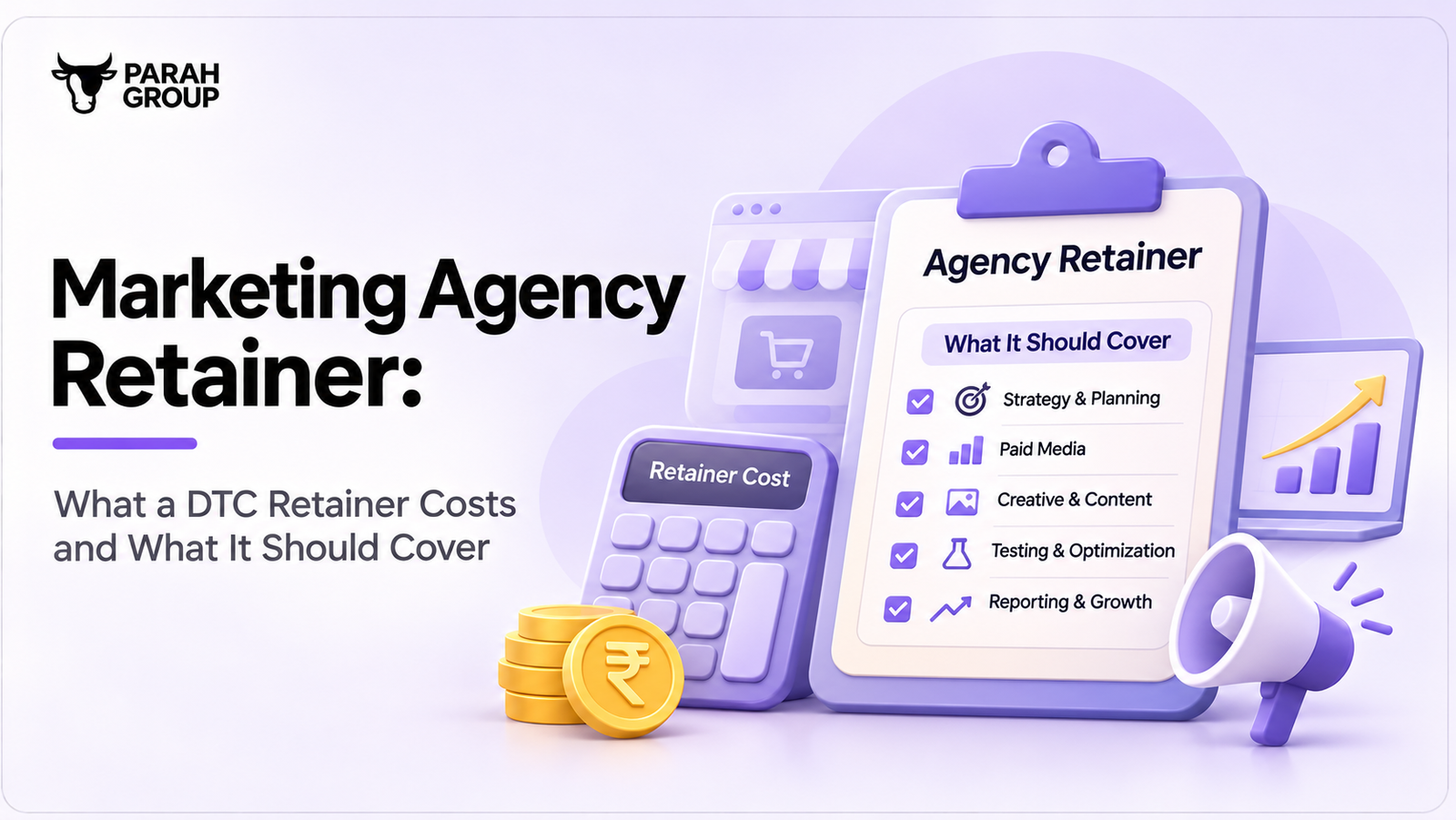
A marketing agency retainer is a fixed monthly fee for an agreed scope of ongoing work. Agencies on Clutch put digital marketing at $5,000 to $50,000 a month, and US agencies most often bill $100 to $149 an hour. The right retainer is the one whose scope, owner and success number are written down before you sign.
What a marketing agency retainer is, and what it is not
A retainer buys capacity and continuity. You pay the same fee each month, and the agency commits a team to an agreed scope: running paid social, producing creative, building landing pages, testing, reporting, or some mix. It suits work that never really finishes, which describes most of what a growing DTC brand needs.
| Pricing model | How it works | Best for | Watch for |
|---|---|---|---|
| Monthly retainer | Fixed fee for a defined scope | Ongoing paid media, creative and testing | Vague scope that shrinks over time |
| Project fee | One price for one deliverable | A site rebuild, a landing page, an audit | Nobody owns results after handover |
| Percentage of ad spend | Fee scales with your budget | Large, stable media budgets | Rewards spending more, not spending better |
| Performance or hybrid | Base fee plus a bonus tied to results | Mature accounts with clean attribution | Arguments over which result the agency caused |
A retainer is not a block of hours to draw down whenever you like. Agencies that sell it that way tend to report on hours used rather than outcomes. It is also not a promise of results; it is a promise of work. The scope document is what turns that work into something you can hold the agency to.
How much a marketing agency retainer costs in 2026
Clutch’s pricing data, built from more than 100,000 listed agencies and updated in September 2026, gives the clearest public range. It shows digital marketing pricing between $5,000 and $50,000 a month, US agencies most often billing $100 to $149 an hour, and reviewed projects most often between $10,000 and $49,999. Ad spend is always extra.
Where you land in that range depends on three things. The first is how many channels the agency runs: Meta alone costs less than Meta, TikTok and Google together. The second is whether creative is included. A retainer that covers new ad concepts and landing pages every month costs more than one that only manages campaigns, and it is usually worth more. The third is seniority: who actually works on your account, and for how many hours.
For channel-specific numbers, our breakdowns of Facebook ads agency pricing and conversion rate optimization pricing show what each service tends to cost on its own. Treat any quote far below Clutch’s range with care: at $100 to $149 an hour, a $2,000 monthly fee buys roughly 13 to 20 hours of work, which is thin for an account that needs new creative every week.
What a DTC retainer should include
Price only makes sense against scope. Before you compare two quotes, get both written in the same format and check each one covers these:
- Channels and budget range: which platforms, and the ad spend range the fee assumes.
- Creative volume: how many new ad concepts each month, and who sources and briefs creators.
- Landing pages: whether new pages are included, how many, and how fast they ship.
- Testing: how many tests a month your traffic supports, and how losing tests are reported.
- Reporting: one weekly number both sides agree on, such as cost per new customer or contribution margin.
- People: who runs the account day to day, and how much senior time you get.
The landing page line is where many retainers fall short. A media buyer who cannot change the page the click lands on will keep adjusting audiences while the real problem sits on the page. If pages are excluded, budget for them separately; our guide to landing page costs sets out the range. The same goes for creative: if new ad concepts are not in the fee, ask what each one costs and how many your account needs each month.
Retainer or in-house hire: the real comparison
A retainer looks expensive next to a salary until you price the salary properly. The US Bureau of Labor Statistics put the median annual wage for marketing managers at $166,790 in May 2025, which is roughly $13,900 a month before benefits, recruiting, tools and management time. Add those costs, then a designer and a developer to build what the marketer plans, and the gap with a mid-range retainer narrows fast.
That buys one person. A DTC brand usually needs several skills at once: media buying, creative strategy, design, copy, landing page development and analytics. One hire rarely covers more than two of them well. A retainer spreads those skills across a team you share with other clients, which is why it is usually cheaper at lower spend and why the maths flips once spend is large and stable enough to keep a specialist busy every day.
Many brands end up with a hybrid: an in-house owner who knows the business, with an agency supplying execution. We set out the trade-offs in our comparison of in-house vs agency for paid social.
Why the fee model changes the agency’s behaviour
Every fee model rewards something. A percentage of ad spend rewards a bigger budget, whether or not the extra spend is profitable. A flat retainer rewards efficiency, but only if the scope is clear enough that the agency cannot quietly do less. Performance fees sound fairest and create the most arguments.
The trouble with paying only for wins is that most ideas do not win. Kohavi and Thomke reported in Harvard Business Review that only about a third of ideas tested at Microsoft improved the metric they were designed to improve. A fee that depends on most tests winning pushes an agency to call winners early or to skip the research and tracking work that earns nothing directly. That is not a reason to avoid performance pay entirely, only to keep it small next to a fixed base.
Cost pressure makes the model matter more than it used to. Meta’s third-quarter 2026 results showed average price per ad up 14% year over year. When media costs more each quarter, an agency paid on spend benefits from the rise. One paid a flat fee is the one with a reason to make each dollar work harder.
Contract terms to agree before you sign
Most retainer disputes come from terms nobody discussed. Settle these in writing:
- Minimum term and notice period. Three months is a reasonable minimum for paid media, because accounts need time to settle; longer lock-ins deserve a reason.
- Account ownership. Ad accounts, pixels, analytics and creative files should be in your name from day one.
- Scope changes. How new work is priced, and who approves it, before it starts.
- Reporting cadence. Weekly numbers and a monthly review, with losing tests shown as clearly as winners.
- Exit plan. What the agency hands over if the relationship ends, and by when.
- Who works on the account. Name the senior person and their monthly hours, so the team that pitched is the team that delivers.
Then run a fair trial. Hand over one channel or one product line for eight to twelve weeks, agree the baseline before work starts, and judge the agency on cost per new customer and margin rather than platform ROAS. Anything shorter mostly measures the learning period. Write the baseline and the result that would make you extend into the agreement, so nobody argues about either later.
How Parah prices retainers
Our paid social agency and CRO program both run as fixed monthly retainers, scoped to your stage and traffic and agreed before work starts. There is no percentage of ad spend and no share of the lift. Standalone landing page projects start at $2,500.
We scope each retainer from three inputs: your traffic, the channels in play, and the volume of creative and page work the account needs each month. When those inputs say a retainer cannot pay for itself yet, we recommend a smaller project instead.
We price it this way because the same team owns the ad and the page it lands on, and that is where results come from. For Binoid, cost per acquisition fell 30% in four months on the back of new landing pages every month. For Momentous, a single shipping test was worth $2 million in profit. More are in our case studies.
If you are comparing agencies now, start with our free CRO audit. You get a written report on where your store leaks revenue between the ad click and the order, so you know what the retainer needs to fix before you price it.
FAQs
1. How much does a marketing agency cost per month?
Clutch’s agency data puts digital marketing between $5,000 and $50,000 a month, before ad spend. The fee depends on channels, creative volume, landing page work and how much senior time is included.
2. What is an agency retainer fee?
It is a fixed monthly fee that pays an agency to deliver an agreed scope of ongoing work, such as running paid media, producing creative and reporting, for as long as the agreement runs.
3. Is a retainer better than paying per project?
For ongoing work such as paid media and testing, usually yes, because accounts need continuous attention. For one-off work such as a site rebuild or an audit, a project fee is cleaner.
4. Should a marketing agency charge a percentage of ad spend?
It can work for large, stable budgets, but it rewards spending more rather than spending better. A flat retainer with a clear scope usually aligns incentives better for growing DTC brands.
5. What is a realistic minimum term for a marketing retainer?
Three months is a reasonable minimum for paid media, because new campaigns and creative need time to settle. Ask why if an agency wants a longer lock-in
- Conversion Rate Optimization Pricing: What CRO Costs and What the Fee Should BuyConversion rate optimization is priced four ways: a one-off audit, a fixed project, a monthly retainer, or a…
- The 10 Best DTC Marketing Agencies in 2026, Compared by ResultsDiscover the top digital marketing agencies driving growth for DTC brands in today's competitive market.
- How Much Does a Landing Page Cost? A 2026 Price BreakdownA landing page costs anywhere from a builder subscription of $29 a month, if you build it yourself,…