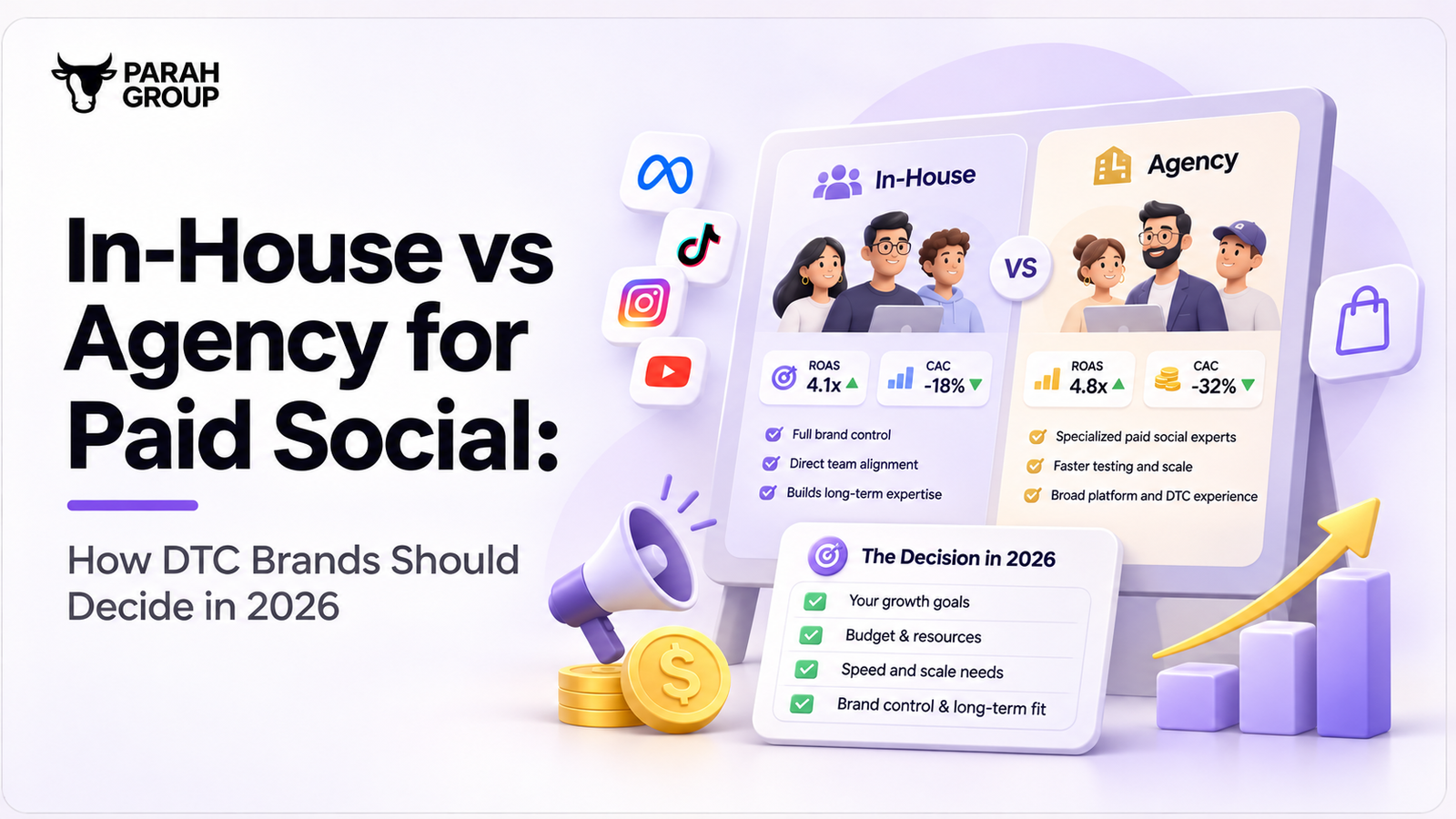
Choose an agency when you need several skills at once, such as media buying, creative testing and landing pages, and your spend does not yet justify a full team. Choose in-house when spend is large and stable enough to keep a specialist busy. Either way, the skills you are missing matter more than the fee.
The short answer by situation
| Your situation | Usually the better fit | Why |
|---|---|---|
| Early spend, one or two platforms, no creative team | Agency or specialist freelancer | You need several skills part-time, not one full-time |
| Growing spend across Meta, TikTok and others | Agency that owns ads and landing pages | Creative volume and page work outgrow one person |
| Large, stable spend on one main platform | In-house buyer plus outside creative and CRO | Daily account attention justifies a salary |
| Strong in-house team, results plateaued | A short audit, not a takeover | A fresh view is cheaper than a new team |
The lines between these rows depend on your margin and how much new creative you need each month. A brand testing ten new ads a week needs a different setup from one running three evergreen ads.
One exercise cuts through most debates. List the work your account needed last month, from new creatives and landing pages to reporting and budget changes, and mark who could do each piece today. The gaps on that list, not the org chart, tell you what to buy. If most gaps sit in creative and pages, a media buyer alone will not close them.
What each option really costs
In-house
A salary is the visible part of an in-house team and rarely the largest. The US Bureau of Labor Statistics put the median annual wage for advertising and promotions managers at $133,660, and for marketing managers at $166,790, in May 2025. A senior paid social lead sits in that territory before benefits and recruiting costs.
Then add what that person needs to perform: a steady supply of creative, someone to build and test landing pages, analytics and creative tools, and management time. One media buyer without creative and page support is a specialist with nothing to work with. Before comparing, list every skill your account needs each month and price each one both ways.
Agency
Agency fees come in three shapes: a flat monthly retainer, a percentage of ad spend, or a base fee plus a performance component. Each changes behavior. Percentage-of-spend fees can reward spending more rather than spending better; flat fees reward efficiency but need a clear scope.
Published survey ranges are collected in our breakdown of Facebook ads agency pricing. The fee is only half the comparison, though. Check what it includes: creative production, landing pages, reporting and who owns the accounts. A cheaper fee that excludes creative often costs more once you buy creative separately.
Why the decision changed in 2026
Media is more expensive and buying is more automated. Meta reported ad impressions up 10% and average price per ad up 14% year over year in the third quarter of 2026. When each impression costs more, the cost of a wrong decision rises with it.
At the same time, much of the bidding and targeting that media buyers used to do by hand is now automated. What separates good accounts from average ones sits increasingly in two places: the creative that goes in, and the page the click lands on. That shifts what you should be hiring for, in-house or outside.
Creative volume is now the deciding skill
Results depend more and more on how many good creative ideas you can test. Creator content shows it clearly. Meta’s own analysis of 20 conversion lift studies, published in October 2026, found that campaigns where partnership ads made up at least 30% of assets had a 45% lower median cost per incremental purchase. Those are Meta’s numbers, with 92% reported confidence, but the direction is consistent with what we see in accounts.
So ask any option you are weighing how many new creatives it can produce and test each month, and who sources and briefs creators. A brilliant in-house buyer with no creative supply will plateau. An agency with a creative engine but no page work will waste the clicks it wins.
The post-click gap neither option fixes by default
Most media buyers, in-house or agency, stop at the click. The landing page belongs to someone else. When results fall, they change audiences and creative, because those are the levers they hold. If the page is the constraint, months can pass without anyone fixing it.
That gap has become expensive. Contentsquare’s 2026 benchmark measured a 30% rise in the cost of a single website visit over three years. Whichever route you choose, write ownership of the post-click experience into the job description or the contract, and make sure someone can ship landing pages built for paid traffic without a long development queue. Our guide to landing page costs sets out what that work should cost.
A simple check shows whether the gap exists in your account. Compare the conversion rate of paid social visitors on their landing pages with the site average for the same products. If paid visitors convert far below everyone else and nobody owns fixing it, that gap is costing you more than any difference in fees.
Not sure where your account is leaking? Our free Facebook ads audit reviews the ads and the pages they send traffic to.
Hybrid models that work
The either-or framing hides the setups most growing DTC brands actually run.
- In-house owner, agency execution. One person who knows the business owns strategy and budget; an agency supplies buying, creative and pages.
- In-house buyer, outside creative and CRO. Daily account work stays inside; creative production and landing pages are bought as services.
- Agency with in-house creative approval. The agency runs the account, but a brand lead approves every creative and offer before it ships.
Each works if the split of responsibilities is written down. Each fails if prospecting, retargeting and pages are owned by different people with no shared number. Our comparison of retargeting vs prospecting shows why those budgets need one owner.
Whatever the split, give both sides the same dashboard. When the in-house owner and the agency read different numbers, every review becomes an argument about data instead of a decision about what to change. Agree on cost per new customer and contribution margin as the shared numbers, review them together every week, and let platform metrics explain them rather than replace them. A shared number turns the weekly call into a decision.
Signs it is time to switch
Move from in-house to an agency when results have stalled for a quarter despite steady spend, when creative output cannot keep up with what the account needs, or when your buyer is also expected to design, write and build pages. Those are signs of missing skills, not missing effort.
Move from an agency to in-house when spend is large and stable, when the same few campaigns run for months with little change, or when slow approvals between brand and agency cost more than the fee saves. Bring the role in gradually, starting with ownership of budget and reporting.
How to run a fair trial
Avoid switching everything at once. Hand over one platform or one product line for eight to twelve weeks, agree the baseline beforehand, and compare cost per new customer and contribution margin rather than platform ROAS. Eight weeks gives new creative and new pages time to settle; anything shorter mostly measures the learning period.
Before you sign anyone, settle four questions in writing: who owns the ad accounts, pixels and data if the relationship ends; which single number both sides report weekly; who builds a new landing page and how fast; and how losing creative tests are reported.
What running ads and pages together delivers
When media and pages are run by the same team against one number, results move. For Bounce Nutrition, paid social customer acquisition cost fell 20% in three months through social proof, a gamified cart progress bar and offer tests. For Binoid, a hemp brand, cost per acquisition fell 30% in four months on the back of new landing pages every month.
Neither result came from a cheaper fee or a bigger budget. Both came from shortening the loop between what the ad promised and what the page delivered, so every new angle had a page built for it. That loop is what to ask for, whichever model you choose. If you keep paid social in-house, the same principle holds: give your buyer a way to ship a new landing page every month. Ask any candidate, agency or hire, how they would do it.
That is the model our paid social agency runs: one team that owns the ad and the page it lands on. If you are deciding now, start with our free Facebook ads audit, which reviews the account and the pages it sends traffic to.
FAQs
Is it cheaper to run paid social in-house or with an agency?
At lower spend, an agency is usually cheaper because you share a team’s skills instead of hiring each one. At large, stable spend, an in-house buyer can be cheaper, provided creative and landing pages are covered.
What are the pros and cons of an in-house marketing team?
In-house teams bring product knowledge and availability. They struggle to cover every skill, take time to hire, and can plateau without outside perspective.
How much should a paid social agency cost?
Fees are usually a retainer, a percentage of spend, or a base plus performance. Compare what is included, especially creative and landing pages, not just the headline fee.
Can I use an agency and an in-house team together?
Yes. Hybrid setups are common: an in-house owner with agency execution, or an in-house buyer with outside creative and CRO. Write down who owns which number.
When should a DTC brand bring paid social in-house?
Usually when spend is large and stable enough to keep a specialist busy every day, and you can supply creative and landing pages around them. Bring ownership of budget and reporting in first, then the day-to-day buying.
- Retargeting vs Prospecting: Which Brings Better Conversion Rates?Retargeting and prospecting drive ecommerce conversions in different ways. This article explores how each strategy impacts conversion rates,…
- 10 FB Ad Examples That Drive Conversions for DTC BrandsDiscover effective fb ad examples that boost conversions for DTC brands in this insightful listicle.
- Facebook Ads Landing Page: How to Build One That Converts Cold TrafficA Facebook ads landing page should repeat the ad’s promise in its headline, show the offer and proof…