Shoplift, the Shopify A/B testing app at shoplift.ai, is the tool we reach for when a store needs to test themes, templates and navigation without a developer. As of September 2026 it starts at $74 a month on an annual plan. It stops at prices, shipping thresholds and checkout, which is where Intelligems takes over.
What is Shoplift and what does it test?
Shoplift is a Shopify A/B testing app that works at the theme level. Instead of injecting changes with a browser script, it tests things Shopify already understands: a whole theme against another theme, one template against a duplicate of that template, or one URL against another. Because the variants are real Shopify objects, you edit them in the theme editor you already use, and the winner is applied with one click.
That covers more ground than it sounds. A template test can target one page, a group of similar pages such as all product pages in a collection, or, by testing whole themes, a global element such as navigation or the cart. As of September 2026 every plan includes template, theme and URL split testing, goals for revenue per visitor, add to cart, click rate and bounce rate, device segmentation and a Bayesian engine that predicts test duration while it runs.
The app launched on the Shopify App Store on 15 September 2022 and, as of September 2026, shows a 4.9 rating from 135 reviews. It is Shopify Plus Certified and supports all Shopify themes, with reduced editing on legacy Online Store 1.0 themes.
Three features carry the “Shoplift AI” positioning. Lift Assist is a recommendation engine that suggests pre-built theme sections, duplicates your template, injects the section and applies your saved brand styles, so a variant with a new trust bar exists in minutes. Campaigns, Personalization, Subscription Testing and a JavaScript API are newer additions on Advanced. And price testing is now in beta on Advanced and above, which we address below.
How much does Shoplift cost in 2026?
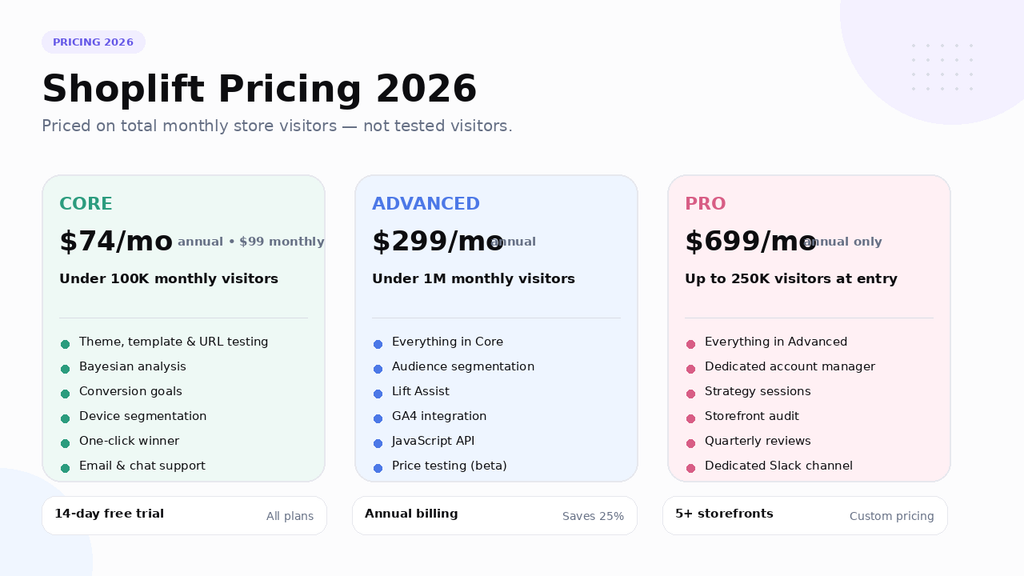
Shoplift is priced on total monthly store visitors, not tested visitors, in bands from up to 50K through 50K to 100K, 100K to 250K, 250K to 500K, 500K to 1M and unlimited. The table shows the entry band as of September 2026, cross-checked against the Shopify App Store listing, which quotes a higher monthly rate for a larger band alongside the same starting prices.
| Plan | Starting price | Visitor limit at entry | Includes |
|---|---|---|---|
| Core | $74/mo annual, $99/mo monthly | Available for stores under 100K monthly visitors | Template, theme and URL testing, Bayesian predictive analysis, conversion and engagement goals, device segmentation, one-click apply winner, order-level export, email and chat support |
| Advanced | $299/mo annual; App Store lists $399/mo monthly for a higher band | Available for stores under 1M monthly visitors | Everything in Core plus audience segmentation by referrer, channel and UTM, country and region segmentation, Lift Assist, GA4 integration, JavaScript API, price testing (beta), Campaigns, Subscription Testing, Personalization, API |
| Pro | $699/mo, annual only; App Store lists $999/mo for a higher band | Up to 250K monthly visitors at the entry price | Everything in Advanced plus a dedicated account manager, twice-monthly strategy sessions, storefront audit and roadmap, quarterly business reviews, dedicated Slack channel |
Every plan carries a 14-day free trial. Annual billing saves 25%. Five or more storefronts get custom pricing. One term to read twice: exceed your visitor allotment and tests pause until you upgrade or the cycle resets. A store that runs paid traffic in bursts should buy the band above its average month.
The vendor’s FAQ puts the performance cost at about a 2 to 4 point reduction in Google’s page speed score, with an anti-flicker blank of around 150 milliseconds while a test is live. That is a fair trade for a template test.
What can Shoplift not do?
Shoplift is excellent inside its lane, and the lane has edges.
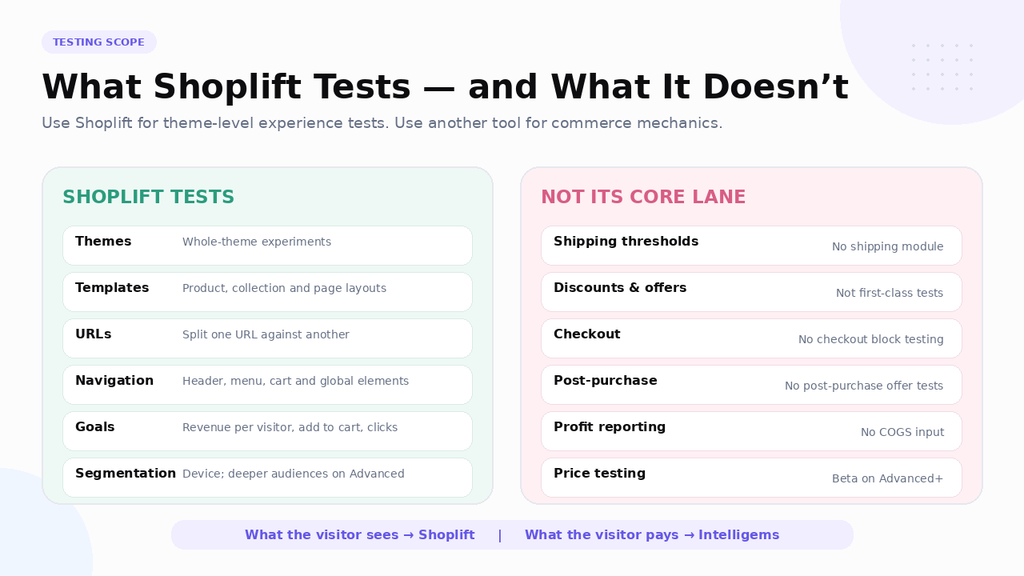
- Shipping thresholds and rates. There is no shipping module. You cannot test free shipping over $75 against $100 and see the profit impact.
- Discounts, bundles and offers as first-class tests. You can build them into a template variant, but the tool does not serve or report on the discount itself.
- Checkout and post-purchase. No checkout block tests, no post-purchase offer tests. On Plus, Intelligems does both; Shopify’s own Rollouts feature can also experiment with checkout configuration, according to Shopify’s Rollouts documentation.
- Profit reporting. Goals are revenue per visitor, conversion and engagement. There is no COGS input, so a variant that lifts revenue while cutting margin still reads as a win.
- Price testing is beta and needs a developer. The vendor’s price-testing page says setup takes 10 to 15 minutes with developer involvement, supports up to 500 products and is built for Plus merchants. We have not run it at scale, so we treat it as promising rather than proven.
Shopify itself is the other boundary. Rollouts, launched with the Winter ’26 Edition, lets stores on the Grow plan or higher run a two-version theme experiment natively. It is coarser than Shoplift, with no segmentation or template-level targeting, but it is free. One theme change a quarter to validate? Start there.
How do we decide between Shoplift and Intelligems?
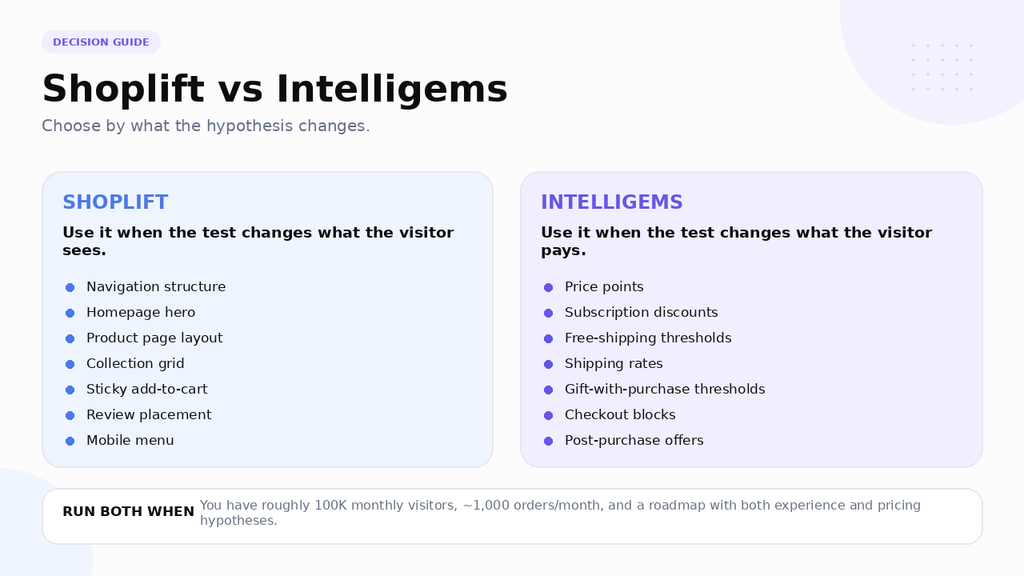
We run both, and the decision is not about which is better. It is about what the hypothesis changes.
If the hypothesis changes what the visitor sees, it goes to Shoplift. Navigation structure, homepage hero, product page layout, collection grid, sticky add-to-cart, review placement, mobile menu. These are template and theme tests, they need no developer, and the variant renders as the page rather than being painted over it.
If the hypothesis changes what the visitor pays, it goes to Intelligems. Price points, subscription discounts, free-shipping thresholds, shipping rates, gift-with-purchase thresholds, checkout blocks, post-purchase offers. Those need the price to hold through checkout and the result read in profit, not clicks. Intelligems’ general FAQ puts the floor at about 300 orders per group to detect a 10% conversion change at 90% confidence, and profit reads need more, so we only send price tests to stores with the orders to support them.
Run both when the store has traffic for two concurrent programs, roughly 100K monthly visitors and 1,000 orders a month, and a roadmap with both kinds of hypotheses. Most 8-figure Shopify stores do. Below that, pick the lane with the bigger unknown. Never touched your threshold or prices? Intelligems. Cluttered homepage and a navigation nobody has tested since launch? Shoplift.
If you want the decision made against your data rather than a rule of thumb, this is how we scope A/B testing as a program.
What have template and navigation tests done for the stores we run?
Navigation and template tests are the least glamorous experiments on a roadmap and some of the most reliable.
For Salt & Stone, a personal care brand, we redesigned the navigation off click data, removed friction identified in session recordings, and ran hero and merchandising placement tests alongside post-purchase upsells. The program added over $7,000,000 in additional annual revenue. The navigation work was a template-level change, exactly the kind of test Shoplift is built to serve.
For Urban Carry Holsters, a sporting goods brand, the work was concise value-prop messaging, a homepage and navigation redesign, testimonials, and a site audit that removed apps and scripts for speed. That added over $1,000,000 in additional annual revenue in six months. Every testing app costs page speed, which is why we audit what is already loading before adding one.
How does Shoplift compare with Intelligems, Convert, VWO and Nelio on Shopify?
All prices as of September 2026 from each vendor’s pricing page or Shopify App Store listing.
| Tool | What it tests on Shopify | Starting price | Priced on | Best for |
|---|---|---|---|---|
| Shoplift | Themes, templates, URLs, navigation; audiences and Lift Assist on Advanced; price testing in beta | $74/mo annual, $99/mo monthly (Core) | Total monthly store visitors | Layout, template and navigation tests without a developer |
| Intelligems | Prices, discounts, shipping thresholds and rates, content, checkout and post-purchase on Plus; profit and COGS reporting | $69/mo (Smart Content); $349/mo (Unlimited, entry order tier) | Sitewide orders | Offer, price and shipping tests on stores over ~1,000 orders/mo |
| Convert | Visual-editor content tests, URL tests, Shopify price testing; wide integration list | $299/mo annual or $399/mo monthly (Growth, 100K tested users); 15-day trial | Monthly tested users | Teams testing across Shopify and other properties |
| VWO | Visual-editor and split URL tests, heatmaps and recordings; no native Shopify price serving | Free Starter up to 50K monthly tested visitors after a 30-day trial; paid tiers not published, quote-based | Monthly tested users | Lead-gen and multi-site programs, or learning to test for free |
| Nelio A/B Testing | Not available on Shopify. WordPress and WooCommerce only | Free Starter at 500 monthly views; paid tiers not shown on the static pricing page | Monthly page views | WordPress and WooCommerce stores; the tool we use for non-Shopify clients |
Nelio is in the table because people ask, and the answer is short: it does not run on Shopify. We use it on WordPress and WooCommerce sites. Between the other four, Shoplift is the cheapest way to run a proper template test on Shopify, VWO’s free tier is the cheapest way to run anything, and Intelligems is the only one that reports profit.
Should you install Shoplift?
Yes if you are on Shopify, you have at least a few thousand sessions a week, and your next three hypotheses are about layout, templates or navigation. Start on Core, run the 14-day trial on a product template test, and upgrade to Advanced only when you need audience segmentation or Lift Assist.
No if your next three hypotheses are about price, shipping or checkout, or if you lack the traffic to conclude a test inside a month. For the first, go to Intelligems. For the second, use Shopify Rollouts for occasional theme validation and spend the money on research.
Either way, the tool is the cheap part. The expensive part is knowing which template to test, building a variant worth testing, QA on every device, and reading the result honestly. If you want that run as a full Shopify CRO program, with Shoplift and Intelligems both in the stack and your developers in the Slack channel, book an intro call. We will tell you which tool your roadmap needs first.
Questions people ask about Shoplift
How much does Shoplift cost?
As of September 2026, Core starts at $74 a month on an annual plan or $99 month to month, Advanced starts at $299 a month annual, and Pro starts at $699 a month on an annual-only plan. Prices rise with total monthly store visitors across bands from 50K to unlimited. Every plan has a 14-day free trial.
Does Shoplift slow down your Shopify store?
A little. The vendor’s own FAQ reports about a 2 to 4 point reduction in Google’s page speed score. While a test is live, an anti-flicker script blanks the page for around 150 milliseconds, and as low as 90, so tested visitors never see both versions. We audit existing apps and scripts before adding any testing tool, because that is usually where the real speed cost sits.
Can Shoplift test prices?
As of September 2026 Shoplift offers price testing in beta on Advanced and Pro plans. The vendor says setup takes 10 to 15 minutes with a developer, supports up to 500 products and is designed for Shopify Plus merchants. We still route price, discount and shipping-threshold tests to Intelligems, which reports profit and COGS and has run those tests for years.
What is Lift Assist in Shoplift?
Lift Assist is Shoplift’s recommendation engine. It suggests pre-built theme sections, such as trust elements or merchandising blocks, then creates a variant by duplicating your template and injecting the section with your saved brand styles applied. It is a feature library with automation rather than generative AI, and it is available on the Advanced plan and above.
Is Shoplift better than Intelligems?
They answer different questions. Shoplift is better for theme, template and navigation tests and costs less to start. Intelligems is better for price, shipping-threshold, discount and checkout tests and reports profit rather than clicks. We run both on most 8-figure Shopify stores and pick the tool by what the hypothesis changes: what the visitor sees, or what the visitor pays.