Start with Microsoft Clarity. It is free with no traffic cap, and it covers recordings, heatmaps, rage clicks and dead clicks. Move to Hotjar (now sold as Contentsquare) when you need surveys, longer data history and funnel tooling on one contract. Pick Lucky Orange if you want a Shopify-native app with checkout and cart tracking at a small store’s budget.
What does each tool actually do?
All three record sessions, render click, scroll and move heatmaps, and flag frustration. The differences are limits, retention, research features and Shopify fit.
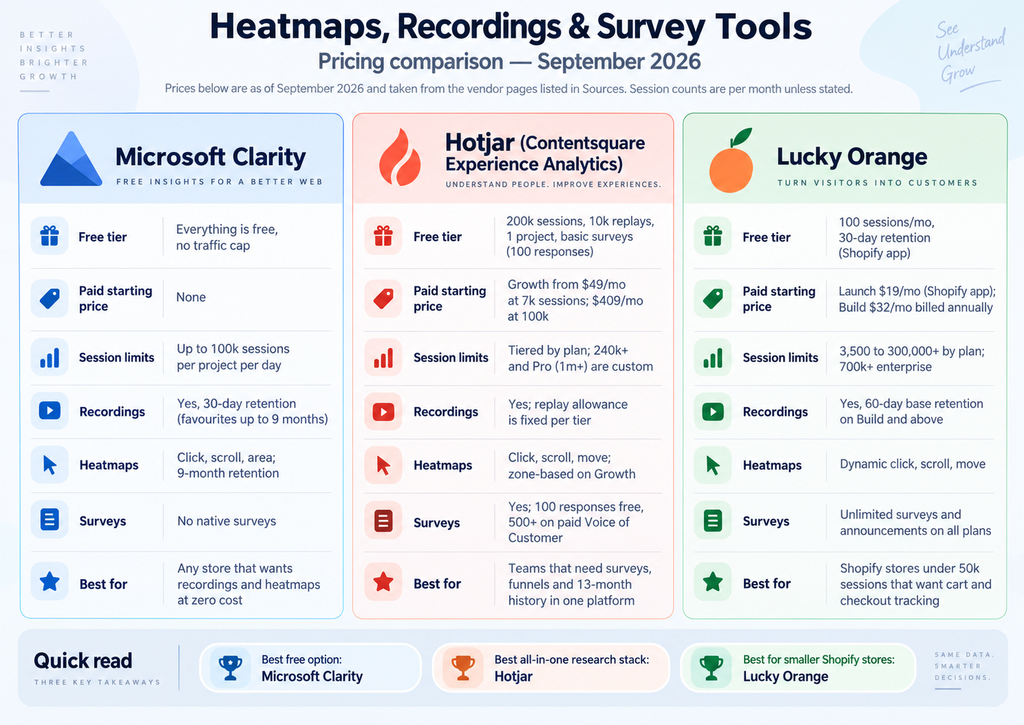
Microsoft Clarity. Clarity’s homepage and FAQ describe it as “free forever” with “no limits on traffic”. The FAQ states it records up to 100,000 sessions per project per day, does not sample traffic, keeps recordings for 30 days (favourites and a random sample up to 9 months) and keeps heatmap data for up to 9 months. It defines rage clicks, dead clicks and quick backs as built-in filters, and it has a Shopify app that adds purchase metrics on all Shopify stores and checkout-abandonment metrics on Shopify Plus. As of September 2026, the price is $0.
Hotjar. hotjar.com now redirects to contentsquare.com. Contentsquare’s page states “Hotjar is now part of Contentsquare” and that the two platforms have merged. The Experience Analytics product carries Hotjar’s replays, heatmaps, funnels and surveys. As of September 2026 the Free plan includes 200k monthly sessions, 10k replays, one project, replays, heatmaps and funnels, error and performance monitoring and basic surveys (100 responses a month). The Growth plan starts at $49 a month for 7k sessions and scales by session volume, with 13 months of data access, zone-based heatmaps and journey analysis. Contentsquare’s pricing FAQ says annual payment set up in-app gets a 20% discount.
Lucky Orange. Lucky Orange sells dynamic heatmaps, session recordings, unlimited surveys and announcements, and conversion funnels on every plan. As of September 2026, luckyorange.com lists Build at $32 a month billed annually for 3,500 sessions, Grow at $72 for 10,000, Expand from $199 (annual) or $249 (monthly) starting at 50,000 sessions, and Scale from $839 (annual) or $1,049 (monthly) starting at 300,000 sessions. Enterprise covers 700,000+ sessions on custom pricing. Data retention starts at 60 days with paid upgrades to 90, 180 or 365 days. The Shopify App Store listing adds a Free plan at 100 sessions a month and a Launch plan at $19 for 500 sessions, both with 30-day retention.
Hotjar vs Microsoft Clarity vs Lucky Orange: comparison table
How much do they cost at 100k and 500k monthly sessions?
This is where the decision usually gets made.
- 100k sessions. Clarity: $0. Contentsquare (Hotjar): the Free plan covers 200k sessions with a 10k replay cap, so you can run 100k sessions free if 10k replays a month is enough. The Growth plan at the 100k tier is $409 a month with 20k replays. Lucky Orange: 100k sits above the Expand floor of 50k sessions ($199 a month billed annually) and below Scale’s 300k floor ($839 a month); the site shows tier floors, not the exact 100k price, so budget between those two numbers.
- 500k sessions. Clarity: $0, still no sampling. Contentsquare: the published Growth ladder stops at 200k sessions for $739 a month; the 240k+ tier and the Pro plan (from 1m+ sessions) are quote-based. Lucky Orange: Scale starts at 300k sessions for $839 a month billed annually ($1,049 monthly); 500k is a Scale add-on tier that is not priced on the page.
At ecommerce volumes, Clarity is the only one that stays free. Lucky Orange gets expensive fastest because its plans are sized for small stores.
How does a CRO team actually use session recordings?
Recordings are a research input, not a scoreboard. The workflow we run in the CRO Program looks like this:
- Segment first. Filter recordings to the behaviour you care about: mobile sessions that added to cart and did not check out, sessions with a rage click on the PDP, sessions that hit the size chart. Watching random sessions is how teams burn a week and learn nothing.
- Tag what you see. Every friction point gets a one-line note: “variant selector requires two taps on iOS”, “shipping estimate hidden below the fold”, “search returns zero results for plural terms”. After 30 to 50 sessions in a segment, patterns repeat.
- Quantify with heatmaps and analytics. A click map tells you how many visitors are hitting the dead element. Scroll maps tell you whether the hero is doing any work. Funnel data tells you the size of the drop.
- Write the hypothesis. “If we move the shipping estimate above the add-to-cart button on mobile PDPs, cart adds will rise because X% of recorded mobile sessions scrolled past the price and left without reaching shipping info.” Then prioritise by reach and effort and put it in the test queue.
Salt & Stone is our reference case. The program added over $7,000,000 in additional annual revenue, and two of the biggest inputs were friction removal from session recordings and a navigation redesigned off click data. Recordings surfaced where customers struggled; click heatmaps showed which navigation items were ignored and which were hunted for. The redesign followed the data, then went through A/B testing before it shipped.
Baymard’s running benchmark puts average documented cart abandonment at about 70%. Most of that is not fixable, but the fixable part shows up on tape. A recordings tool is the cheapest way to find it.
Where does each tool fall short?
Clarity. Retention is the weak point. 30 days of recordings is fine for a weekly research cadence and bad for a quarterly one, and you cannot pay to extend it. There are no native surveys, so voice-of-customer work needs a second tool. The Clarity FAQ notes that without explicit consent from EEA, UK and Swiss visitors, Clarity cookies cannot be used and “funnel tracking and session recordings might be impacted”, so European traffic will be thinner than your analytics numbers suggest. On Shopify, the FAQ warns that a theme update can remove the script, which we have seen happen mid-test. Checkout abandonment metrics are Shopify Plus only, and Shop Pay and expedited checkouts are excluded from them.
Hotjar / Contentsquare. The replay allowance is a fixed count per tier that cannot be bought up, so a busy store that wants to watch a lot of tape will feel the 10k or 20k replay cap before it feels the session cap. Pricing is now a three-product matrix (Experience Analytics, Voice of Customer, Product Analytics), and surveys beyond 100 responses a month are a separate Voice of Customer plan from $99. The Shopify integration is not first-party: the Shopify App Store listing we found for “Hotjar Install” is a third-party app from a developer called Dualsided at $0.99 to $2.99 a month, so most stores install through theme code or Shopify’s custom pixel, which does not cover the checkout on non-Plus stores.
Lucky Orange. Session quotas are small relative to Shopify traffic. 10,000 sessions a month is a few days for a mid-size DTC store. Base retention is 60 days, or 30 days on the Shopify app’s Free and Launch plans, so trend work needs the paid storage upgrade. Rage-click and dead-click detection are not called out on the pricing page, unlike Clarity where they are a headline filter.
Which heatmap tool for Shopify?
- Under 10k sessions a month, Shopify, small team. Lucky Orange’s Shopify app. Cart abandonment tracking and surveys in one app, priced at $19 to $89 a month. Clarity is the free alternative if you can live without surveys.
- 10k to 200k sessions, any platform. Clarity for recordings and heatmaps plus a survey tool of your choice, or Contentsquare’s free plan if you want everything in one login and can work within 10k replays. Both cost nothing.
- 200k+ sessions, a real testing program. Contentsquare on a Growth or Pro contract: 13 months of history, journey analysis, revenue-tied impact numbers and replays filtered by rage clicks and frustration score. Keep Clarity installed in parallel as a free second opinion.
Whichever you pick, mask personal data at the source and load the script through your consent tool, not a script tag in theme.liquid. If you want the research done for you and turned into a test roadmap, that is what our website conversion optimization engagements cover.
What should you do with the tool once it is installed?
Most stores install a heatmap tool, look at it twice and never open it again. Set a cadence: one hour a week on a defined segment, one written note per session, one hypothesis per week into the test backlog. After a month you have a ranked list of friction points with rough reach numbers. That list is worth more than the tool choice.
Then test. A recording tells you a customer struggled with the variant picker; it does not tell you the new picker will sell more. Momentous is the reminder: in testing, trust and scientific authority beat social proof for that audience, which recordings alone would not have predicted. Recordings write the hypothesis. The A/B test decides.
If your store is past 100k monthly sessions and nobody owns that loop, book an intro call. We will look at your recordings, your analytics and your current test queue and tell you what we would test first and what it is likely worth. Book an intro call.
Frequently asked questions
Is Microsoft Clarity really free?
Yes. As of September 2026 Clarity’s site and FAQ describe it as free forever with no traffic limits and no sampling, and the Shopify app is listed as free. The trade-offs are 30-day recording retention, no native surveys and Microsoft using aggregated behavioural data to improve its own products. Read the privacy terms before installing.
Is Hotjar still a separate product?
Not as a brand. hotjar.com now redirects to contentsquare.com, which states Hotjar is now part of Contentsquare. Existing Hotjar users log in at the same place and get the Contentsquare free plan: 200k monthly sessions, 10k replays and basic surveys. Paid Growth plans start at $49 a month for 7k sessions as of September 2026.
Lucky Orange vs Hotjar: which is better for a small Shopify store?
Lucky Orange, if you want cart and checkout tracking and surveys in a native Shopify app for under $100 a month. Hotjar’s free plan through Contentsquare is more generous on sessions (200k versus Lucky Orange’s 100 on the free Shopify tier), but the Shopify install is less turnkey. Above 50k sessions, Contentsquare’s free plan is the better deal.
Do heatmap tools slow down a Shopify store?
Every third-party script costs something. Clarity, Contentsquare and Lucky Orange all load asynchronously, but you should measure Largest Contentful Paint before and after install and load the script through your consent tool rather than in the theme head. If you run more than one recording tool, keep it temporary. Urban Carry Holsters’ site audit removed apps and scripts for speed and contributed to over $1,000,000 in additional annual revenue.
Do session recordings comply with GDPR?
Only if you gate them behind consent for EEA, UK and Swiss visitors and mask personal data. Clarity’s FAQ states its cookies cannot be used without explicit consent in those regions and that input fields are masked in every mode. Contentsquare and Lucky Orange offer masking and consent APIs too. Configure them before go-live, not after a complaint.