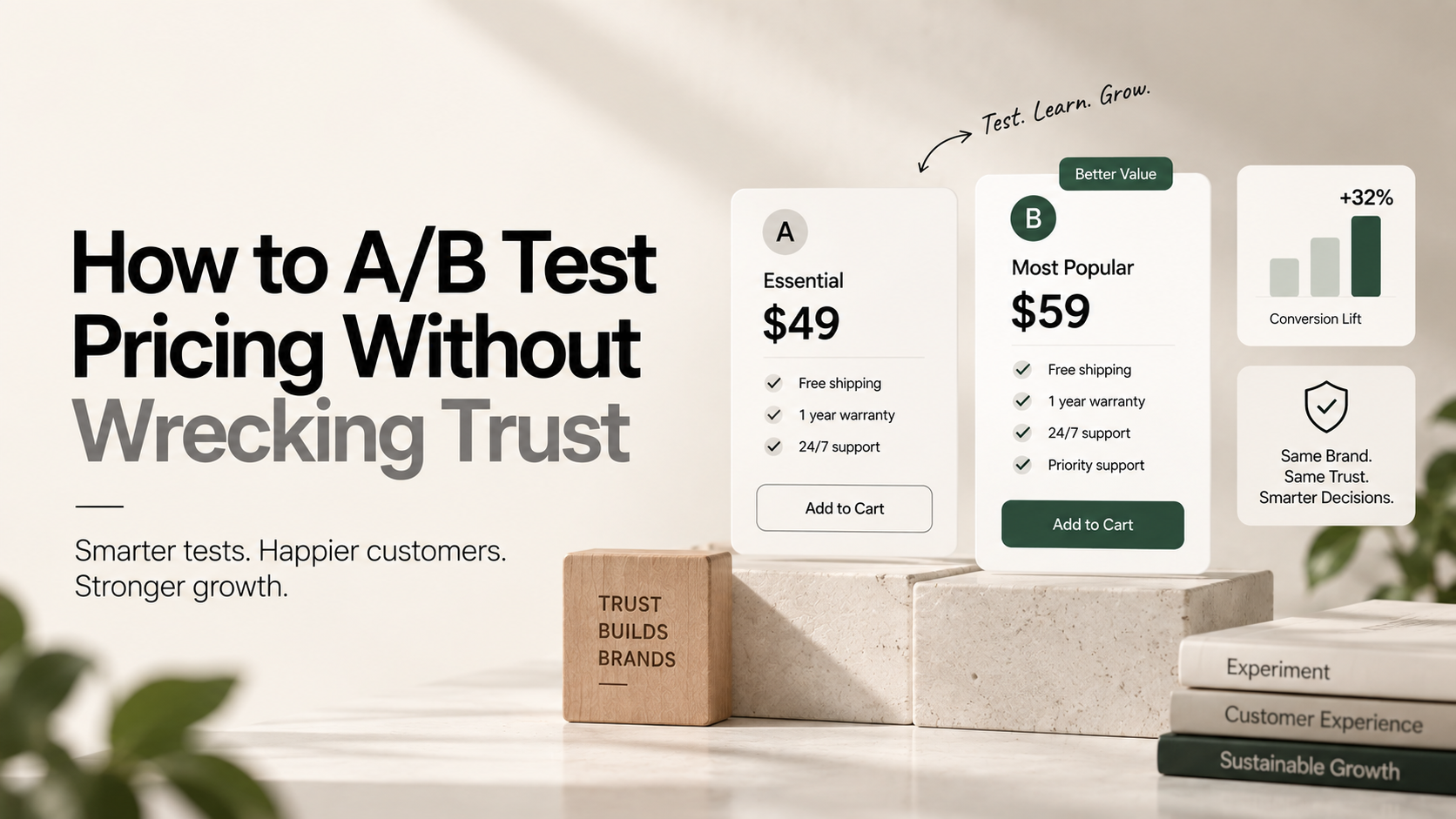
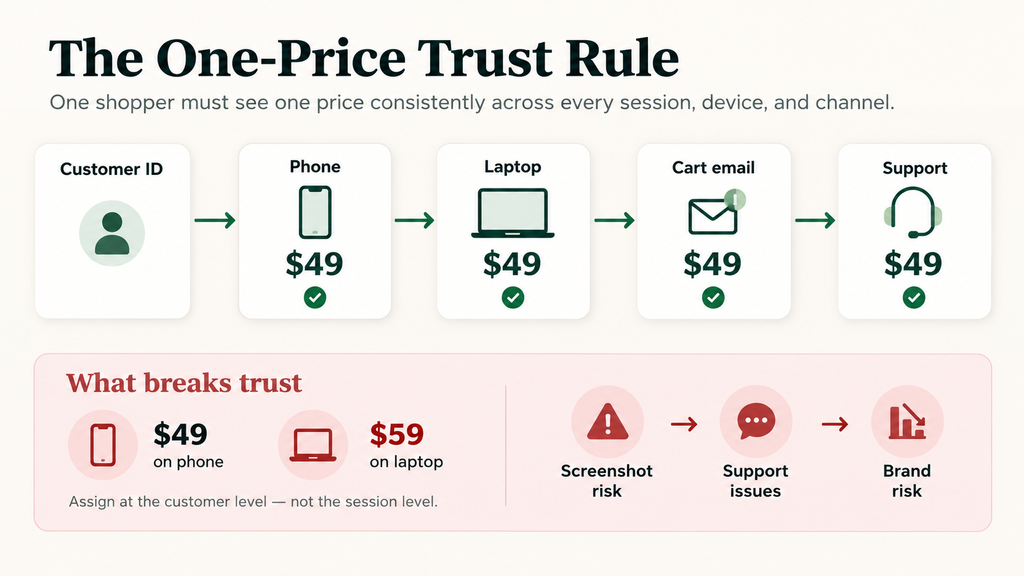
Test price structure before you test price itself. Bundles, thresholds, anchoring and payment terms move revenue per visitor with none of the trust risk, and they are legal everywhere. If you do test raw price, the non-negotiable rule is that one shopper sees one price, consistently, across every session and device.
The rule that governs everything else
A shopper who sees $49 on their phone and $59 on their laptop will screenshot both and post them. That is a brand problem, a support problem and in several jurisdictions a regulatory problem.
So price tests are not standard A/B tests. Assignment has to persist across sessions, devices and channels, which means testing at the customer level rather than the session level. Tools built for price testing handle this. General-purpose testing tools frequently do not, and running a price test in a tool that reassigns on cookie expiry is how brands end up in that screenshot.
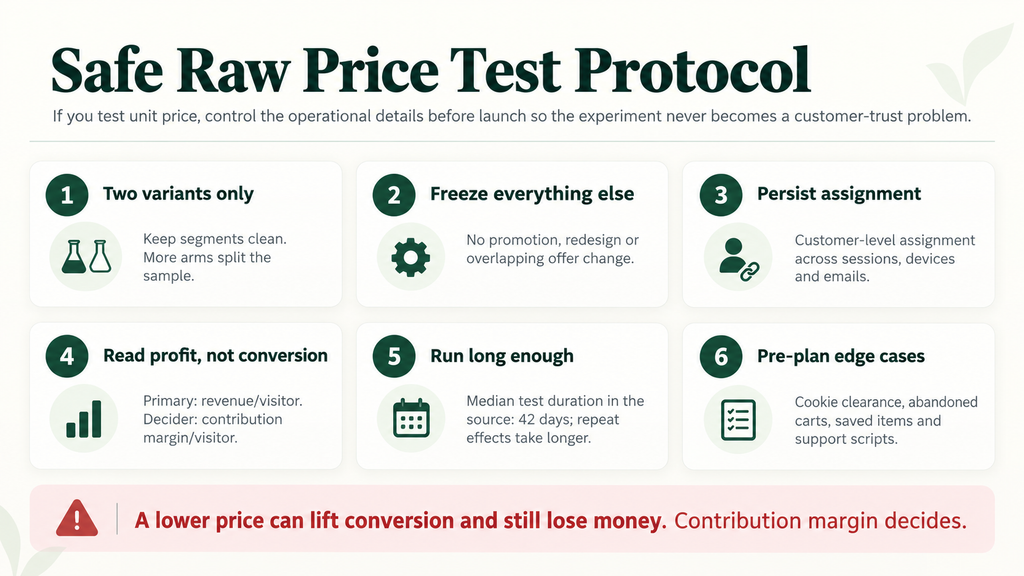
Decide before launch: what happens when a customer returns after cookie clearance, what price honours in an abandoned cart email, and what your support team says if someone asks.
Test structure before price
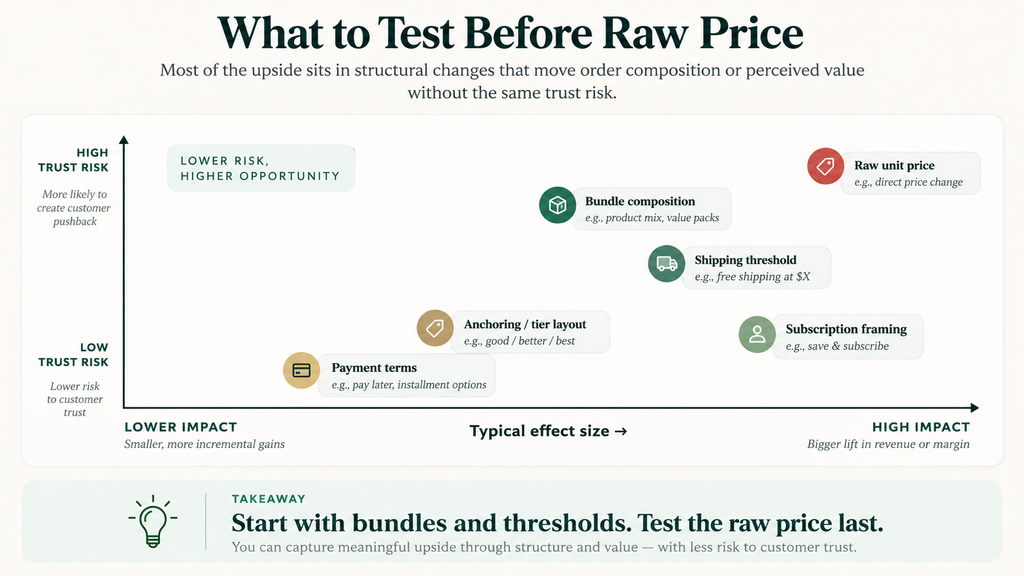
Most of the return sits here anyway, and none of it carries the same risk.
Bundles. Changes what the customer buys rather than what a unit costs. The mechanism is order composition, which is where large effects live.
Free shipping thresholds. Functionally a price change that shoppers experience as a target. Shopify’s average cart during BFCM 2025 was $114.70 against an $85 annual average, which shows how much order composition moves when the frame changes.
Anchoring. Presenting a higher-tier option alongside the one you expect to sell shifts the reference point without changing any price.
Subscription against one-time. A pricing decision in everything but name, and the take rate is testable without touching the underlying unit price.
Payment terms. Instalments and buy-now-pay-later change perceived affordability at a constant price.
| What you change | Trust risk | Typical effect size |
|---|---|---|
| Bundle composition | None | Large, order composition |
| Shipping threshold | None | Large, order composition |
| Anchoring and tier layout | None | Moderate |
| Subscription framing | None | Large on LTV |
| Payment terms | Low | Moderate |
| Raw unit price | High | Large, and hard to reverse |
If you do test raw price
Test few variants. Two, not five. Price tests need clean segments and each additional arm splits your sample further.
Hold everything else constant. A price test running alongside a promotion is not a price test.
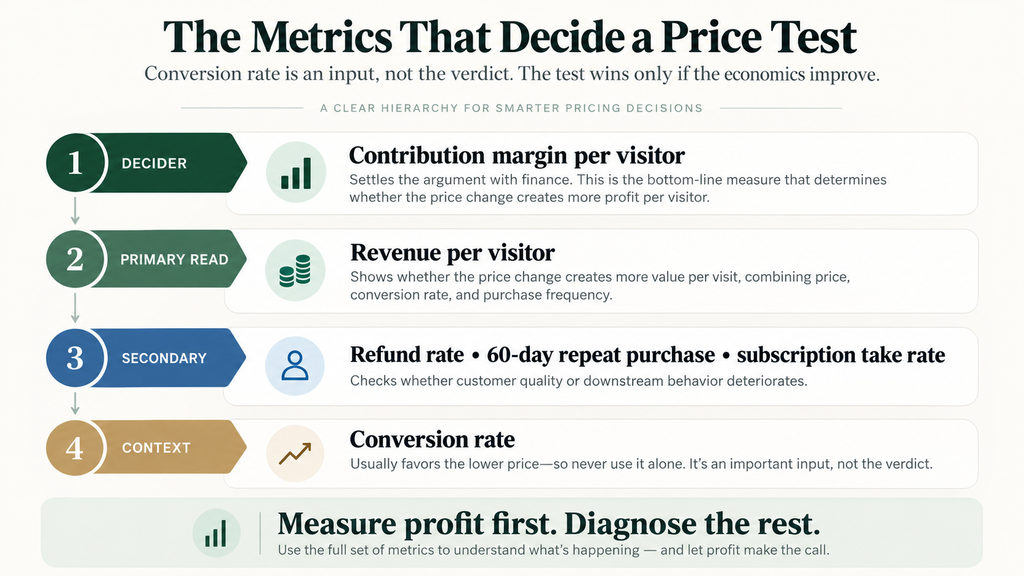
Read it on contribution margin, not conversion rate. This is the whole point. A lower price will raise conversion almost every time, and the question is whether it raises profit. Winners in DRIP’s experiment data produced a median 1.88% conversion lift against a 2.77% revenue per visitor lift, and price tests are the clearest case where those two numbers diverge.
Run it long enough. The median test in DRIP’s database ran 42 days, and price effects on repeat purchase take longer than that to appear. A price cut that lifts first orders and depresses second orders is a loss with a delay on it.
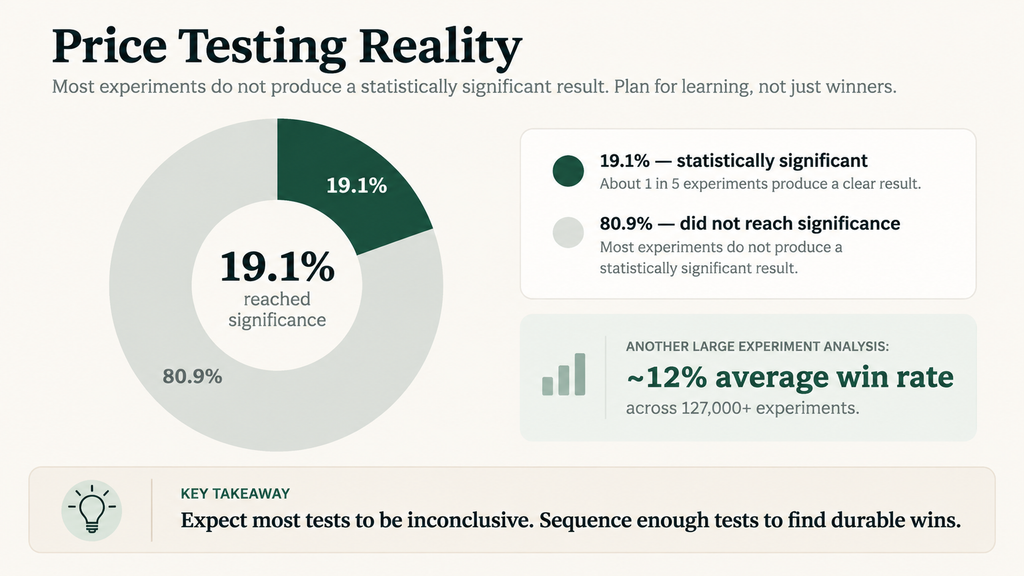
Expect most of it to be inconclusive. ConversionTeam’s audit of 2,288 tests found 19.1% reached statistical significance per test, and Optimizely’s analysis of more than 127,000 experiments puts the average win rate near 12%.
The four structural tests worth running first
Each one changes what the customer pays without changing what anything costs.
Bundle composition. Not whether to bundle, but what goes in it. A bundle of the two products customers already buy together performs differently from a bundle designed to move slow stock, and the second is where brands usually start. Build from your actual order data. The mechanism is order composition, which produces the largest effects available in ecommerce testing.
Threshold placement. Covered at length elsewhere, and it belongs on this list because it is a price change the customer experiences as a target rather than a cost. Shopify’s average cart during BFCM 2025 was $114.70 against an $85 annual average, which is what happens when the frame changes rather than the price.
Tier layout and anchoring. Three tiers where the middle is the intended sale. The top tier does not need to sell to earn its place; it needs to make the middle look reasonable. Test the gap between tiers rather than the absolute numbers.
Subscription framing against one-time. The largest pricing decision most consumable brands make, and it is testable without touching a unit price. Median conversion for subscription businesses sits at 3.6% against 4.7% for standard ecommerce, so the trade is conversion now against lifetime value later, and where you offer it changes the trade entirely.
The three mistakes that ruin price tests
Testing during a promotion. Any discount running concurrently contaminates both arms. Price tests need a clean window, which on most stores means planning around the promotional calendar months ahead.
Reading it too early. Price effects on repeat purchase take a full purchase cycle to appear, and the first-order effect is nearly always more favourable than the full picture. A price cut lifts first orders and can depress second orders, which reads as a win at three weeks and a loss at three months.
Forgetting the people already in the funnel. Customers with abandoned carts, saved items or email flows in progress were quoted a price. Decide what happens to them before launch, not after the first support ticket. This is the operational detail that turns a well-designed price test into a brand problem, and it is invisible in every testing tool’s documentation.
The metrics that decide it
Revenue per visitor is the primary read. Contribution margin per visitor is the one that settles arguments with finance.
Then check three secondary reads before calling anything: refund rate, because a price change can shift who buys as well as how many; repeat purchase at sixty days, because acquisition price sets an expectation for every subsequent order; and subscription take rate if you run one, since it is usually the fastest signal on customer quality.
What price work produced in practice
At a DTC supplements brand we work with, price elasticity testing ran alongside a shipping threshold test. The threshold test produced two million dollars in profit, and it did so without changing a single unit price.
That ordering is the lesson worth taking. The structural change was where the money was. Raw price testing had a role, but it was the smaller and slower part of the programme, and it carried all of the risk.
At a cannabis DTC brand, checkout-level testing produced 25% growth in average order value inside three months alongside 75% on subscription take rate. Again, structure rather than sticker.
Want price work run safely? A/B Testing covers the assignment, tooling and read windows that keep price tests out of trouble.
Communicating a price change once you have won
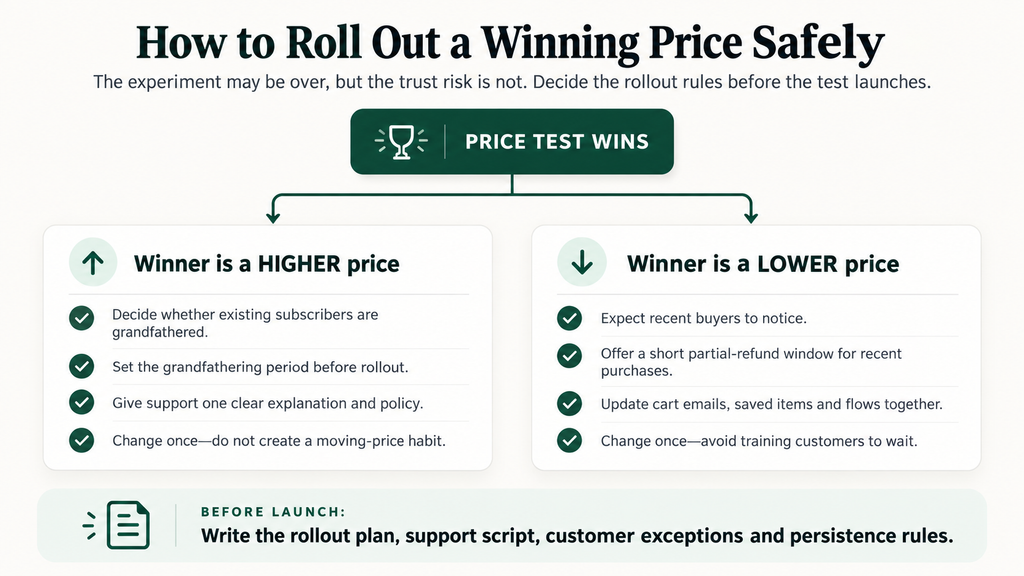
A winning price test still has to be rolled out, and rollout is where the trust risk actually lands.
If the winner is a higher price, existing customers noticing is not a hypothetical. Decide in advance whether current subscribers are grandfathered, for how long, and what the support team says. Grandfathering is usually cheaper than the churn and the social media cost of not doing it.
If the winner is a lower price, recent buyers will ask. A short window of automatic partial refunds for anyone who bought at the old price in the previous fortnight costs very little and prevents the specific complaint that spreads.
Either way, change the price once and leave it. A price that moves repeatedly teaches customers to wait, and once a category has learned to wait for the next discount, you have converted a pricing programme into a promotional treadmill that is extremely hard to get off.
Write the rollout plan before the test launches. Deciding it after you have a winner means deciding it under pressure, with a number you like and an incentive to move fast.
A final point on tooling. Before you design anything, confirm your testing tool assigns at the customer level and persists that assignment. If it does not, the entire approach above is unavailable to you regardless of how carefully the test is designed, and the honest answer is to test structure instead until the tooling changes.
Frequently asked questions
Is A/B testing prices legal?
Generally yes in most markets, provided the same customer sees a consistent price and you are not discriminating on protected characteristics. Rules vary by jurisdiction, so check locally before launching, particularly in the EU.
How do I stop one shopper seeing two prices?
Assign at the customer level rather than the session level, and make the assignment persist across devices and through abandoned-cart emails. Tools built for price testing do this; general testing tools often do not.
Should I test price or test bundles first?
Bundles and thresholds, almost always. They change order composition, produce larger effects, and carry none of the trust risk of raw price testing.
What metric decides a price test?
Contribution margin per visitor. Conversion rate will nearly always favour the lower price, which is exactly why it cannot be the deciding number.
Next step: The CRO Program sequences structural offer tests ahead of raw price tests for this reason.