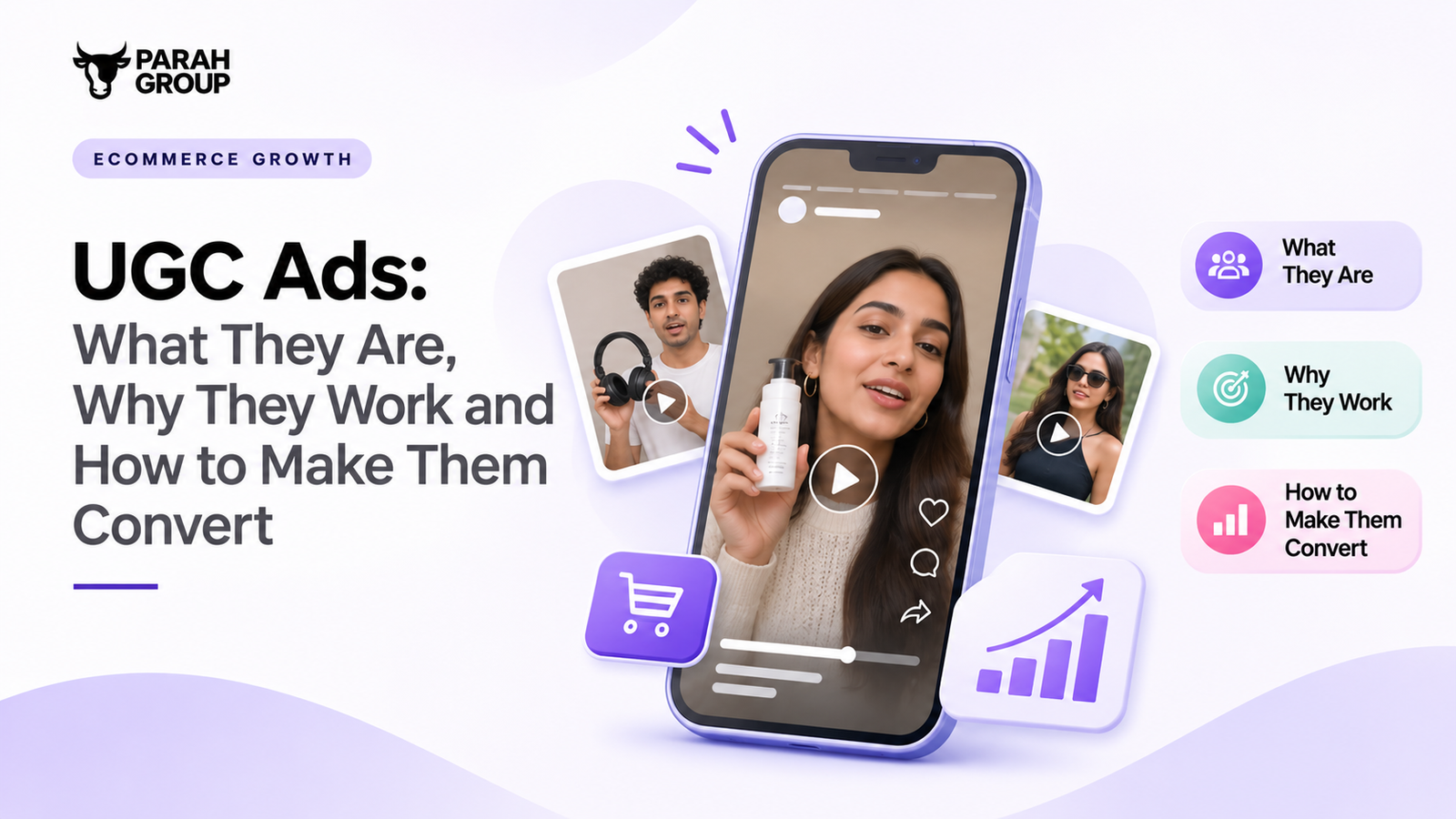
UGC ads are paid ads built from content that looks and sounds as if a customer or creator made it: phone-shot video, reviews, unboxings and routines rather than studio shoots. They work because they read as proof rather than promotion. Most brands now commission UGC from paid creators, which makes disclosure and honest claims the brand’s responsibility.
What counts as a UGC ad
UGC stands for user-generated content. In advertising, the term has drifted from content customers post unprompted to a style: unpolished, first-person, filmed on a phone and talking straight to the viewer. Today most UGC ads are made by creators paid to produce content in that style. That is fine, as long as the ad does not pretend otherwise.
| Type | Who makes it | Strength | Watch for |
|---|---|---|---|
| Customer content | Real buyers, unprompted | Most credible | Needs written permission to use in ads |
| Paid creator UGC | Creators paid per video | Volume and control | Disclosure of the paid relationship |
| Partnership ads | Creators, run from their handle | Creator’s credibility in the header | Permissions and contract terms |
| AI-generated UGC | AI avatars and synthetic voices | Cheap and fast | Must not pose as a real customer’s experience |
The label matters less than the source: viewers and regulators care whether the person speaking is real and whether they were paid. Running paid creator content from the creator’s own handle is a separate format, covered in our guide to Meta partnership ads. This post covers the creative itself: what to brief, which formats convert, and how to test them.
Why UGC ads work
A polished brand ad announces itself as an ad. A person talking into a phone camera looks like the rest of the feed, so viewers watch long enough to hear the argument. It also does a job a brand cannot do for itself: show someone like the viewer using the product and saying it worked for them.
The numbers support testing it seriously. In Meta’s analysis of 20 conversion lift studies in Europe, the Middle East and Africa, campaigns where creator-led partnership ads made up at least 30% of assets had a 45% lower median cost per incremental purchase. Media costs make creative efficiency matter more each quarter: Meta reported average price per ad up 14% year over year in the third quarter of 2026.
UGC is also cheaper to produce in volume than studio content, and volume matters. Meta’s delivery system rewards fresh creative, and a brand that can test ten new concepts a month learns faster than one testing two. That is why UGC video is one of the core formats in the paid social programs we run, alongside static, carousel and catalog ads.
How to brief UGC creators
Most weak UGC ads fail at the brief, not the filming. A creator given “make a fun video about our product” produces content that is pleasant and forgettable. A creator given a clear argument produces an ad.
A good brief fits on one page and covers six things:
- The angle: the one reason this viewer should care, such as a problem solved, a result, or a comparison.
- The hook: two or three opening lines to try, since the first three seconds decide whether anyone stays.
- The proof: what the creator can show or say that is true, such as using the product, a visible result with a time frame, or a review quoted.
- The offer: the exact offer the landing page will repeat.
- The call to action: one action, said out loud and shown on screen.
- The limits: claims they must not make, especially for health, beauty and supplement products.
Send the product early, so creators have used it before they film. Ask for raw footage and multiple hooks on every video. Cutting three openings onto one body gives you three tests for the price of one shoot.
UGC ad formats that convert
Most converting UGC ads use one of a handful of structures. Knowing them makes briefs faster and tests cleaner, because you can test one format against another while keeping the angle fixed.
| Format | Structure | Best for |
|---|---|---|
| Problem and solution | Names a frustration, then shows the product fixing it | Products that solve a clear problem |
| Testimonial | A user explains their result and how long it took | Products with visible or felt results |
| Unboxing | First impressions, packaging, what is inside | Gifting, premium and visual products |
| Routine | The product inside a daily routine | Supplements, skincare, food and drink |
| Comparison | Versus the old way or a common alternative | Crowded categories |
| Founder | The founder explains why the product exists | New brands and mission-led products |
Pick the two or three formats that suit your product and rotate new angles through them, rather than chasing every format at once. A format that works for a supplement routine may fall flat for a gift. For examples of these structures in finished ads, see our roundup of Facebook ad examples that drive conversions. On TikTok, the same content can run from the creator’s account as Spark Ads, covered in our TikTok Spark Ads guide.
How to test UGC ads
Test angles, not creators. If you change the creator, the hook, the angle and the format all at once, a winning ad tells you nothing about why it won. Our testing order is fixed: angles first, hooks second, formats third. Once an angle wins, test new hooks on it; once a hook wins, try it across formats and creators.
Judge UGC on cost per purchase and new-customer revenue, not on views, thumb-stop rate or click-through rate. A video that entertains can attract cheap clicks from people who never buy. Use the early metrics to cut obvious losers fast, then let survivors run until they have enough purchases to compare.
Plan for fatigue. A UGC ad that works will wear out as the same people see it again, and performance usually drops before anyone notices in the dashboard. Keep new concepts in the pipeline so a replacement is ready before the winner fades, and log every test, including losers, so each brief builds on the last.
Need a steady supply of tested creative? Our paid social agency runs creative testing, ads and landing pages as one program, with every test logged.
The rules: disclosure, fake reviews and AI UGC
Paid UGC is an endorsement, and the FTC treats it as one. Its Endorsement Guides guidance, updated in July 2025, says paid relationships should be disclosed clearly. It recommends a disclosure in the video itself, and states that “your company is ultimately responsible for what others do on your behalf.”
Fake testimonials carry real penalties. In August 2024 the FTC finalized a rule banning fake reviews and testimonials. It bans reviews and testimonials from people who do not exist, “such as AI-generated fake reviews,” or from people with no actual experience of the product, and it allows civil penalties against knowing violators.
When in doubt, have someone who knows the rules review every claim before the ad goes live. That rule is the line for AI UGC. An AI avatar explaining a product’s features is a style choice. An AI avatar describing “my results after 30 days” is a testimonial from someone who does not exist. Keep AI content to explanation and demonstration, keep testimonials real, and keep every claim within what you can substantiate. Supplement and health brands should also follow the platform rules in our guide to Facebook ads for supplements.
Where UGC ads should send traffic
A UGC ad builds trust in a person’s voice, and that trust drops if the click lands on a generic product page that sounds nothing like the ad. The page should continue the argument: the same promise in the headline, the same kind of proof near the buy button, and the offer the creator mentioned, shown exactly.
This is where much of the return on UGC is won or lost. For Optimize Minerals, a supplement brand, landing pages built for paid traffic lifted conversion 40%. For a hemp brand, cost per acquisition fell 30% in four months through landing pages built for its ads.
Most of that traffic arrives on a phone. Adobe expects 57.4% of US online holiday spending this season to come through mobile, and Littledata’s Shopify benchmark puts the median mobile add-to-cart rate at 5.3% against 10% on desktop. Build and check the landing page on a phone first.
Build one page per winning angle from a shared template, so a new UGC angle gets a matching page within days rather than weeks. Our guide to the Facebook ads landing page covers how to build it, and our landing page team builds them for paid traffic.
FAQs
1. What are UGC ads?
UGC ads are paid ads that use content made in the style of real customers or creators, such as phone-shot reviews, routines and unboxings, instead of studio-produced brand content.
2. What does UGC mean in ads?
UGC stands for user-generated content. In ads it usually means creator-made content in a native, first-person style, often paid for by the brand.
3. Do UGC ads need to be disclosed?
Yes, when the creator was paid or given free product. FTC guidance says the relationship should be disclosed clearly, ideally in the content itself as well as the platform label.
4. Can I use AI-generated UGC ads?
You can use AI to explain or demonstrate a product, but not to present testimonials from people who do not exist. The FTC’s 2024 rule bans fake and AI-generated testimonials.
5. How many UGC ads should I test?
Enough to keep fresh creative ready before winners fatigue. Test a few new angles each month, with several hooks per video, and judge them on cost per purchase.
- What Is a Good Ecommerce Conversion Rate in 2026? Benchmarks by IndustryGood ecommerce conversion rate benchmarks for 2026 by industry, device and traffic source, with the median, the top…
- The Anatomy of a High-Converting eCommerce PDPDiscover the anatomy of a high-converting eCommerce Product Detail Page (PDP) in this comprehensive guide. Learn how to…
- Meta Partnership Ads: How They Work, When to Use Them and How to Set Them UpMeta partnership ads show a creator’s or partner’s handle in the ad header, with or without the brand’s,…