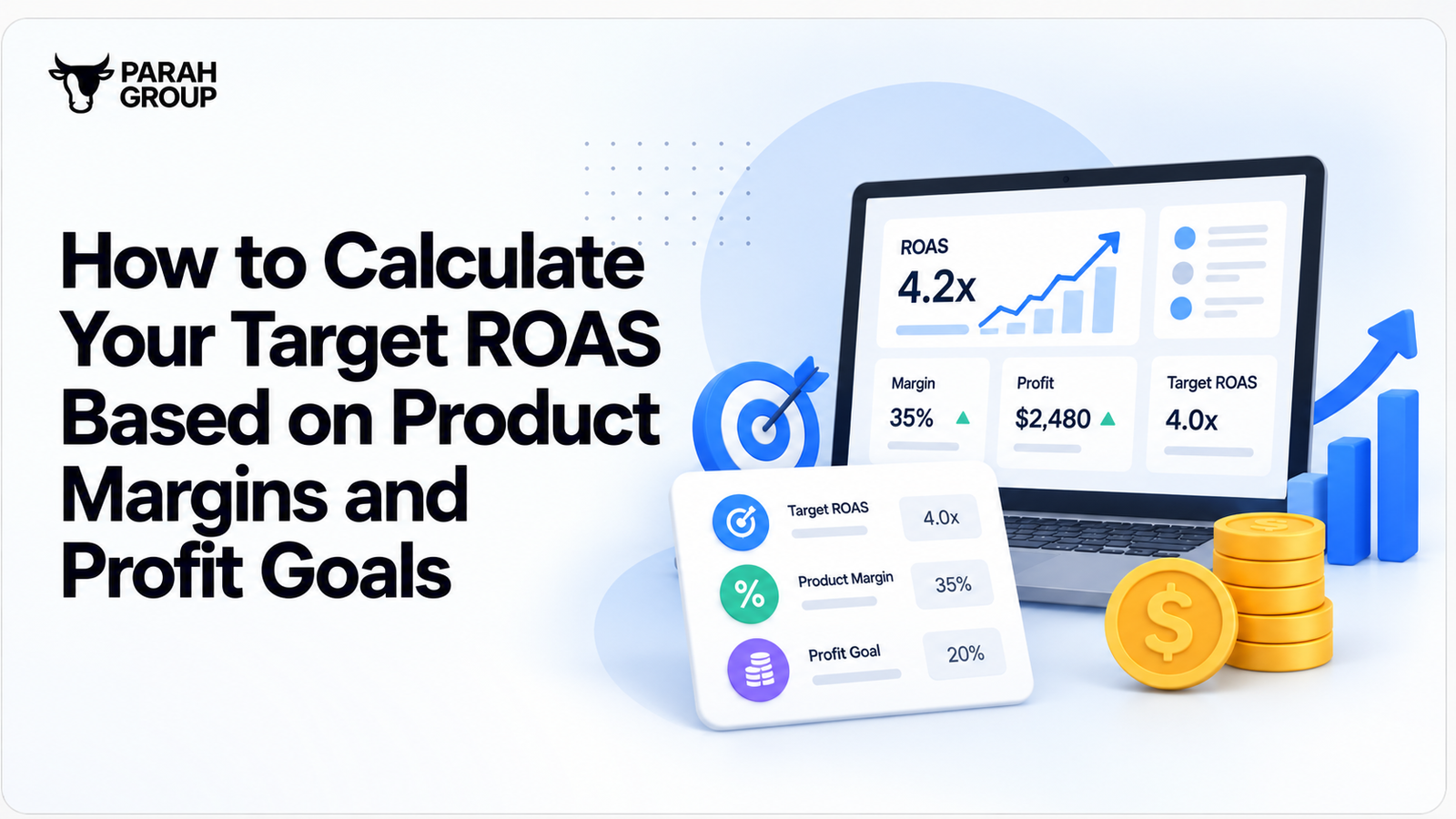
A strong return on ad spend (ROAS) might look impressive in your advertising dashboard, but it does not always mean your business is profitable. For e-commerce and direct-to-consumer (DTC) brands, profitability depends on product margins, fulfillment expenses, customer acquisition costs, and the amount of profit the business wants to retain.
This is why setting advertising targets based on business economics matters more than chasing a generic ROAS benchmark. A target that works for one brand may be unsustainable for another, even when both generate similar advertising returns.
Using a ROAS calculator can help you understand your break-even point, evaluate product margins, and establish advertising targets that support sustainable growth. This guide explains how to approach ROAS calculation and make more informed decisions about advertising profitability.
What Is ROAS and Why Does It Matter?
Return on ad spend measures the revenue attributed to advertising relative to the amount spent on ads.
The formula is:
ROAS = Revenue Attributed to Ads ÷ Advertising Spend
This metric helps businesses evaluate how efficiently their advertising generates revenue. However, it does not account for the costs of producing products, shipping orders, processing payments, or running the wider business.
A campaign can generate substantial revenue while leaving little contribution toward overhead and profit. For this reason, ROAS should be evaluated alongside contribution margin, customer acquisition costs, and other relevant financial measures.
For DTC brands, understanding this relationship helps distinguish campaigns that generate revenue from those that contribute meaningfully to business growth.
How to Calculate ROAS Using a ROAS Calculator
A basic ROAS calculation requires advertising spend and the revenue attributed to that advertising. However, interpreting the result requires consistent measurement and a clear understanding of business costs.
Follow these steps:
- Identify advertising spend: Review media expenditure for the campaign and reporting period.
- Measure attributed revenue: Use the revenue associated with the campaign, applying consistent attribution settings and accounting for refunds and discounts where appropriate.
- Calculate ROAS: Divide attributed revenue by advertising spend.
- Evaluate profitability: Compare the result against product margins, variable costs, and your desired profit.
Parah Group’s free ROAS calculator can help businesses assess break-even ROAS and establish target returns based on their financial goals.
Remember that platform-reported revenue may differ from actual store revenue because of attribution methods, reporting windows, and measurement discrepancies. Consistent data is essential when comparing campaign performance over time.
How Product Margins Affect Your Target ROAS
Product margins determine how much revenue remains available to cover advertising expenses and contribute to profit. Understanding these margins is essential before deciding what advertising return your business needs.
Gross Profit Margin
Gross profit margin measures the revenue remaining after deducting the cost of goods sold (COGS). It provides an initial view of product profitability but does not include every expense associated with fulfilling and acquiring a customer.
A product with a healthy gross margin may still have limited room for advertising after shipping, packaging, payment processing fees, and other variable costs are considered.
Contribution Margin
Contribution margin provides a more useful foundation for setting advertising targets because it accounts for the variable costs associated with generating and fulfilling sales.
For ROAS planning, pre-ad contribution margin represents the share of revenue remaining after non-ad variable costs but before advertising expenditure.
These costs may include:
- Product manufacturing or purchasing costs
- Shipping and packaging
- Payment processing fees
- Discounts and other variable fulfillment expenses
The contribution margin indicates how much revenue is available to cover advertising, fixed overhead, and profit. Businesses should calculate it using costs relevant to their products and sales model.
Brands with lower contribution margins generally need higher ROAS to cover advertising expenses. Those with stronger margins may have greater flexibility when acquiring customers.
How to Calculate Break-Even ROAS
Break-even ROAS represents the minimum advertising return required to cover advertising spend and the non-ad variable costs included in your contribution margin calculation.
The formula is:
Break-Even ROAS = 1 ÷ Pre-Ad Contribution Margin (Decimal)
To use this formula, convert your contribution margin percentage into a decimal before calculating the result.
A break even ROAS calculator helps businesses establish the minimum return required to cover these costs. It is particularly useful when comparing products with different margins or reviewing whether campaigns are generating sufficient revenue relative to their expenditure.
However, break-even ROAS does not automatically mean the business is profitable overall. Fixed overhead, agency fees, taxes, and other excluded expenses may still need to be covered.
Understanding this distinction helps businesses avoid treating a campaign that covers its variable costs as one that necessarily generates net profit.
How to Calculate Your Target ROAS Based on Profit Goals
Break-even ROAS identifies the minimum return needed to cover the included costs. Target ROAS goes further by establishing the return required to achieve a desired contribution after advertising.
When your profit goal is expressed as a percentage of revenue, the formula is:
Target ROAS = 1 ÷ (Pre-Ad Contribution Margin − Desired Profit Margin)
Both margins must be expressed as decimals. The desired profit margin represents the proportion of revenue you want to retain after advertising and the non-ad variable costs included in your calculation.
The process involves three steps:
- Calculate your pre-ad contribution margin using relevant variable costs.
- Subtract your desired profit margin to determine the share of revenue available for advertising.
- Divide one by that advertising allowance to establish the target ROAS.
If your desired profit margin equals or exceeds your pre-ad contribution margin, the business does not have a feasible positive advertising allowance under these assumptions. You may need to improve product margins, reduce costs, or revise your profit target.
Also consider fixed operating expenses when setting business-wide profit goals. A target based only on contribution after advertising should not be described as a net-profit target unless those additional costs have been included.
What Is a Good ROAS for E-Commerce Businesses?
Businesses often ask, what is a good ROAS? The answer depends on their individual financial circumstances rather than a universal industry benchmark.
The appropriate target varies according to product margins, average order value, fulfillment expenses, acquisition costs, repeat purchases, and overall profit expectations.
A ROAS that supports one business’s goals may fall short for another with higher costs or lower margins. This is why calculating your own break-even point is more useful than adopting a target simply because it is common in your industry.
Customer lifetime value can also influence advertising decisions. Customers who purchase repeatedly may generate additional long-term contributions, but businesses should base these decisions on reliable retention and purchasing data rather than assuming future revenue will offset current losses.
Ultimately, a good ROAS is one that supports your acquisition strategy while contributing to sustainable business profitability.
How to Improve ROAS Without Increasing Advertising Spend
Once you establish a realistic target, the next step is to improve how efficiently your existing advertising traffic converts.
Improve Website Conversion Rates
A better shopping experience can help more visitors complete purchases without requiring a proportional increase in advertising expenditure.
Review landing page messaging, product information, mobile usability, checkout friction, and customer objections. Parah Group’s conversion rate calculator can help businesses understand how conversion rate changes may affect performance.
Its e-commerce CRO services focus on testing and improving the customer journey to support measurable business outcomes.
Increase Average Order Value
Relevant product bundles, upsells, and merchandising improvements can increase order value. However, evaluate the contribution from additional purchases rather than assuming higher revenue always means higher profit.
Parah Group’s published CRO case studies include work with Grab Green that increased average order value through bundling and merchandising improvements.
Align Advertising With Landing Pages
Advertising messages should match the landing pages customers reach after clicking an ad. Clear product information, relevant offers, trust signals, and a straightforward checkout experience can help reduce friction throughout the purchase journey.
Monitor Profitability Alongside ROAS
Track contribution margin, customer acquisition costs, refunds, and actual revenue alongside platform-reported advertising returns. Regularly reviewing these metrics helps identify whether campaigns continue to support business goals.
Conclusion: Set ROAS Targets That Support Profitable Growth
Effective advertising is not simply about achieving the highest possible ROAS. It is about generating sufficient revenue to cover acquisition costs, protect product margins, and support sustainable profit.
Start by calculating your contribution margin, establishing your break-even ROAS, and determining the advertising return required to meet your profit goals. Then identify opportunities to improve conversion rates, strengthen offers, and increase the value generated by your existing traffic.
Use Parah Group’s free ROAS calculator to establish a clearer profitability target. For DTC brands looking to improve performance across the customer journey, Parah Group’s CRO program combines research, experimentation, and conversion optimization to help businesses turn more of their existing traffic into profitable revenue.
Frequently Asked Questions
1. What is the formula to calculate ROAS?
Divide revenue attributed to advertising by advertising spend. The result shows how much attributed revenue is generated for each unit of advertising expenditure.
2. How do I calculate break-even ROAS?
Divide one by your pre-ad contribution margin expressed as a decimal. This establishes the minimum return needed to cover advertising and the non-ad variable costs included in that margin.
3. What is a good ROAS for an e-commerce business?
A good ROAS exceeds your break-even threshold by enough to support your profit goals. The appropriate target depends on margins, operating costs, and customer economics.
4. Can a high ROAS still result in a loss?
Yes. A campaign can generate strong attributed revenue while the business loses money after product costs, fulfillment, advertising, and other expenses are deducted.
5. How often should I update my target ROAS?
Review your target when product pricing, contribution margins, fulfillment costs, discounts, or profit goals change. Regular reviews also help ensure advertising remains commercially sustainable.