Facebook ads agencies charge in one of three ways: a flat monthly retainer, a percentage of ad spend, or a hybrid of the two. Clutch’s data puts average monthly project costs at about $7,200 for PPC and $5,100 for social media marketing. The fee matters less than what it buys: creative testing, tracking and a landing page that converts.
Comparing proposals for Meta ads? Our Facebook ads agency page explains how Parah Group runs Facebook and Instagram ads together with the pages they send traffic to.
The three ways Facebook ads agencies charge
Almost every proposal you receive will use one of three models, sometimes with a setup fee on top. Each one shapes how the agency behaves, so it is worth understanding before you compare numbers.
| Pricing model | How it works | Works best when | Watch out for |
|---|---|---|---|
| Flat monthly retainer | A fixed fee for an agreed scope, regardless of spend | Spend is stable and the scope is clear | Scope creep, or a retainer that buys little hands-on time |
| Percentage of ad spend | A share of what you spend on Meta, often with a minimum | Spend scales quickly and the agency carries most of the work | An incentive to raise spend rather than lower cost per acquisition |
| Hybrid | A base fee plus a percentage of spend or a performance component | You want a floor for the agency and an upside tied to growth | Performance terms that are hard to measure or attribute |
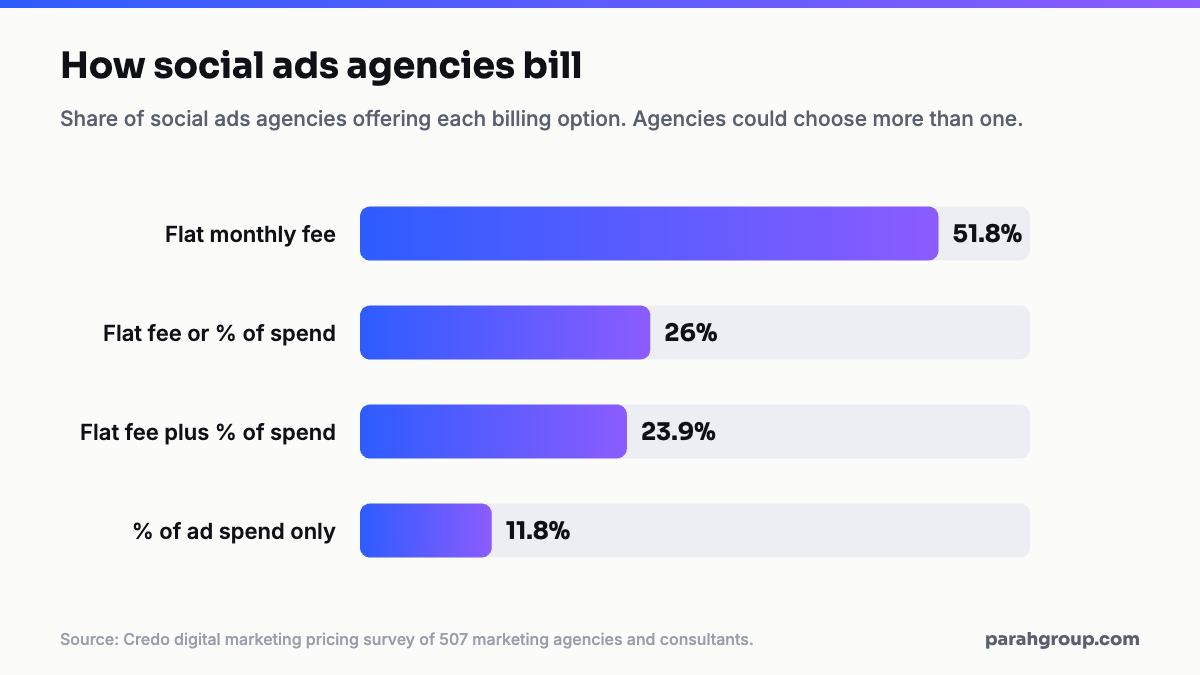
How common is each? The most detailed public breakdown comes from Credo’s digital marketing pricing survey of 507 marketing agencies and consultants, published by the Credo marketplace. Among social ads agencies, 51.8 percent offered flat-fee billing, 23.9 percent offered a flat fee plus a percentage of spend, 26 percent offered either a flat fee or a percentage of spend, and 11.8 percent offered a percentage of spend alone. Respondents could choose more than one option. It is agency-reported and a few years old, but the direction matches large advertisers too: in the ANA’s 2022 agency compensation study of 101 client-side marketers, 82 percent used fee-based compensation in at least one agency agreement, up from 68 percent in 2016.
What Facebook ads agencies actually charge
Published pricing data on Meta ads management is thin, so treat every benchmark as a range rather than a quote. Clutch’s PPC pricing guide, compiled from verified client reviews, puts the average monthly cost of PPC projects at $7,165, with typical hourly rates of $100 to $149. Its social media marketing guide puts the average monthly cost of social media marketing projects at $5,107.
Minimums are common. In Credo’s survey, 39 percent of social ads agencies had a minimum retainer of $1,000 to $3,000 a month, and 59 percent charged $100 to $200 an hour. Expect the low end to cover account management with limited creative, and the high end to include creative production, landing pages and weekly analysis.
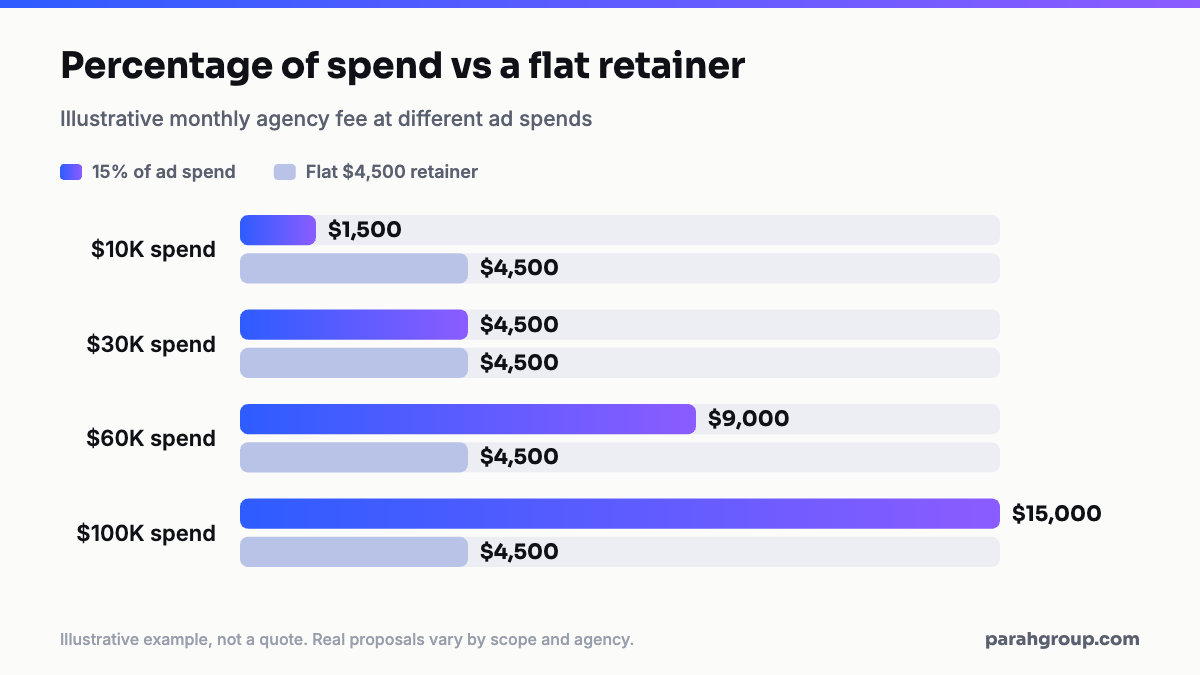
The fee also scales differently by model. A flat retainer stays put as spend grows; a percentage-of-spend fee rises with every dollar. The chart below shows the difference for an illustrative 15 percent fee against a $4,500 retainer.
What the fee should buy in 2026
Meta has automated much of what agencies used to bill for. Meta reports a 20 percent improvement in cost per acquisition for advertisers using Advantage+ sales campaigns. Bid tweaking and manual audience splitting are no longer where an agency earns its fee.
Creative is. Meta has published research with market research firm Nepa showing that following its creative best practices was associated with a 1.2 to 2.7 times increase in long-term sales, and cites Nielsen’s finding that creativity drives 56 percent of a campaign’s sales return on investment. A modern Facebook ads fee should therefore pay for:
- Tracking that matches your orders. Pixel and Conversions API set up and reconciled with your store before spend scales.
- A creative testing system. New angles, hooks and formats every week, judged on cost per acquisition rather than clicks.
- Account structure that lets automation work. Fewer, larger campaigns with clean signals, rather than dozens of tiny ad sets.
- Landing pages. One page per winning angle, because the page decides how many paid clicks become orders.
- Reporting on money. Cost per acquisition, average order value, new-customer revenue and contribution margin, not reach and likes.
Not sure what your current fee is buying?
Parah Group offers a free audit of your ad accounts and the pages they send traffic to.
The cost that moves more than the fee: ad prices
Whatever you pay the agency, ad costs are rising underneath it. In Meta’s second-quarter 2026 results, ad impressions grew 14 percent year over year and the average price per ad rose 12 percent, across 3.60 billion daily active people on Meta’s apps. Meta sets prices through an auction, and its pricing overview notes it may spend up to 75 percent over a daily budget on a given day, although weekly spend will not exceed seven times the daily budget.
Minimums are not fixed either. Meta’s minimum budget guidance says minimums vary by country and objective, and that with a cost per result goal your daily budget should be at least five times that goal. If you set a $30 cost per result goal in Meta, that means a daily budget of at least $150 for that ad set before an agency fee enters the picture.
That is why the cheapest agency is rarely the cheapest option. A team that lowers your cost per acquisition by even a few dollars saves more than a lower retainer would.
Why the landing page changes the math
Cost per acquisition is the ad cost divided by the number of orders. The ad account controls the top of that ratio; the page controls the bottom. If a landing page converts 30 percent better, the same spend buys 30 percent more orders, which cuts cost per acquisition by roughly 23 percent with no change to the ad account at all.
We have seen this repeatedly. Binoid’s paid social cost per acquisition fell 30 percent in four months on a program of multiple new landing pages every month, each testing a different angle and product, plus offer tests. Bounce Nutrition cut paid social acquisition cost 20 percent in three months once social proof, a gamified cart progress bar, offer tests and post-purchase upsells were run alongside the ads. The full story is in the Binoid case study.
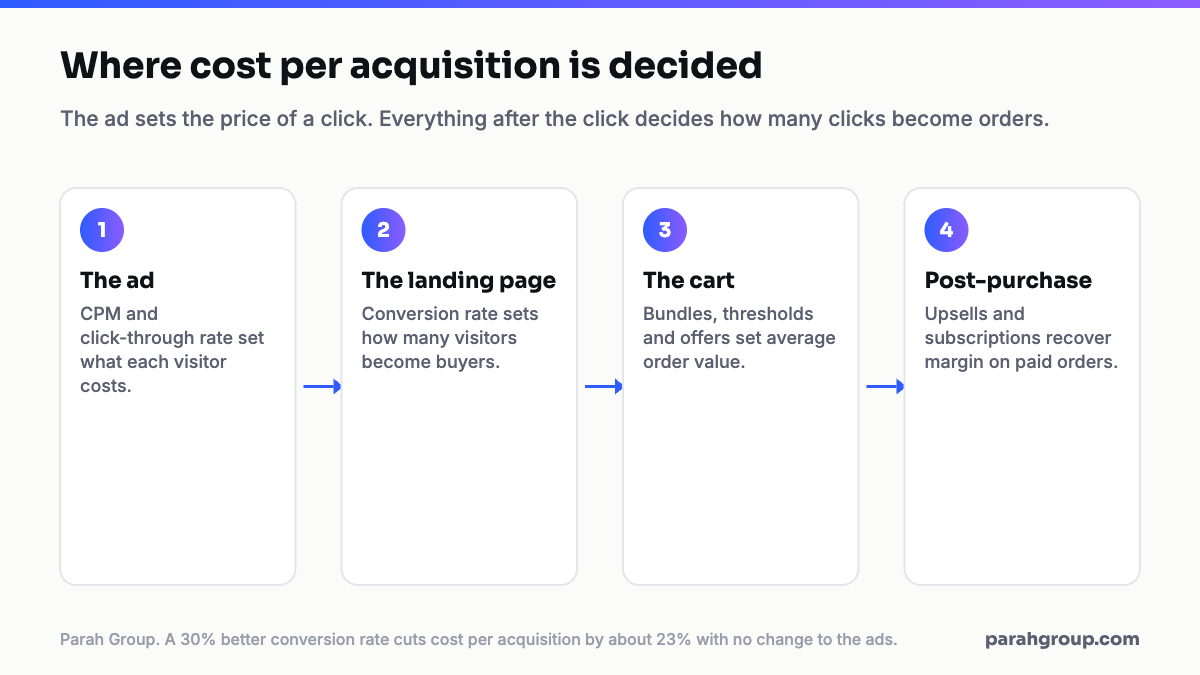
So when you compare proposals, ask whether the agency can build and test the landing page or only the ads. Our landing page design work exists for exactly this reason.
In-house, freelancer or agency?
An agency is not the only option. A freelancer is usually cheaper and can be excellent, but rarely brings creative production, landing pages and analysis in one package. An in-house hire gives full-time focus; the U.S. Bureau of Labor Statistics put the median annual wage for market research analysts and marketing specialists at $78,760 in May 2025, before benefits, tools and creative costs.
- Freelancer: lowest cost, best for smaller accounts with simple creative needs.
- In-house: best when spend is large and steady enough to justify a full-time owner plus creative support.
- Agency: best when you need media buying, creative testing and conversion work together, without hiring three people.
Whichever you choose, compare total cost per acquisition after six months, not the fee in month one.
How Parah Group prices paid social
Parah Group runs Facebook, Instagram, TikTok, Snapchat and Pinterest ads as one paid social program, with budget following the lowest cost per acquisition each month. We scope one fee across platforms on a call, and the audit of your ad accounts and the pages they send traffic to is free. Andrew Cowan, a former brand-side CMO who has been running Facebook ads for close to 15 years, runs the accounts with the Parah Group team.
The program covers what this article argues a fee should buy: Pixel and Conversions API checked against real orders, a weekly creative testing cadence, landing pages for each winning angle, cart and checkout optimization, and weekly reporting on cost per acquisition, average order value and contribution margin. If the audit shows Facebook is not the right channel for your margins, we say so.
Questions to ask before you sign
- What exactly does the fee include, and what costs extra: creative, landing pages, tracking fixes?
- Who will run the account day to day, and how much of their time is mine?
- How do you measure success: cost per acquisition and revenue, or reach and return on ad spend alone?
- Can you build and test the landing pages, or only the ads?
- What happens to the fee if spend doubles, or halves?
- What is the notice period, and who owns the ad account and creative if we part ways?
Want Meta ads run with the page they land on?
See how Parah Group runs Facebook and Instagram ads for DTC brands, measured on profit.
Frequently asked questions
How much does a Facebook ads agency cost per month?
It depends on the pricing model and your ad spend. Clutch’s pricing data, compiled from verified client reviews, puts the average monthly cost of PPC projects at about $7,165 and of social media marketing projects at about $5,107. Many agencies also set a minimum retainer; in Credo’s survey, 39 percent of social ads agencies had a minimum between $1,000 and $3,000 a month.
Is a percentage of ad spend a fair way to pay?
It is simple, but it rewards the agency for spending more rather than for spending better. In Credo’s survey only 11.8 percent of social ads agencies offered percentage of spend alone; flat fees, alone or combined with a percentage, were far more common.
What should a Facebook ads agency fee include?
At minimum: tracking set up and verified, account structure, creative testing, audience and budget management, and reporting on cost per acquisition and revenue. The better agencies also cover the landing page, because the page decides how many of the clicks you paid for become orders.
Is it cheaper to hire someone in-house?
Sometimes, at scale. The U.S. Bureau of Labor Statistics put the median annual wage for market research analysts and marketing specialists at $78,760 in May 2025, before benefits, tools and creative production. An agency spreads those costs across clients, while an in-house hire gives you full-time focus.
Is there a minimum ad spend on Facebook?
Meta has no single platform-wide minimum, but it requires a minimum budget for each campaign or ad set that varies by country and objective. With a cost per result goal, Meta advises a daily budget of at least five times that goal.