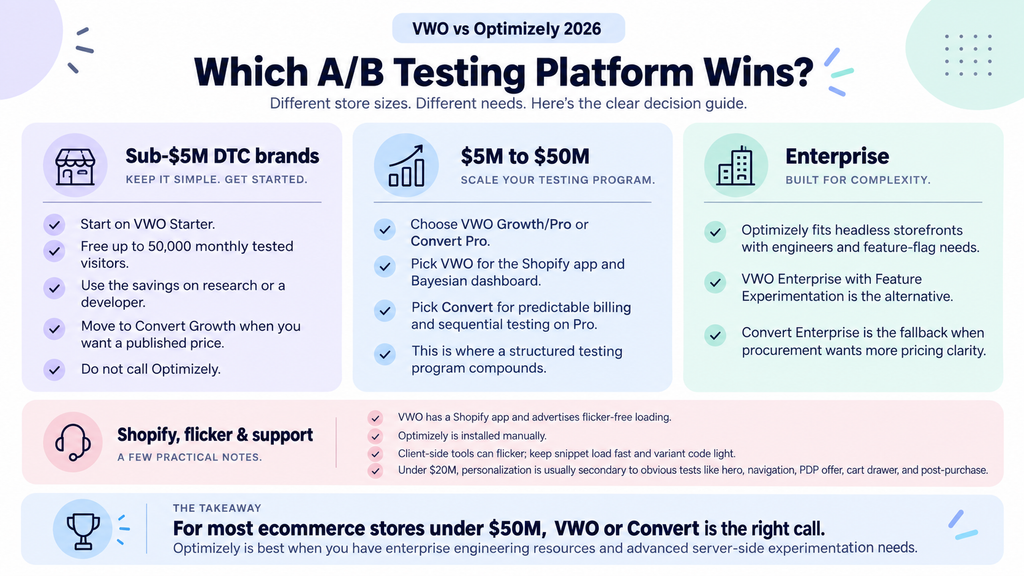
For most ecommerce stores under $50M, VWO or Convert is the right call. VWO has a free Starter tier and Bayesian reporting; Convert publishes its prices and starts at $299 a month. Optimizely is quote-based and built for enterprise engineering teams. Pick by monthly tested visitors, dev capacity and how much you want to pay for a stats engine.
We run VWO and Convert for clients, not Optimizely. This post explains why, where Optimizely is still the better fit, and what each costs at 100k and 500k monthly visitors. Every price is as of September 2026 from the vendor’s own page. Where a vendor publishes nothing, we say so.
What is the real difference between VWO and Optimizely?
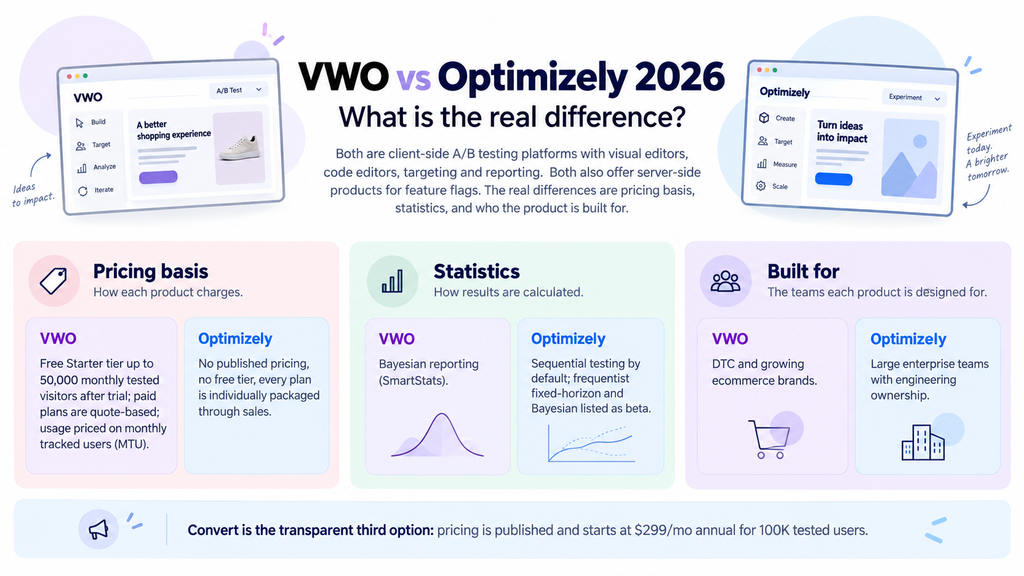
Both are client-side A/B testing platforms with a visual editor, a code editor, targeting and reporting, and both sell a server-side product for feature flags. The differences that matter to a store owner are pricing basis, statistics, and who the product is built for.
VWO sells four tiers: Starter (free), Growth, Pro and Enterprise. Billing is usage-based on monthly tracked users (MTU). VWO’s own FAQ says each product keeps a separate MTU quota, and a common quota can be bought across most products. The free Starter tier covers up to 50,000 monthly tested visitors after a 30-day full-featured trial. Reporting runs on a Bayesian engine VWO calls SmartStats. VWO does not publish dollar prices for Growth, Pro or Enterprise on its pricing page; you get a quote from the calculator or sales.
Optimizely sells Web Experimentation (now marketed as Agentic Experimentation) and Feature Experimentation (now Feature Management). Its pricing page says “Every Optimizely plan is individually packaged” and asks you to talk to sales. There is no published price, no free tier and no self-serve signup. The stats engine is Optimizely’s own sequential-testing method that controls false discovery rate; frequentist fixed-horizon and Bayesian modes are listed as beta on the Optimizely support site.
Convert Experiences is the third option we include because it publishes everything. Growth is $399 a month billed monthly or $299 a month billed annually for 100k tested users. Pro is $599 monthly or $420 annually. Enterprise is price on request from 1M tested users a month. All plans include both editors and a frequentist and Bayesian stats engine.
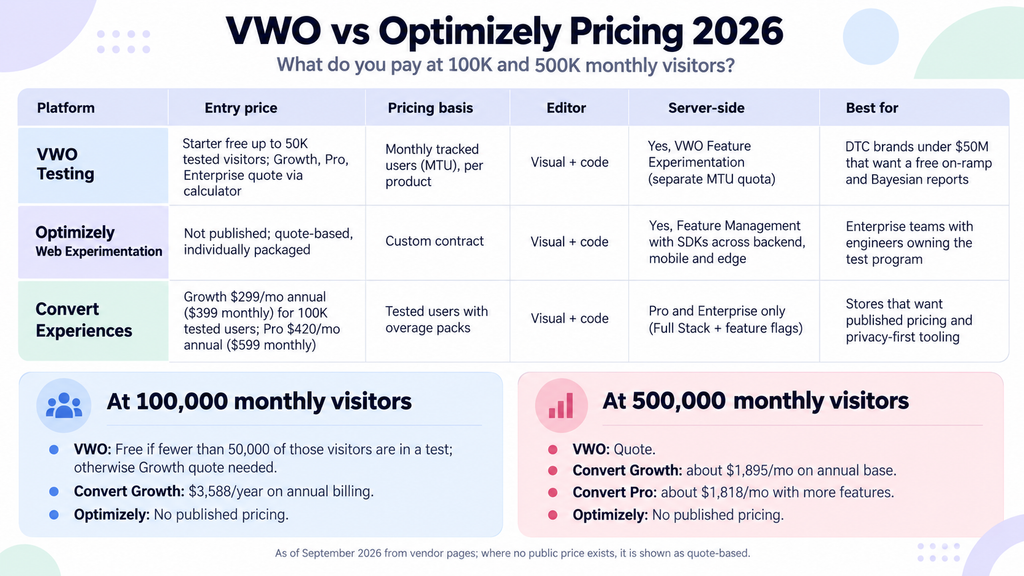
VWO vs Optimizely pricing: what do you pay at 100k and 500k visitors?
Two of the three vendors do not print a number. The table gives you what is published as of September 2026.
| Platform | Entry price | Pricing basis | Editor | Server-side | Best for |
|---|---|---|---|---|---|
| VWO Testing | Starter: free up to 50k monthly tested visitors. Growth, Pro, Enterprise: quote via calculator | Monthly tracked users (MTU), per product | Visual + code | Yes, VWO Feature Experimentation (separate MTU quota) | DTC brands under $50M that want a free on-ramp and Bayesian reports |
| Optimizely Web Experimentation | Not published. Quote-based, “individually packaged” | Custom contract | Visual + code | Yes, Feature Management with SDKs across backend, mobile and edge | Enterprise teams with engineers owning the test program |
| Convert Experiences | Growth $299/mo annual ($399 monthly) for 100k tested users; Pro $420/mo annual ($599 monthly) | Tested users, with overage packs | Visual + code | Pro and Enterprise only (Full Stack + feature flags) | Stores that want published pricing and privacy-first tooling |
At 100,000 monthly visitors. VWO Starter is free if fewer than 50,000 of those visitors are actually in a test; if you test on every page you pass the cap and need a Growth quote. Convert Growth covers 100k tested users at $3,588 a year on annual billing. Optimizely does not sell at this size on a published basis.
At 500,000 monthly visitors. VWO is a quote. Convert Growth is 100k included plus four overage packs at $399 per 100k, about $1,895 a month on an annual base. Convert Pro is $420 a month plus two packs at $699 per 250k, about $1,818 a month, and it adds sequential testing, multivariate and Full Stack. At that traffic Convert Enterprise (1M+ users, price on request) is usually the better negotiation. Optimizely remains quote-based; no figure is published, so we will not estimate one.
On “vwo vs optimizely pricing”, then: only Convert tells you the price before the call. VWO gives you a free tier. Optimizely gives you a sales process.
Which stats engine should an ecommerce store trust?
VWO reports on a Bayesian engine. It gives you a probability that a variation beats control and an expected loss, which is the number a merchandiser can act on, and it tolerates the daily peeking store owners do anyway.
Optimizely’s default is sequential testing with false discovery rate control. Its support documentation frames the choice as: sequential lets you “monitor results continuously during the experiment” and “stop the experiment early if you have reached a clear winner”, while fixed-horizon “requires you to define the sample size and analysis plan before the experiment starts”. The sequential approach is more conservative: a feature when an enterprise runs dozens of concurrent tests, a cost when a $10M store runs three.
Convert gives you both frequentist and Bayesian on every plan, and sequential testing on Pro and Enterprise. In practice we find the engine matters less than the discipline around it: one primary metric, a pre-registered minimum run time of two business cycles, and revenue per visitor as the tie-breaker rather than conversion rate. That is how a shipping-threshold test for Momentous was read as $2M in profit rather than a conversion-rate headline. Any of the three engines would have found that result. The program found it.
Visual editor or code: which do you actually need?
All three ship a visual editor and a code editor. The visual editor is fine for copy, image swaps and hiding elements. It is not fine for a new hero, a new navigation, a reordered PDP or a cart drawer with a progress bar. Those are code tests, and they are the ones that move revenue.
For Urban Carry Holsters, the work that produced over $1,000,000 in additional annual revenue in six months was a homepage and navigation redesign, concise value-prop messaging, testimonials, and a site audit that removed apps and scripts to speed the store up. None of that was a visual-editor test. It was written as code variants, QA’d across devices, and shipped through the testing platform. Whether that platform is VWO or Optimizely is secondary to whether you have a developer writing the variant.
If you have no developer, VWO Starter’s visual editor lets you learn the basics for free. If you have a developer or an agency, the editor is a wash; decide on pricing and stats instead.
If you would rather not build the testing muscle in-house, our A/B testing program handles research, variant build, QA and analysis on your platform of choice.
Do you need server-side testing and feature flags?
Server-side experimentation decides the variant in your backend or edge before the page renders. No client-side script, so no flicker, and you can test search ranking, checkout logic and recommendation algorithms that a DOM editor cannot touch.
Optimizely is strongest here. Feature Management claims sub-millisecond local evaluation “in process, not over a network call”, SDKs “for your entire stack, backend to mobile to edge”, and a 99.9% uptime SLA. If you have a headless storefront on Hydrogen or Next.js with an engineering team that ships weekly, this is the product built for you, and it is the main reason we would point an enterprise brand at Optimizely.
VWO Feature Experimentation covers the same ground with SDKs, rollouts, mutually exclusive groups and Bayesian reporting, on a separate MTU quota. Convert offers Full Stack and feature flags on Pro and Enterprise only, not Growth.
For a Shopify store on a Liquid theme, server-side testing is mostly moot. Shopify’s checkout only accepts changes through checkout extensibility, not injected scripts, and price tests are better run through Intelligems, which we use for exactly that. That is a large part of why we have not needed Optimizely for our client base.
How do VWO and Optimizely handle Shopify, flicker and support?
VWO has a Shopify app that, per its App Store listing, “automatically deploys VWO’s tracking code across your store (except for checkout and order-related pages)”, supports cart transforms via Shopify Functions and advertises “flicker-free loading”. It is free to install with a VWO subscription. Optimizely has no Shopify app; you install the snippet in theme.liquid yourself. Convert installs the same way.
Flicker is the flash of the original page before the variant paints. Every client-side tool can flicker, and every one ships an anti-flicker snippet that hides the page for a few hundred milliseconds. On mobile, where Adobe measured 57.5% of Cyber Monday 2025 online sales, that delay is worth managing. Load the snippet synchronously in the head, keep variant code small, and audit what else is loading. The Urban Carry site-speed audit that stripped unused apps and scripts did more for flicker than any vendor setting.
Personalisation is available on all three: a separate MTU-quota product at VWO, a product line at Optimizely, included in Convert’s plans. Under $20M it is usually a distraction until the obvious tests are done: hero, navigation, PDP offer, cart drawer, post-purchase.
VWO lists 24×5 support on Growth and Pro; Enterprise adds a dedicated CSM, one-to-one training, 24×7 support and a four-hour first response. Convert lists email and in-app chat on Growth, adding phone on Pro and Enterprise, with a 15-day trial and no credit card. Optimizely’s support is part of the negotiated package, alongside its academy and AI “Virtual Teammates”.
Support matters more if you run tests yourself. When we run VWO or Convert for a client, we are the support tier; the platform’s job is to serve variants and count events reliably, and both do.
Verdict: which A/B testing platform by store size?
Sub-$5M DTC brands. Start on VWO Starter. It is free up to 50,000 monthly tested visitors and includes the visual editor and Bayesian reports. Spend the money you save on a developer or on research. Move to Convert Growth at $299 a month annual when you outgrow the cap and want a published price. Do not call Optimizely.
$5M to $50M. VWO Growth or Pro, or Convert Pro. This is where a structured program compounds: Combat Iron Apparel’s homepage rebuilt around social proof, fewer pop-ups, optimised pricing, a gamified free-shipping bar and post-purchase upsells returned a 35% conversion rate lift in six months. Pick VWO for the Shopify app and Bayesian dashboard; pick Convert for predictable billing and sequential testing on Pro.
Enterprise. Optimizely earns its quote when you have a headless storefront, engineers who own experimentation, and a need for feature flags with SLAs across web, mobile and edge. VWO Enterprise with Feature Experimentation is the alternative; Convert Enterprise at 1M+ tested users is the fallback if procurement needs a published number.
Why we run VWO and Convert and not Optimizely: our clients are DTC and lead-gen brands, mostly on Shopify. They need a reliable client-side tool, a stats engine a founder can read, price tests through Intelligems, and a team building variants. VWO and Convert cover that within a monthly CRO budget. Optimizely solves a problem most of them do not have yet.
If you want the platform question answered inside a full program rather than a procurement exercise, see how we scope website conversion optimization, or book an intro call. We will tell you which tool fits your traffic and dev capacity in the first 20 minutes. We have no reseller arrangement with any of the three.
Frequently asked questions
Is VWO cheaper than Optimizely?
Almost always, as of September 2026. VWO has a free Starter tier up to 50,000 monthly tested visitors and usage-based MTU pricing above that. Optimizely publishes no prices and packages every plan through sales. Neither prints a dollar figure for paid plans; if you need one, Convert starts at $299 a month annual.
Does Optimizely have a free plan?
No. Optimizely’s pricing page says every plan is individually packaged and directs you to sales. There is no free tier and no self-serve trial listed. VWO offers a 30-day full-featured trial and a free Starter plan afterwards. Convert offers a 15-day trial with no credit card required.
Which is better for Shopify, VWO or Optimizely?
VWO. It has a Shopify App Store listing that deploys the tracking code, supports cart transforms via Shopify Functions and claims flicker-free loading. Optimizely has no Shopify app and is installed manually in the theme. For price and shipping-threshold tests on Shopify, we pair either tool with Intelligems rather than relying on a DOM editor.
Is Bayesian or frequentist better for A/B testing?
Both work when the program is disciplined. Bayesian (VWO) gives a probability of beating control and an expected loss, which is easier for operators to read. Sequential frequentist (Optimizely) controls false discovery across many concurrent tests. Convert offers both. Run each test for at least two business cycles and judge on revenue per visitor regardless of engine.
What are the best A/B testing tools for ecommerce in 2026?
For most stores: VWO or Convert for client-side tests, Intelligems for price and offer tests on Shopify, Shoplift for template-level tests, and Optimizely Feature Management for enterprise server-side work. We run VWO, Convert, Intelligems, Shoplift and Nelio. The tool is a fraction of the result; research, variant quality and QA are the rest.
Can you A/B test the Shopify checkout with VWO or Optimizely?
Not with the client-side snippet. VWO’s Shopify app deploys everywhere except checkout and order pages. Checkout changes on Shopify go through checkout extensibility rather than injected scripts, and shipping-threshold or price tests are usually run through Intelligems. Given Baymard puts cart abandonment at about 70%, the cart drawer and PDP are where the reachable wins are.