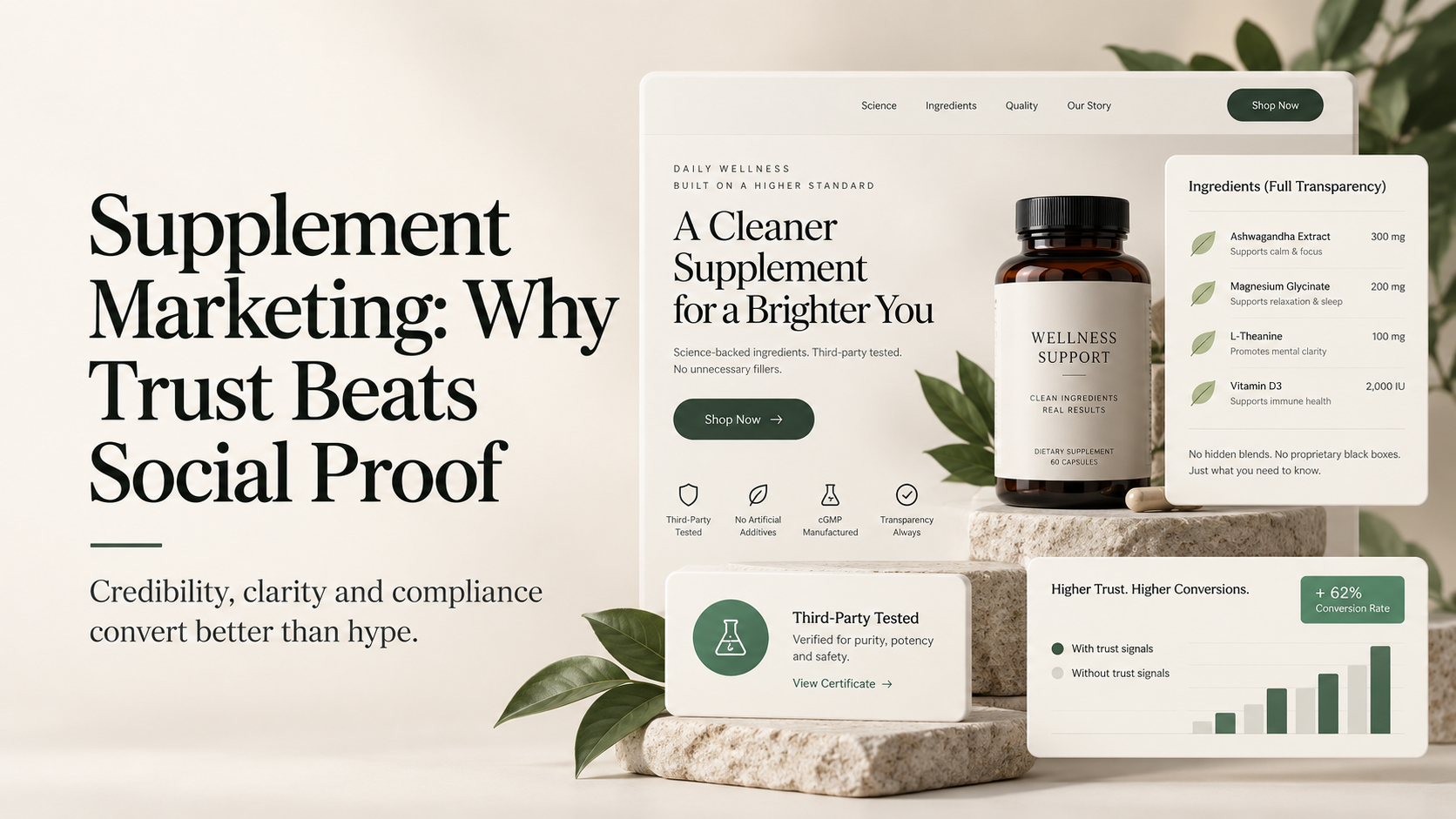
Supplement buyers are making a risk assessment, not a price comparison. They are putting something in their body on the strength of what a website says. That changes the hierarchy: sourcing, testing and scientific credibility outrank reviews and social proof, which is the opposite of how most DTC categories behave.
What the category is actually competing on
In most ecommerce categories, social proof is the strongest trust lever available. Reviews, ratings and user counts do heavy lifting because the risk of a bad purchase is a wasted forty dollars.
Supplements are different because the downside is health, not money. That reframes what the shopper wants to know. Where does this come from, who tested it, what is actually in it, and why should I believe the label.
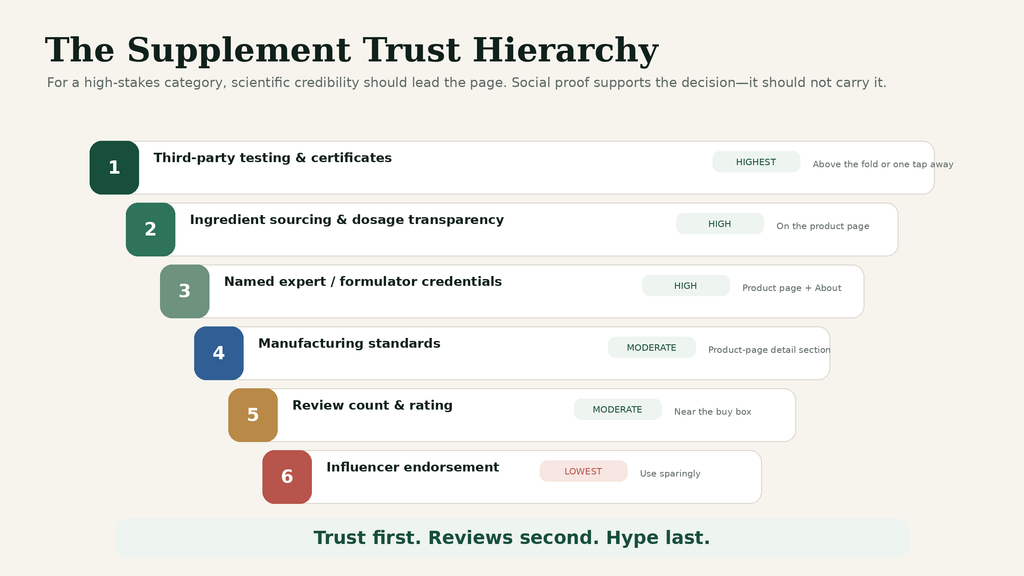
We have measured this directly. At a supplements brand we work with, trust and scientific authority signals outperformed social proof in testing. Third-party testing information and sourcing detail moved conversion further than review counts did, which runs against the default assumption almost every agency brings to the category.
That does not make reviews worthless. It means the order of the page is wrong on most supplement sites, with social proof at the top and the substantive material buried in an accordion nobody opens.
The trust hierarchy for this category
| Signal | Weight | Where it belongs |
|---|---|---|
| Third-party testing and certificates | Highest | Above the fold or one tap away |
| Ingredient sourcing and dosage transparency | High | On the product page, not a separate page |
| Named expert or formulator credentials | High | Product page and About |
| Manufacturing standards | Moderate | Product page detail section |
| Review count and rating | Moderate | Near the buy box, not leading the page |
| Influencer endorsement | Lowest | Use sparingly, it can reduce credibility here |
The last row is the one brands resist. In a category where the shopper is assessing scientific credibility, a paid endorsement can subtract trust rather than add it.
The conversion problem underneath
Supplement stores usually have a strong repeat-purchase profile and a weak first-purchase profile. The first order is where the risk assessment happens, and it is where most of the friction sits.
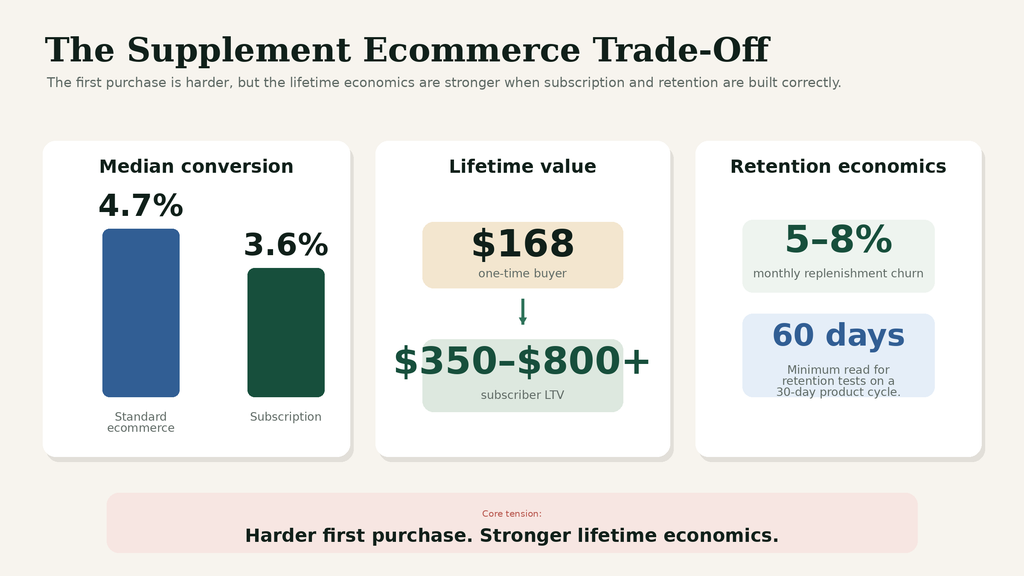
Median conversion across 1,055 audited tests sits at 4.7% for ecommerce and 3.6% for subscription businesses, and most supplement brands are running a subscription offer at the point of first purchase, which means they are asking for the harder commitment at the moment of highest uncertainty.
That sequencing is testable. Offering subscription on the confirmation page rather than at checkout separates the two decisions: buy this once, then commit to a cadence. It costs nothing to test because the order is already banked.
Where the money is in supplement DTC
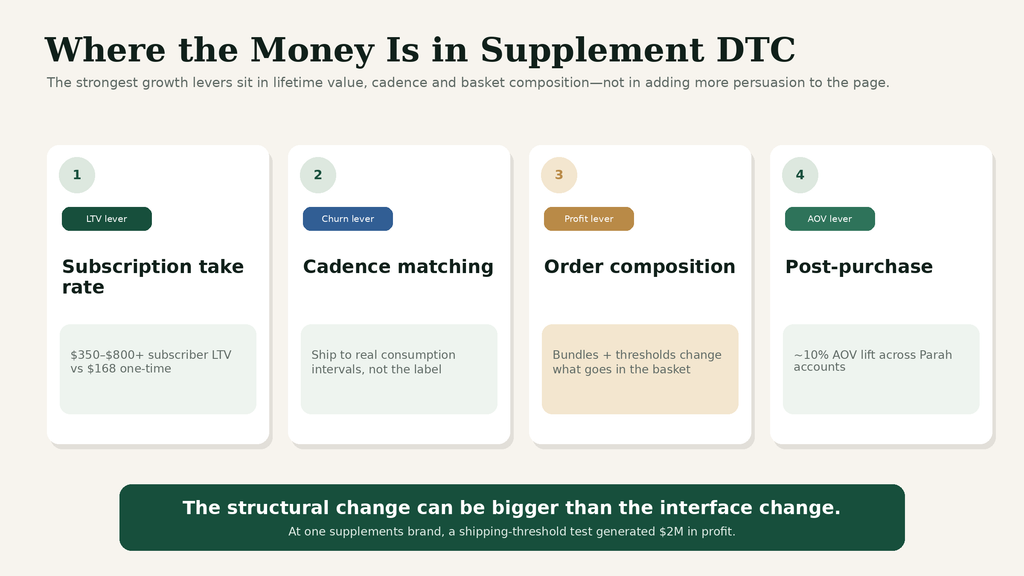
Subscription take rate. For a consumable, this is the dominant lever on lifetime value. Subscriber LTV runs between $350 and $800 against $168 for one-time buyers, and replenishment models carry the lowest churn in subscription commerce at 5% to 8% monthly.
Cadence matching. Ship a 30-day supply on a 30-day cycle and any customer who misses doses accumulates stock and cancels. Cadence is a churn lever disguised as a logistics decision.
Order composition. Bundles and shipping thresholds move revenue per visitor faster than interface changes. At a DTC supplements brand, a single shipping threshold test produced two million dollars in profit, because it changed what went in the basket rather than how many baskets there were.
Post-purchase. Across our accounts, post-purchase upsells add around 10% to average order value.
The first-order funnel, step by step
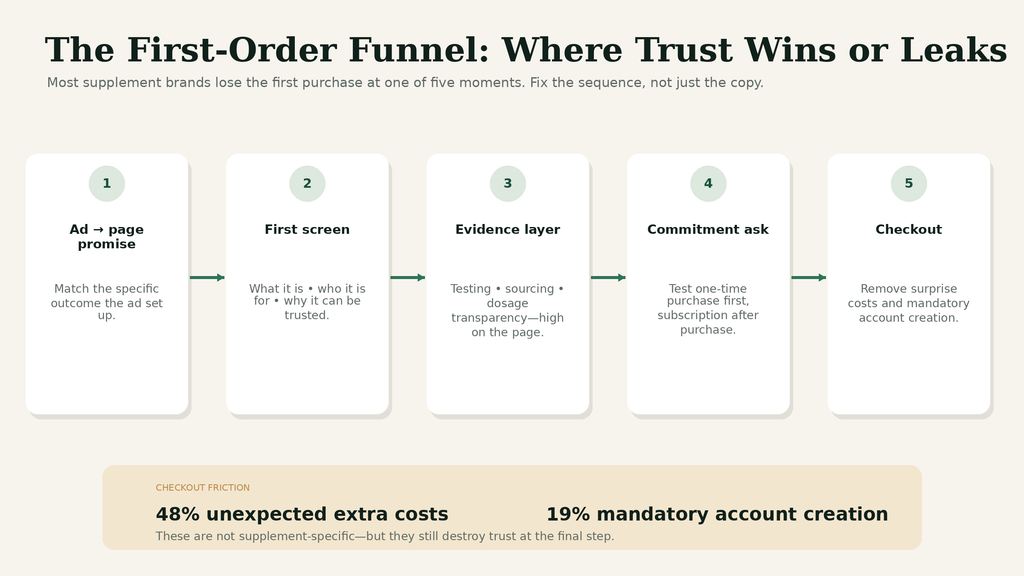
The repeat profile takes care of itself if the first order goes well. Most supplement brands are losing money at exactly one of the following five steps.
The ad-to-page promise. Cold traffic arrives with an expectation set thirty seconds earlier. If the ad promised a specific outcome and the page opens with brand language, the mismatch costs more than any on-page change will recover. Analysis of 2026 landing page benchmark data indicates a page with poor Core Web Vitals can even pay 22% more per click than a faster competitor, so the penalty compounds.
The first screen. What is in it, who it is for, and why it can be trusted. In this category that last item outranks the first two, which is the reverse of most DTC pages.
The evidence layer. Third-party testing, sourcing, dosage transparency. Not in an accordion at the bottom. This is the section the shopper came to find, and burying it is the single most common structural error on supplement product pages.
The commitment ask. Subscription at checkout compounds two decisions into one moment. Separating them is testable and costs nothing.
Checkout. Baymard’s meta-analysis of fifty studies attributes 48% of abandonments to unexpected extra costs and 19% to mandatory account creation. Neither is category-specific, and both are usually still present.
What to measure, and over what window
Supplement economics are lifetime economics, which makes short measurement windows actively misleading.
Revenue per visitor is still the primary read on any individual test. But three secondary reads decide whether a win is real: subscription take rate, reorder rate at sixty days, and refund rate.
That last one matters more here than in most categories. A page that oversells produces orders and returns, and in a category where trust is the currency, a refund is worse than a lost sale because it costs you the customer permanently.
Set the review window to match the product cycle. A 30-day supply means a 60-day minimum read on anything claiming to improve retention, because you need two billing events to know whether the cadence works.
Claims, and the constraint they impose
Everything above has to work inside advertising and labelling rules that vary by market. Structure-function language, disease claims and testimonial claims are all regulated, and the penalty for getting it wrong is considerably larger than a failed test.
The practical consequence for conversion work: you cannot solve a supplement landing page with persuasion. You solve it with evidence, presented clearly, inside what you are permitted to say. That constraint pushes the work toward sourcing transparency, testing documentation and format clarity, which is also where this audience responds best.
Get legal review before any claims-adjacent test goes live. A test that wins on a claim you cannot make is not a win.
Running a supplement brand without a testing programme? Ecommerce CRO covers the trust, subscription and post-purchase layers as one sequence.
What a full programme produced
At a supplements brand we work with, subscription take rate moved from 25% to between 55 and 60% over six months, roughly tripling the subscriber base, and paid landing page conversion improved by 40% with no change in media spend.
Six months, not six weeks. Churn tests cannot be read faster than the billing cycle allows, and trust-signal tests need enough first-time buyers to reach significance. Most tests along the way were inconclusive: Optimizely’s analysis of more than 127,000 experiments puts the average win rate near 12%.
The retention work most brands postpone
Supplement brands tend to spend the first year on acquisition and discover the retention problem in the second, by which point the cadence and onboarding decisions are baked into the platform.
Three things are worth building early even when growth looks fine.
Consumption-matched cadence, taken from actual reorder intervals rather than the label. Getting this wrong is the largest single driver of replenishment churn and it is invisible until month three.
A first-thirty-days communication sequence. What to expect, when, and what normal looks like. In a category where the customer cannot immediately verify whether the product worked, the communication is doing the work the product cannot do yet.
Failed payment recovery. A meaningful share of what brands record as churn is expired cards. It is unglamorous, it recovers real revenue, and almost nobody builds it before it hurts.
None of the three needs a test to justify. All three are cheaper to build in year one than to retrofit in year two.
One caution that applies to everything above. Supplement audiences vary enormously between a performance customer buying on ingredient detail and a general wellness customer buying on brand and simplicity. The trust hierarchy in this post reflects the former. If your customer is the latter, test the order rather than assuming it, because the same page structure can win with one audience and lose with the other.
Frequently asked questions
What converts best on a supplement product page?
Third-party testing information and sourcing transparency, placed high on the page. In our testing, scientific credibility outperformed social proof for this audience, which is the reverse of most DTC categories.
Should supplement brands offer subscription at checkout or after?
Test both. Offering it on the confirmation page separates the purchase decision from the commitment decision, and it cannot cost you the order because payment has completed.
What is a normal churn rate for a supplement subscription?
Replenishment models sit at the low end of subscription commerce, around 5% to 8% monthly. Consistently higher usually points at a cadence mismatch rather than a pricing problem.
Do influencer endorsements help supplement conversion?
Less than in most categories, and they can reduce credibility where the buyer is assessing scientific rigour. Weight sourcing and testing information higher.
Next step: The CRO Program starts with an audit of the trust hierarchy on your live product pages.